On this score, our constant HP output conditions are much easier to cool
than "racers" and the temperature readings we achieve are probably quite
close to the second to second conditions being experienced in the
system, except possibly for nucleate boiling in the immediate vicinity
of the spark plugs at the very limit of acceptable operating limits.
What is not to like about 195 deg coolant and 205 deg oil?????????
Doug in CO
My only comment Doug was this was only a 80 degree F day. What happens
when you have a 100 degree F day? The rate of heat transfer goes down
20%.
Paul Lamar
Good point, Paul. I find it interesting that the coolant temperature
seemed to stabilize at 195 deg F, which is probably a function of the
"total system capabilities". That is...a balance of the heat exchanger
capacity (BTU/sec), mass airflow (lbm/sec), coolant flowrate
(lbm/gpm), inlet/exhaust duct quality (pressure recovery), etc.. and
most important, TAS of the plane.
As the O/S temperature goes up several contradicting forces come into
play, as you know. Yes, the cooling medium (O/S air) is higher in
temperature yet as that goes up the coolant temperature will go
up...approximately maintaining the differential temperature. Meanwhile,
the combustion temps remain unchanged so the differential between
combusion temps and coolant temps goes down...reducing heat transfer
from the combustion chamber and increasing the demand on the oil cooling
requirements? This is not good, but again it is difficult for me to
believe that even 230 def F coolant temperatures and/or 250 deg F oil
temperatures for reasonable times (<30 mins.) will result in any engine
damage, especially with today's oils. (This assumes correct mixture
setting to prevent pre-ignition/detonation.)
Of course, this is another reason to have at least stock coolant
flowrates from the waterpump. I don't buy that it is the waterpump that
causes boil over in idling/AC usage. It is the insufficiency of the
mass airflow rate through the radiator. It is the A/C pouring BTU's
into the airstream just in front of the radiator that complicates and
over loads the system. Those idle solenoids which kick in with the A/C
on raise the idle speed to increase the airflow, not primarily to
increase the coolant flowrate (which is also increased and does help
some). Those shrouds are not for 60 mph cruise, they are for idle
conditions. An auto A/C is equivalent to that required to cool a small
3 bedroom house!! That is a lot of heat for the coolant heat exchange
system to accomodate, especially with little/no airflow through the
radiator.
NOTE: One needs at least a 20 psi cap or preferably higher if one is
going to do 230 deg F at our 5,000-7,000 MSL field altitudes. Of
course, one can't generate that kind of HP at our altitudes!! Now with
a turbo.....!! However, at Sea Level that Hmmmmmr will put out a lot of
HP from that little package @ WOT and 6,500.
My SWAG is that the coolant and oil temperatues will increase approx.
the same degrees as the O/S temperature, that is at 100 deg F, O/S
air (+20 deg F over current), will result in 215 deg coolant and 205 deg
oil (or whatever +20 brings).
__
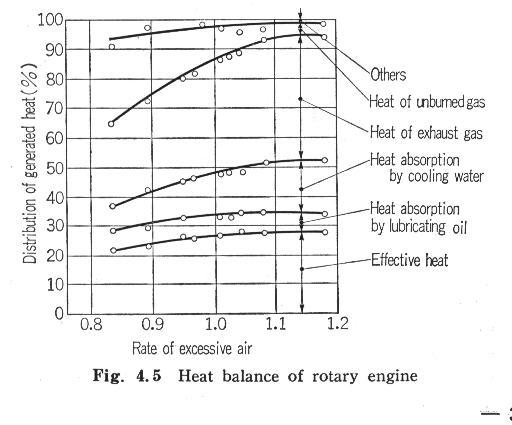
One of the really interesting things of the Hmmmr is the relationship
between the coolant and oil temperatures particularly in the 13B...and
now with the side exhaust ports perhaps even more so, the Rensis? Both
seem to put a greater proportion of "wasted" heat into the oil.
What say you? 195-80 = 115 differential, 215-100 = 115 differential??
Doug in CO
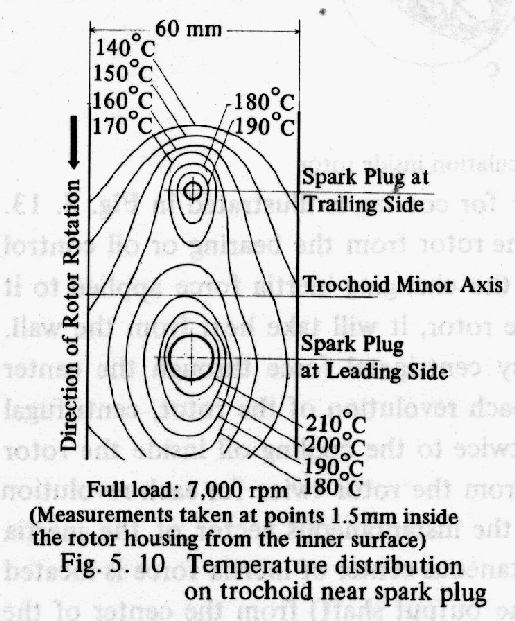
As far as proportion of heat is concerned you must remember that a given area
of the rotor is in longer contact with the rotating combustion
chamber than the rotor housing. I have a rotor heat distrubution diagram
around some where but I can't find it at the moment. I might
have to scan it in from the Rotary Engine book. As I recall it
was about 500 F more or less uniform
On your last point I can't say. Too many factors.
I am not against running 215 F. Should improve the BSFC
like you say. Especially if you have teflon encapsulated silicone O-rings
everywhere, are running Idemitus Rotary Engine oil in the
crankcase and are mixing two cycle oil with the fuel. Also
a 25 psi pressure cap or higher. I know you know all this
but this is for the new guys. The main thing is you need
a large margin so you never boil the coolant in an aircraft
engine. That will bring you down as fast as a dropped
exhaust valve in a silly piston engine. Well maybe not quite
that fast :)
Paul Lamar
The Rotary Engine NewsLetter. Powered by Linux.
ACRE NL web site.
http://www.rotaryeng.net
Copyright 1998-2005 All world wide rights reserved.