Paul
Does anyone out there have a picture of the six port arrangement under
the manifold? All I can find on the web is the four port. Are the four
outer ports all the same size or are the lower auxiliary ones smaller,
and if so what are each of the sizes? In the picture of the previously
posted cut down manifold it looks like the upper ports are much bigger
than the bottom ones.
Tony Beaton
The large round top holes in the end housing is the reason the
RX8 high power engine can generated 240 HP.
Paul Lamar
Tony here are a couple of pictures of the manifold and the fuel rail. The
gears are to close off two of the ports.
Ian Beadle
Makes sure you don't leave any parts of those movable RX8 sixth port
valves
in the engine. Chuck Dunlap had an off airport landing as one of the small
parts came loose and got into the engine.
Paul Lamar
I was thinking of shutting of the two sixth ports at low rpm using a TPS. A
per stock. There is no injector in these ports.
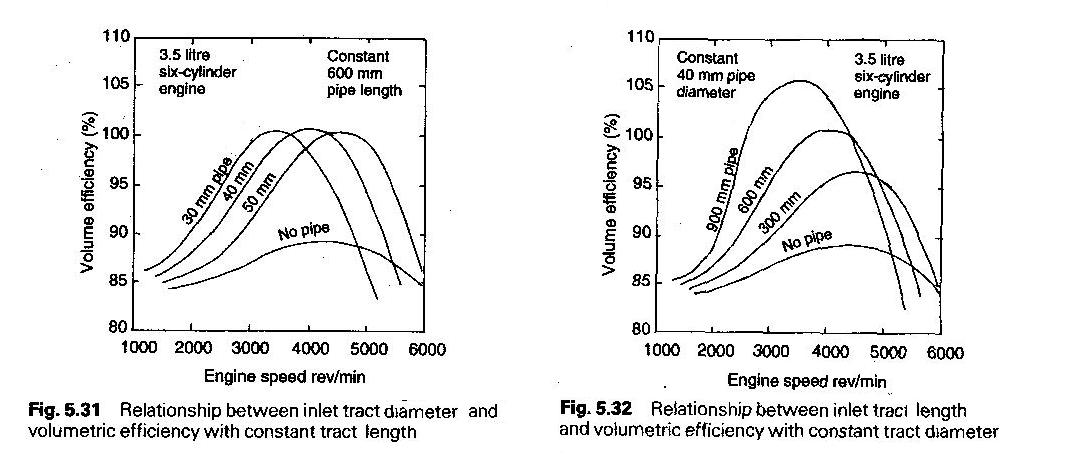
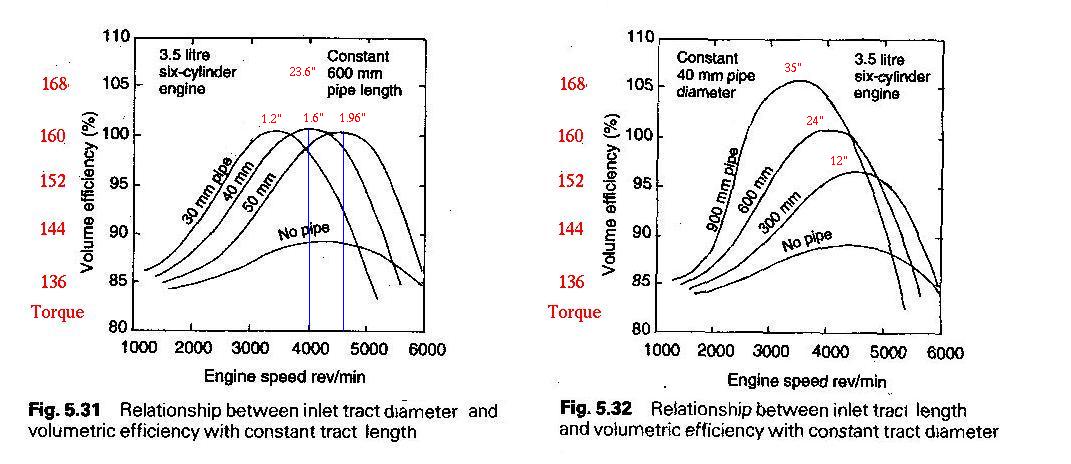
The stock inlet runners are 21" long. Is there a formula for runner length to
RPM.
Ian Beadle
If there is I don't have it. It is not only a function of length
it is a function of inside diameter as well. This is (I think) because of
the skin friction drag in small runners. Here is a chart on
the subject from Advanced Engine Tech by H. Heisler. Unfortunetly
the right side of the chart it is for only one pipe diameter. You
might be able to extrapolate to the 40 mm pipe size.
To convert volumetric efficiency to HP you have to assume
VE is the same as torque. As a crude guess the ratio for the rotary
would be roughly 100%VE = 160 ft pounds. If the HP numbers come out
too low adjust this ratio. For example 100% = 170 or 200 ft pounds.
Then use the formula HP = Torque X RPM / 5252 to plot the
HP curves. I'll do a little work for you and calculate
the torque curves based on 100%VE = 160 ft pounds. If someone does
plot the HP curves on this second chart please send them to me.
My guess is it will be around 20 inches plus or minus
5. Sorry I can't come any closer. I suggest you make them ground adjustable.
If I were you I would forget the stock RX8 manifold and build
an RX8 engine P-port. Very simple to do once you take the leap
of boring the holes in the rotor housings. On the other hand there is
a lot of incentive for not taking apart a brand new RX8 engine to
bore large holes (40 mm) in the rotor housings.
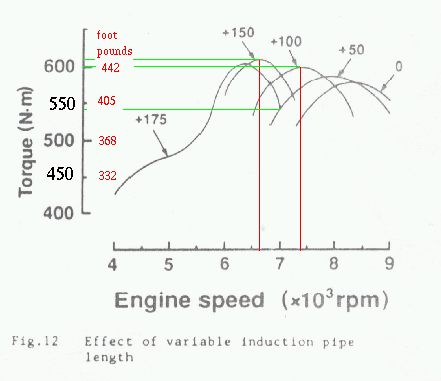
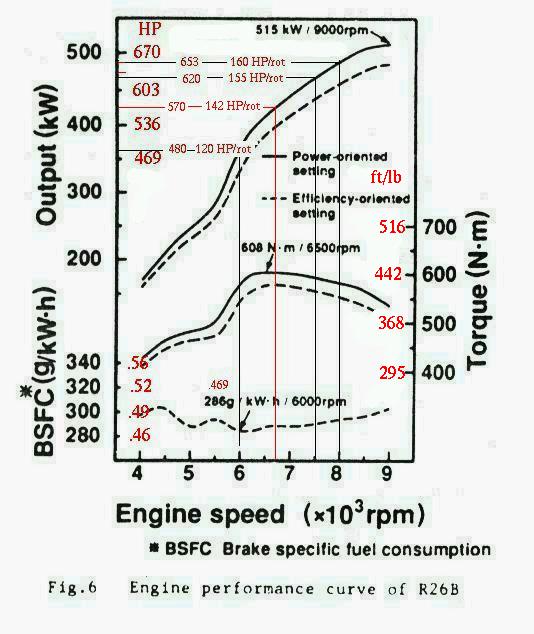
The Lemans P-port numbers are as follows in chart 3.
The pipe diameter is about 40 mm in this case.
Paul Lamer
The Rotary Engine NewsLetter. Powered by Linux.
ACRE NL web site.
http://www.rotaryeng.net
Copyright 1998-2005 All world wide rights reserved.