I am trying to work on a solution for your slide throttle situation. It
appears that the fuel is wicking up between the plates due to capillary
action. If that is the case the it could also seep out the sides where the
linkage is connected as well as the top right? In that case you would need
two seals on each side of the Teflon plate around the outer perimeter of the
P ports on the inner side and the manifold pipe on the outer side. The seal
would have to be U shaped in profile and if memory serves me correctly these
seals are used on rotary disc valves. Still need some silicon grease to make
things move easier as well.
I'm sure you know well that circular shafts are easy to seal. The following
idea won't help in the short term but a form of rotary valve might be the
answer.
For ease of discussion imagine two discs with their centers offset above the
ports. The discs have a throttle dia. hole located out near their
circumference and their rotating action is controlled by turning the shafts.
You need one for each P port and they are linked together. To save space
the discs actually would be more like a wedge shape. Lets call them paddles.
With a little imagination you can see that the total outer case could easily
be sealed and the whole unit a bit smaller then what you now have. The
paddles would be made of metal and Teflon inserts (T -shape in profile)
would be placed in P port and manifold side faces. This approach minimizes
Teflon to the frictionally contact area only and makes manufacturing simpler
and less expensive. The case that contains the paddles is sealed with a
flat gasket and is screwed together. The case will retain any excess fuel
and the shafts centers are above the P Ports. The circular shafts can have
and O-ring as well to seal off any chance of escaping fumes.
Doug in Japan.
Can you make a drawing? I am having trouble visualizing
this.
I don't think it is wicking Doug. It would not get past the lowest
point of the intake runners. All four injectors were full on.
They were pouring fuel into those intake runners. They are 50 pounds
an hour each injector or 8 gallons and hour each or a total of 33
gallons an hour!!!! 1/2 gallon a minute!!!!
Not something that happens everyday unless there is a major problem
with the electronics. Under normal starting conditions the intake
is under high vacuum and any fuel in the slide spaces would be drawn
into the intake port along with some air that leaks in around
the slide. There is lots of clearance around that Teflon slide.
I will move the throttle attachment slot up and dam off the
aft end of the slide with a drain pipe. The heat shield/tray
will catch any additional fuel that leaks by the sealed
slide throttle. I am now leaning towards straight epoxy
to seal it as it works well for fuel tanks.
BTW Teflon is cheap. There is only $10 worth in each slide throttle.
Paul Lamar
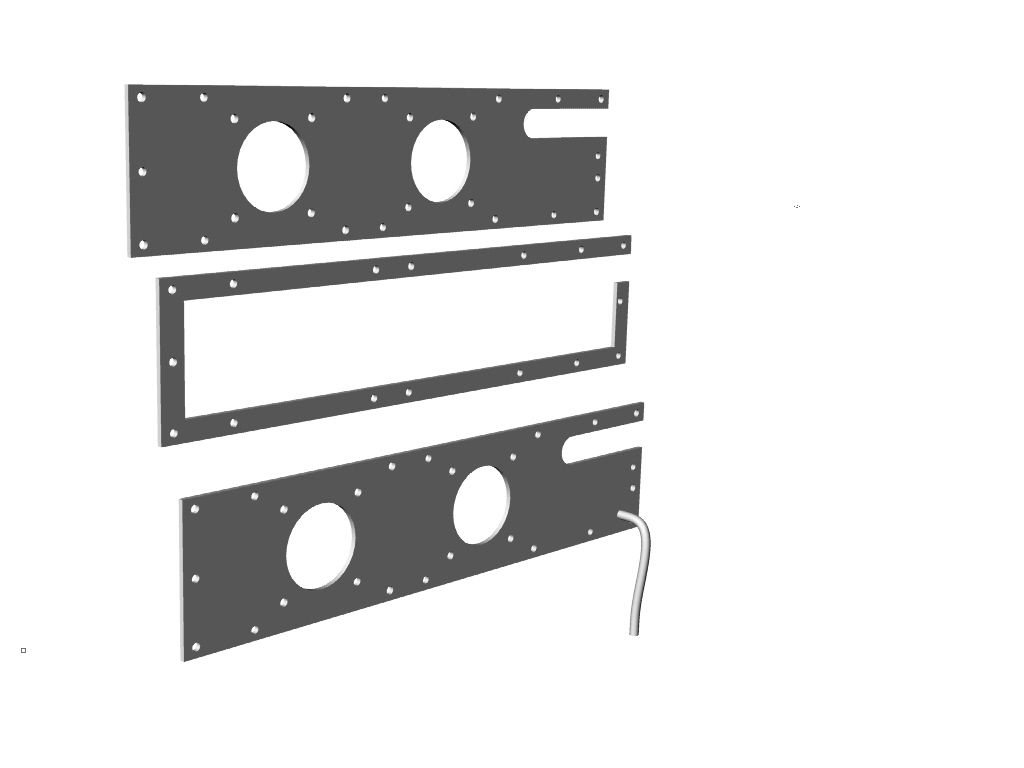
Here is what I had in mind. I am going to use paper gasket material
just like the old carburetors used. Tried and true on a zillion
cars for 100 years :) Due to the tolerance on Teflon sheet we had to
use .016 shims in there anyway. The paper gasket material will take
the place of the shim.
Paul Lamar
Opps forgot the picture.
Paul Lamar
The Rotary Engine NewsLetter. Powered by Linux.
ACRE NL web site.
http://www.rotaryeng.net
Copyright 1998-2005 All world wide rights reserved.