I thunk about it some more and discovered a few things on
the dyno. I am having trouble getting the runners short
enough so I made some changes. The 180 degree bend is
9.42 inches long by itself. Add four inches for the tube
stubs going into the engine and you have 13.42 inches. That
only leaves three or four inches for optimization.
We also needed to seal the
slide throttle in case somebody floods the engine during
starting. In normal operation and starting it is no problem
as is but if you flood the engine you could leak a bit
of fuel. I decided to weld the runners to the outer plate
thereby eliminating a couple of flanges and a whole bunch
of nuts and bolts. The inner plate must be still bolted
on or one would never be able to take the engine apart.
I also changed how the flanges and plates are welded to the
runners. They go into a 2 inch holes in the plates improving
the alignment and make the transitions smoother.
the plates are now 3/16 instead of 1/8 thick so welding
the runners to the plates do not warp the plate. Same thickness
as the old flanges. The inner flanges are larger so the same
bolts that bolt the plates together also bolt on the flanges.
This saves a few nuts and bolts and a whole bunch of counter
sunk holes.
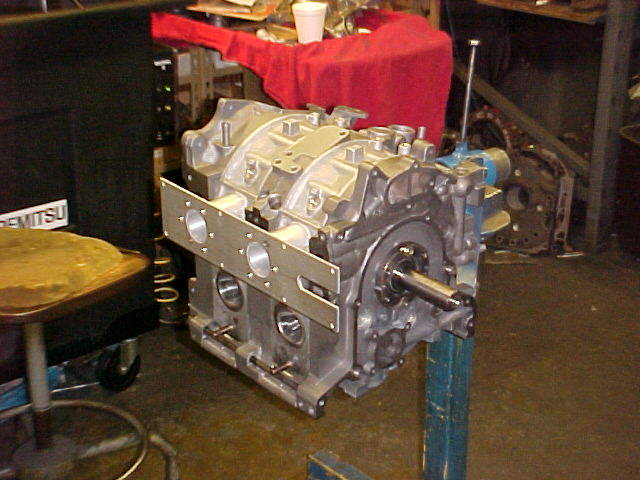
The first two pictures are the current design with the long
runners. Way too long.
The third illustration is the new design. I will use ordinary
gasket material to seal the slide throttle. Not all parts
are shown.
BTW Dave did not want to run the dyno today so it will probably
be the middle of next week before we can try out the new intake
manifold vacuum referenced fuel pressure regulator and the EFI.
I hope to improve upon the 230 HP we are getting at 6250 RPM
with the long pipes and the 245 HP we are getting at 7000 RPM
with the short pipes using the Webber 58 mm carb.
Paul Lamar
The Rotary Engine NewsLetter. Powered by Linux.
ACRE NL web site.
http://www.rotaryeng.net
Copyright 1998-2005 All world wide rights reserved.