<snip>
TO THE POINT: In the many helpful discussions on the MegaSquirt list,
one was how to "smooth out" the intake pressure pulses to avoid
spurious MAP readings at various RPMs.
Intuition leads you to implement a "surge tank" solution, where rapid
changes in pressure are "averaged out". Turns out this is a bad idea,
due to opposing goals:
1) Larger surge tank = slower system response to throttle changes. 2)
Smaller surge tank = inadequate "averaging" of pressure pulses.
#1 is the REAL problem, though. A real long or fat vacuum line counts
as a surge tank, too.
It seems the best solution discussed is to put a restrictor in the
vacuum line to the MAP sensor. A metal vacuum hose coupler drilled to
a specific size seems to be popular. The only "surge tank" left is
the unavoidable minimal volume of the MAP vacuum line. (The
restrictor can be at the manifold, the MAP sensor, or anywhere in
between.) The restrictor effectively controls maximum rates of
pressure change in the MAP sensor side of the vacuum tube. Drill to
size to get your desired response rate.
*******************************\__/*******************************
Manifold __ MAP Sensor
*******************************/ \*******************************
Restrictor
This *is* RPM dependent. The MAP tables are ultimately responsible
for factoring the fuel adjustments in. We just want to eliminate
problematic MAP-sample-timing issues.
Simple. Reliable. Cheap. Lightweight. Reproducable.
What's not to like?
BTW - "taking many samples and averaging the data" is like adding a
surge tank. Tracy probably wants to maintain system response. (I'm
just guessing here...)
Vince Orton
----------------------------------------------------------
What about building and installing an integrator circuit using an op-amp
and place it between the MAP sensor and Tracy's pickup?
Del Johnson
------------------------------------------------------------------ Given
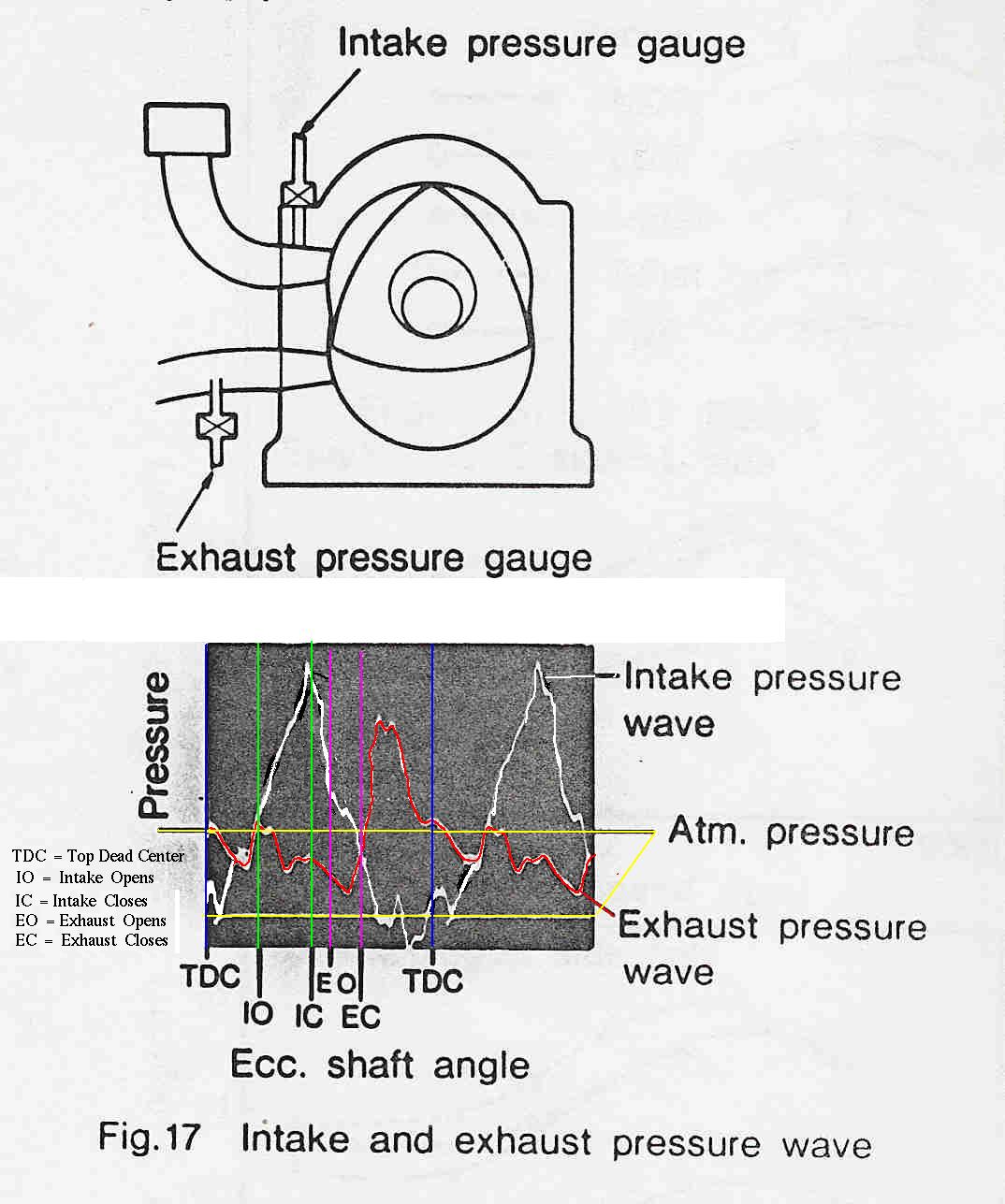
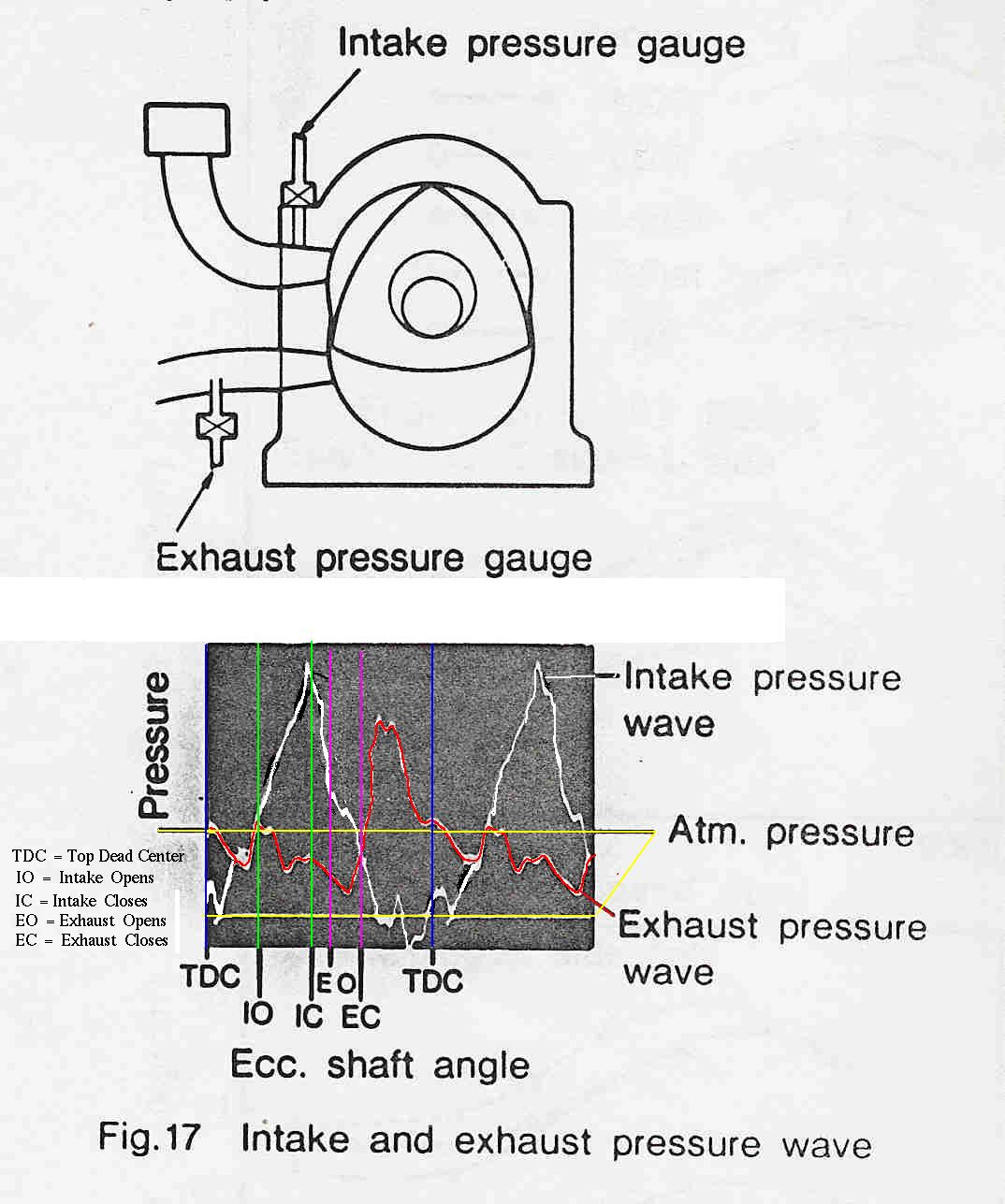
the pulse characteristics of a tuned intake manifold I am now not so
sure you want to average the pressure with a accumulator or
restriction in the vacuum line. See the attached file.
An integration of the pressure on the other hand over the time the port
is open (IO to IC) sounds intriguing. Right now Tracy is sampling the
pressure just as the Exhaust Opens (EO) and the intake pressure is
dropping rapidly. Integration could be done by taking ten samples
equally spread over the time the intake port is open, multiplying each
sample by a time constant and summing the individual samples in
software. In other words a crude integration process.
Great idea Del. Thanks for thinking of integration. Hard to do with just
an op amp but it could be done using a gate. Easy to do with
a pressure sensor and a cheap ($1.00) single chip microcomputer
in software. The output of the single chip would be a number
proportional to the area under the curve when the intake port
was actually open. Sounds like a patentable device to me except
it is not as you read it on here first :)
Paul Lamar
Even after looking at the picture, I still don't understand the problem
with averaging.. Maybe you could describe the issue in a different way.
Thanks,
Matt-
No problem Matt.
Think of these curves as the side view of some mountains
and valleys. Averaging would be like drawing a straight line half
way up the intake mountains... valleys included. What you might get is just
atmospheric or static pressure (top yellow line) as the valleys below the top
yellow line are below atmospheric pressure and those above are above
atmospheric pressure. What you want is atmospheric pressure PLUS the area of the
side view of the mountain between to the two green lines and above the
top yellow line. Namely the additional air going into the engine
when the port is open due to the dynamic ram effect. The mass of air
going into the engine is directly proportional to the side view area
of the mountain above the top yellow line PLUS the top yellow line.
Tracy refers to this as total pressure. This represents the 20% of additional
air you get with a highly tuned intake. This is also why the volumetric
efficiency of a p-port tuned intake rotary engine is roughly 120%.
This is also probably why we are 20% lean on the top end.
BTW Chrysler referred to the effect years ago as RAM charging and the
roots of the name are still used by Daimler/Chrysler.
I hope this clears it up. Perhaps someone else can give it a try
as well. Never hurts to have someone else explain things in different
words.
Paul Lamar
The Rotary Engine NewsLetter. Powered by Linux.
ACRE NL web site.
http://www.rotaryeng.net
Copyright 1998-2005 All world wide rights reserved.