Here is the strange series of fortunate events:
Yesterday: Finish removing the waste gate flapper (making the waste
gate wide open). Install an aftermarket racing muffler (easy, light
weight, works pretty well may not last), and finish installing new
tires and wheel pants with fresh coat of primer. Fix oil leak at
redrive exit, and small coolant leak. Remove Evans coolant and put
wetted water back in.
Ground engine run, all is well.
Brief flight around the pattern, performing and cooling very well.
Fly 20 miles from MFY to CRQ near my house (saving 1.5 hrs of driving in
traffic) (they are removing GA from all the local airports and NOTHING
is available there and the are not taking any names): On start-up
engine running rough, switch to computer B fixes problem (frequent
occurrence of rough running on computer A when engine warm that I
attribute to heat soak of the manifold temp sensor runs normally after
take off). Fly to CRQ on computer B (forgot to change back to computer
A) with great performance and cooling land an taxi on computer B.
Today: Arrive at airport with wife, load plane for trip to mountains.
Start on computer A and taxi out. Switch to computer B during run-up
and it sounds like it is running on one rotor, but normal on computer A.
Tried change in mixture, cold start, and lead/trail tests, mixture
variance without change. Dang!
Taxied back to parking on controller A which was working perfectly. The
only thing I could think of which would make one computer work but not
the other was the MAP tubingŠ. which was intact on inspection. Tried
it again turning off all avionics no change.
I called Tracy and discussed the issue leading culprit seemed to be
the primary injector actuator of one of the rotors for the computer B.
Time to call in Fed-ex before Tracy leaves for Oshkosh.
BUT, I am away from my hangar in 95+ heat with no tools or shadeŠ. Then
someone offers some shade and says throw on that cowl and taxi over, so
I do (foreshadowing #1).
FORTUNATE EVENT #1: So, because my engine sounds so strange all the old
guys are stopping over for a chat and to see if they can helpŠ I need
a hangar at this airport I say, and low and behold within 2 hours I am
paying for my new hangar. Never mind that I am going to be paying
$625/mo for a tiny t-hangar with no power and the locks don't work!! I
am still glad to have something near my house. hand over the checkŠ
So I decide to taxi over to my hangar. On accident, I start it on
computer B AND IT WORKS!!! WTF???? Now everything is working as
normalŠ unlikely a failed component in the EC2.. Hmmmm
So we go to lunch and I think about itŠ Wife says that it sounded
really funny from the outside on the last engine start, kind of like a
gear-box noise (foreshadow #2). "That's OK" I say, "the new muffler is
just allowing you to hear the non-engine noises better". Finally decide
to go back and try it again.. Start it up an everything seems OK on
both computers.. why not take it once around the pattern or something?Š
Get ATIS, talk to ground, taxi, wait my turn, position and hold, cleared
for take off, throttle forward and suddenly remember the cowl is only
thrown onŠ no pins in place! Idiot!! (Fortunate events #2 and #3).
Abort, no issue, taxi back is normal, shutdown is particularly smooth
no rattle like usual must be the new muffler (foreshadow #3).
I put the plane in it's estate (after all it must be an estate for that
price), and another old guy comes over. Sounds funny.. yea yeaŠ Show
him the engine, pull the prop through a couple timesŠ wait, that feels
funnyŠ
HEY! The flywheel is barely turning as I turn the propŠ Oh there it
goes, the prop is totally freewheeling!!!
It was the luckiest bad day I ever had. My RD-1B is clearly broke,
completely. Last inspection was less than 10 hours ago, no issues.
When computer B was not working sometimes it would give a backfire and
it was running VERY rough. Maybe that was the cause. Maybe I put it
back together wrong after the last inspectionŠ
Tomorrow I will go get my tools and close out my old hangar. Take off
the RD-1B and EC2. Send both back for inspection and upgradesŠ..
I guess there will be no flying this vacation, but that's OK because I
still have a plane and my skinŠ.
Luckiest Bad Day I ever hadŠ
Dave Leonard
Turbo Rotary RV-6 N4VY
http://members.aol.com/_ht_a/rotaryroster/index.html
http://members.aol.com/vp4skydoc/index.html
Hi Dave
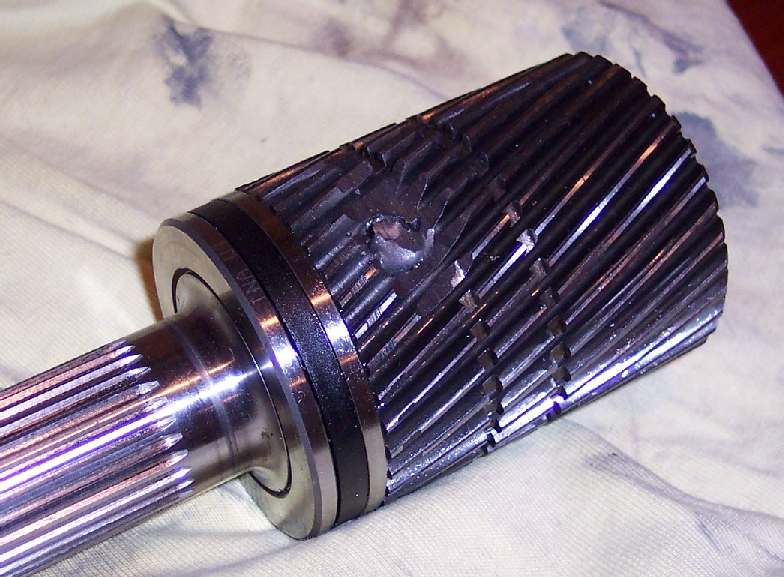
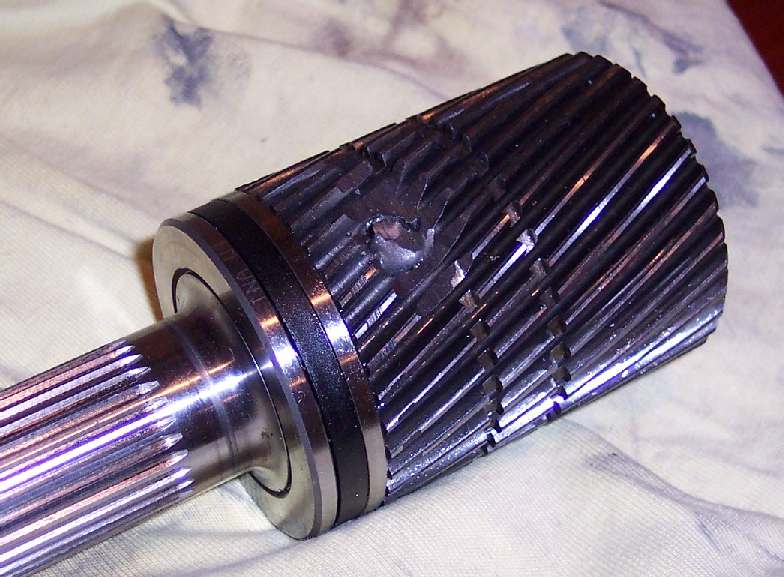
Thanks for the report. Just for clarification. You mention the prop is
totally freewheeling. After looking at your picture I assume this is only
for the area of where the gear teeth have been stripped which is about 30
degree of arc multipled by your gear ratio. Is the shaft itself OK?
BTW .... lucky you ...to find a hangar for $625 a month. Pricy in the states
no doubt but the best quote I could find for tying down my airplane in the
grass, a hour and half drive away from home was $1,100/month plus a deposit.
Three year waiting list as well. Needless to say an $900 round trip ticket
to California is a better deal. You can't even mention the word experimental
over here. Glad you are both safe.
Doug in Japan
--------------------------------------------
The gear teeth were not striped. On that early version Tracy used two
rosette welds holding the gear to the input shaft. Those apparently
are what failed when Dave's engine backfired. Tracy currently uses
a 5/16th pin which may also be marginal in a back fire situation.
We don't know that yet. I made a few suggestions to beef it up to
the point back fires should not cause problems even with high power
turbo engines like Dave is using.
That planetary gear set is bullet proof if properly installed
in a gear box, cooled and lubricated. The latest six pin versions
are used behind V8 turbo diesel engines with 600 foot pounds of input torque.
The rotaries puny 160 foot pounds should be no problem.
It is the connection between the input shaft and the sun gear
that is the problem here.
Here are my comment more or less to Tracy on the subject.
*****************************************************************
Butch says bolt shear loads should be very conservative.
A: So it looks like at least two pins are called for.
B: Or a one piece input shaft and gear.
C: or a spline.
D: Or press the gear on the shaft with twenty tons and use two pins.
Dave can rotate the two relative to each other by hand so they
were not pressed together or the shaft reamed the gear.
My theory says if the shaft is pressed on the gear any
relative motion will spin weld or gaul the two together.
This could be tested by using a couple of long levers.
BTW here is an invention. Heat them in an oven
to 1800 to 2400 degrees, move them to a large lathe and spin weld
them together. Let them cool and heat treat both back to hard. To my
knowledge this is not done yet. Cold spin weld yes but only on face to face
as far as I know. That is how turbines are welded to turbo charger
shafts.
next day ------------------------------------------
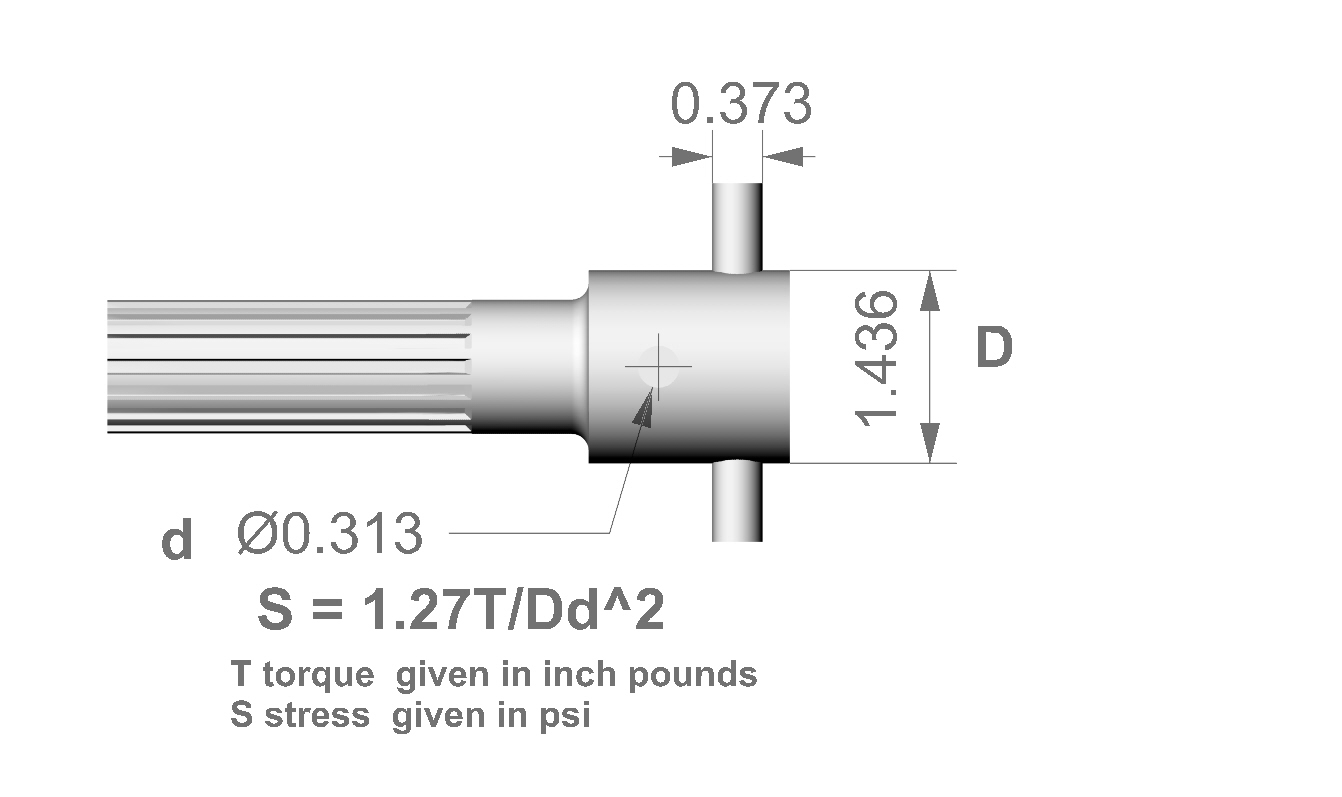
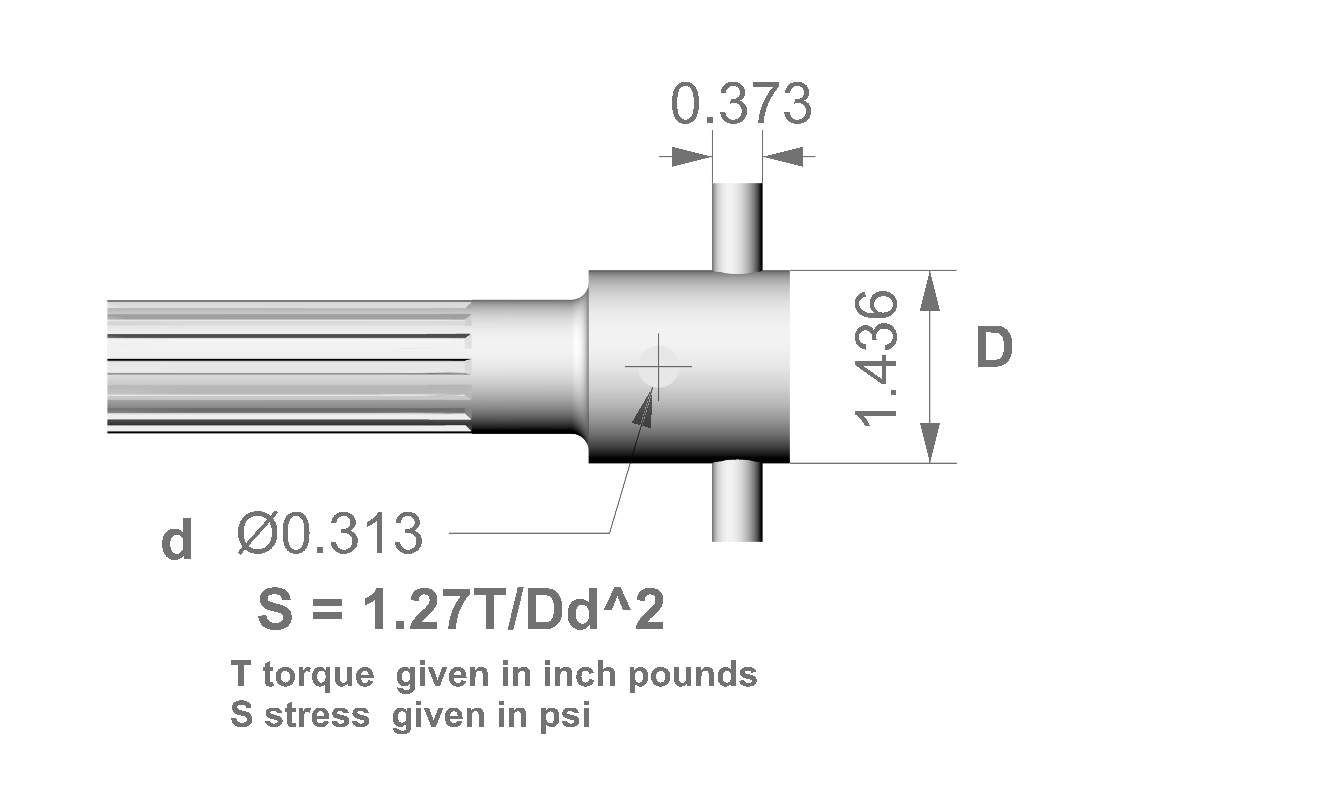
I checked with Machinery Handbook and they recommend only
6000 psi stress for the pin part. Wow! that is low!
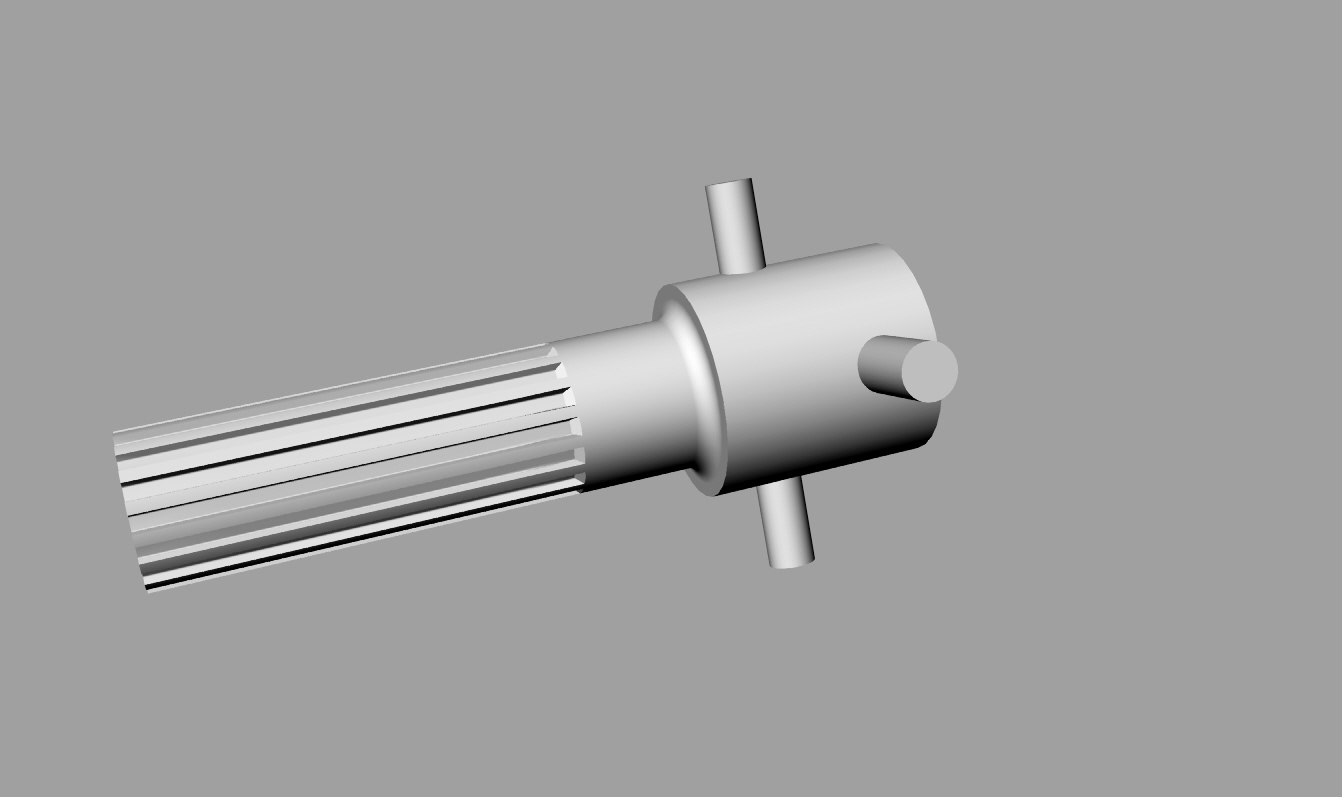
Here is a simple formula for pin stress from that book in
the attached 3D.
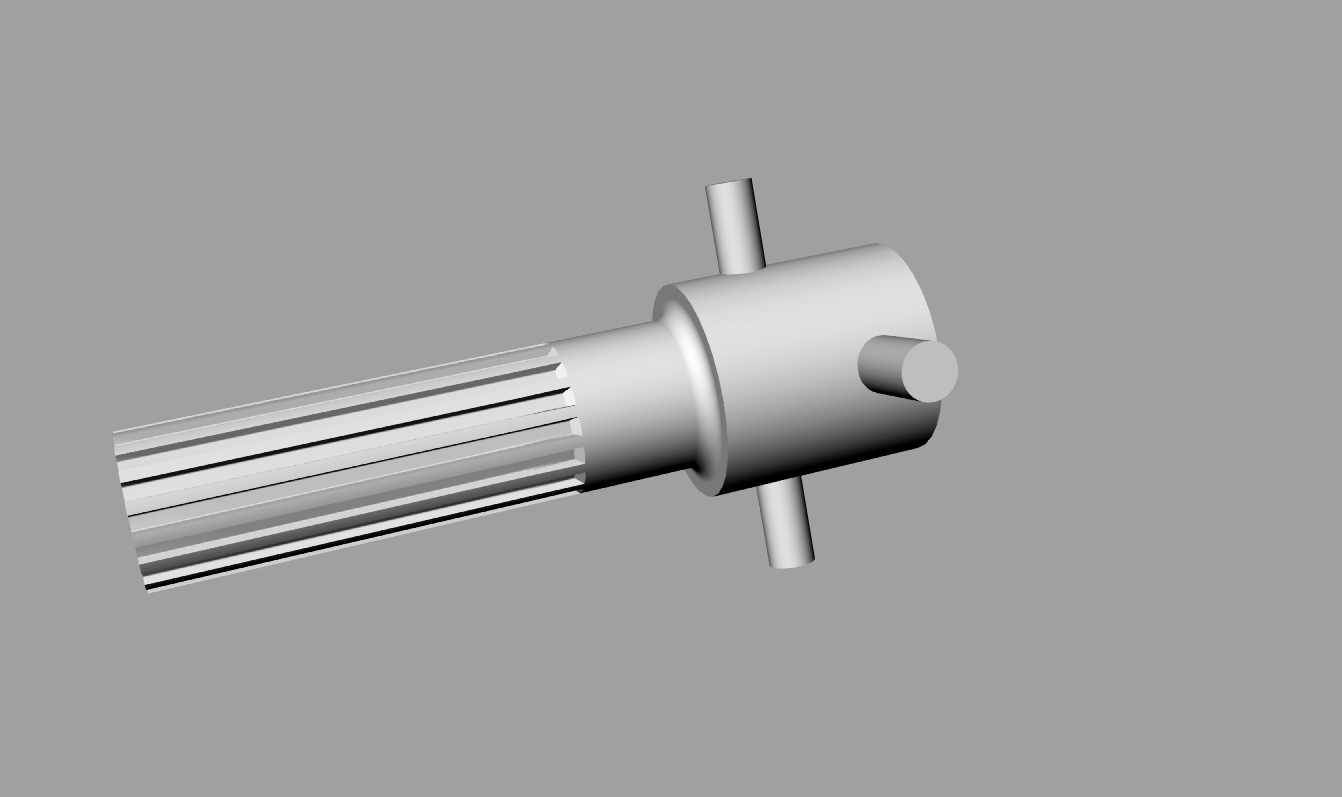
Here also is the two pin configuration 3D I was talking about.
You might want to go up another 1/16 inch all around on both pins.
Even from the 5/16th pin that you are using now. 3/8th and
1/2 pins should be about right. An FEA on the shaft and pins
would be ideal.
BTW I don't how in heck you are drilling
the holes in that hard gear and input shaft. Not easy.
Grinding? EDM? Carbide bit? Maybe they are just case hardened
in that case you lucked out :) A bit of grinding should
break through the hard layer. What ever you do it is going to be
tedious and expensive.
Paul
The Rotary Engine NewsLetter. Powered by Linux.
ACRE NL web site.
http://www.rotaryeng.net
Copyright 1998-2005 All world wide rights reserved.