Old message from Vance. Looks like Vance agrees.
Sent: Monday, May 09, 2005 4:23 PM
Subject: Prop for Midget mustang - was: P-port engine status
-------------------------------------------------
>
> Rotary Engine wrote:
-
> >>
> >> I think Vance might be able to help you. He has a prop program.
> >> Vance what say you for a Mustang II with about 250 HP.
> >>
> >> Paul Lamar
> >>
> >
> > I can plug it into my program and get a pretty close size, Need at
> > least a
> > couple
> > of HP points at prop shaft rpm - What max dia can you comfortably
clear
> > and how would you rate the plane - ie "clean" average? well faired
gear"
> > tri or tail dragger? - Vance
> >
> >
> The airplane is a Mustang II (2-seater), not a Midget Mustang
> (1-seater). It is a tailwheel. It has the minimum fairing, so I
> suppose it would be at best average, maybe even dirty. Typical prop
> diameter is 70". Some guys swing 74", but that's a little aggressive
> for me.
>
> Thanks,
>
> Mark & Mark
Guys - I still need to know what propshaft rpm do you plan on supplying
that
250hp?
The full throttle sea level design speed for the airframe as described is
probably
about 210 mph, and the prop would be pitched for about Cl of 0.4 at that
point. and the width
distribution of the blades set to use the stated hp at that point. The
shape
of the power
curve back down on rpm will establish the predicted static rpm and power.
The shape of the power
curves for conversions (even Wankels) is usually "fatter" than that for an
"aircraft" engine
usually providing better static and climb power for the same "rated
power".
Conts and
Lycs are rated usually just at or before the torque peak making a
virtually
straight line.
Conversions are usually "rated" at peak horsepower - usually well past the
torque peak,
"fattening" the curve.
Vance
7500 engine RPM gives a 2630 prop RPM with a 2.85:1 PSRU ratio.
We are hoping for 250 HP at 7500 engine RPM.
Paul Lamar
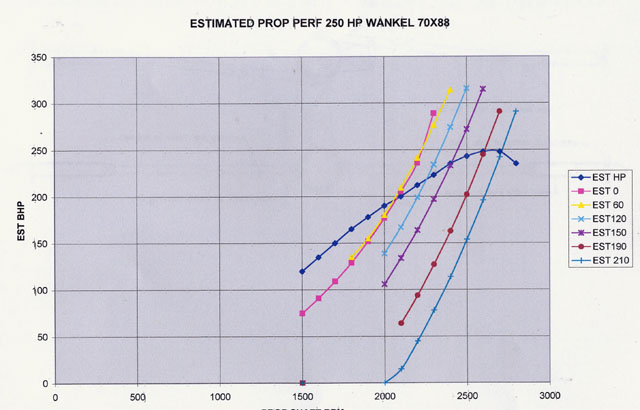
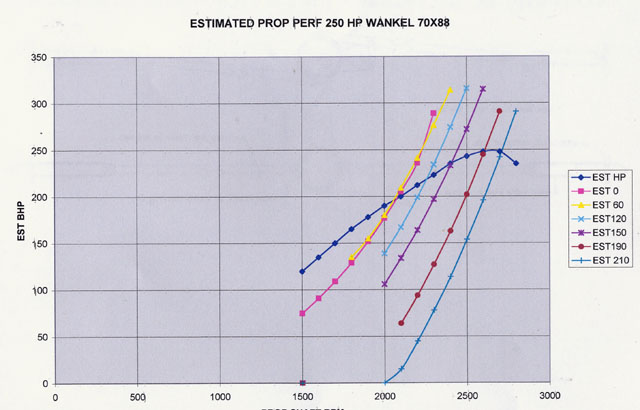
Mark - Paul and others- I plugged in the reqirements for a fixed pitch prop
for 250 hp at 2630rpm and 210mph.
The 70 inch diameter is actually a bit past reccomend on tip speed for a
wood prop but not too bad.
The first output was for a 90 inch pitch, and I backed down a bit to 88
inches, and downsized the raw
blade width numbers 5in at 90% radius, 6in at 70, 8in at 50, and 10in at
30%. Running the model at
these values provided the power vs rpm at selected speeds as shown on the
Excell chart. The available
power curve was an estimate - lacking any dyno data on these engines. The
static and 60mph points
indicate that this would be one of those props that "catch hold" and slow
the engine initially as sections
of the blade become un stalled. The computed blade width is based on a
constant horsepower per unit
of disk area. the 30 percent point is quite wide with that approach (Paul
Lipps loads the inner portion
of the disk even heavier in his very successful props) - every thing inboard
of 20% is considered
blocked and inneffective. As with all computer analysis GIGO rules - but
this should be pretty
close. Vance
--------------------------------------------------------
The Rotary Engine NewsLetter. Powered by Linux.
ACRE NL web site.
http://www.rotaryeng.net
Copyright 1998-2005 All world wide rights reserved.