Now if I could just find out how to control the stepper motor on the oil
injector pump, and what is the purpose of the vacuum feed to the
injectors?
Ian Beadle
++++++++++++++++++++++++++++++++++++++++++++++++++++++++++++++
C & D pins are 12 Volt supply. E,F,A & B pins are stepper coils 1,2,3,&4
respectively. Ground side is switched. There is also a position switch
which is monitored by the PCM to keep track of the amount of oil
being metered. Step up and step down.
Oil metered is a function of RPM, coolant temp and amount of intake air.
The oil nozzle receives barometric pressure to prevent the
negative pressure in the intake chamber from being applied to the oil
inlet.
There is also a one way valve to prevent oil from flowing out of the
air hose side when positive pressure is in the intake chamber.
BTW As I was saying this is a good place to monitor the vacuum or MAP
for
fuel injection purposes.
There is a fail safe mode when the PCM detects a insufficient amount
of oil it then limits the engine RPM. Limp home mode. This prevents
seizure of the apex seal. As I said many times before one of
the functions of the apex seal oil is to cool the seals.
One of the advantages of the RX8 engine side exhaust is the apex seals
run cooler.
Good luck on controlling the stepper motor. BTW that is an
extremely expensive part at around $1500 US.
If it were me I would forget it and mix 2 cycle oil with the fuel.
Paul Lamar
That is not like you Paul (Thanks for the info). Controlling a stepper
motor should be a good challenge. Right up your street. Actually running
the
motor at the full speed setting and feeding it two stroke oil with the
$90
Richard Sohn adapter would probably be OK as we run our motors at high
speed
most of the time.
The control could be 4 micro switches and a cam on the throttle. I will
have
a play.
By the way IMHO premixing the oil at an away airfield in 100 degrees and
half a gale is a pain in the proverbial.
Ian Beadle
You should know being the outback rotary engine pilot meister :)
The main reason Mazda goes to all that trouble with the stepper
motor is the draconian emissions rules in the US and Japan.
I kind of like Mazda using the PCM to monotor the oil feed to the
apex seal oil injectors and shutting down the engine if the oil injection
fails.
There are a lot of rotary engines in junkyards around the world
where the cheap 10 cent nylon lines feeding the apex seal oil hardened
and cracked
without the owner being aware of what was going on. Those lines need to
be changed every eight to ten years no matter what. It blew me way to
discover
the RX8 engine still had cheap nylon lines. If it were me I would design
those critcal oil feed lines in steel. Never the less the PCM apex seal
oil monitoring feature on the RX8 engine should extend the life of the
rotary in automotive
service to well over 500,000 miles. It will take another 20 or 30 years
to
find out:)
Paul Lamar
There is one more function of the vacuum hook up to the oil injection
valve,
if not its only one.
Since the vacuum line is seeing the same pressure situation as the intake
runner, with a little bit different timing, it provides a misting air
stream
for the oil during the intake stroke. If you leave the vacuum line off the
valve, the oil would enter the combustion chamber as a droplet and do next
to nothing in there.
The check valve in the injector valve prevents oil from filling the vacuum
line, and thus defeat the purpose of it.
Richard Sohn
N-2071U
OMP Adapter
I think you mean the atmospheric pressure line Richard. It is not
hooked to intake manifold vacuum. This makes more sense as the
atmospheric pressure is higher than the vacuum pressure in the intake
chamber except for the turbo models. It indeed would inject the
apex seal oil better as you say. In the RX8 the same pressure
line is used to assist fuel injection into the primary
intake ports.
BTW This is a critical system to the life of the engine so
it pays to make sure it is working properly and keeps working.
Paul Lamar
Sorry Paul, but my repair manuals and my RX7 show that vacuum line to be
hooked up to the intake plenum about 2" down streem from the butterfly set.
Richard Sohn
N-2071U
Yep you are right on the 1986 through 1991 models.
It is shown in the Haynes Manual on page 78 and 79.
It is a mystery to me why they did that on the normally aspirated models.
Must be a big difference in vacuum pressure between that point and the
intake chamber. IMHO would work better on the other side of the throttle plates.
I can see why they did it on the turbo models as the pressure
is above atmospheric some of the time (boost).
On the RX8 however atmospheric pressure is used on the oil injectors
and not vacuum. Page 01-13-3 Mazda RX8 2004 Service Highlights. Makes
more sense to me.
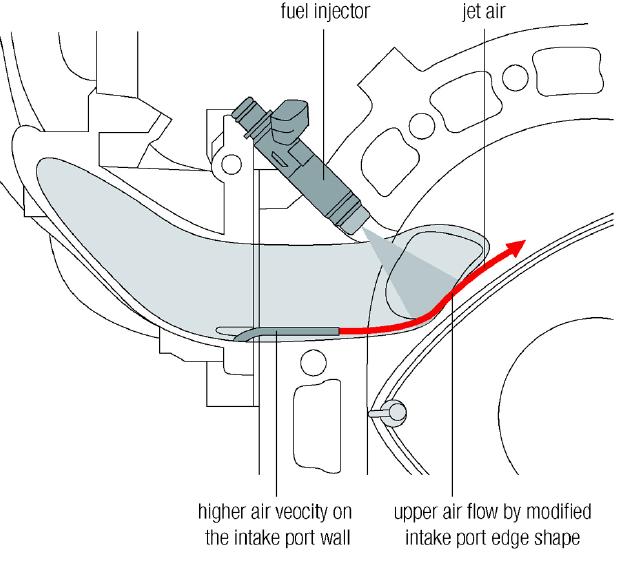
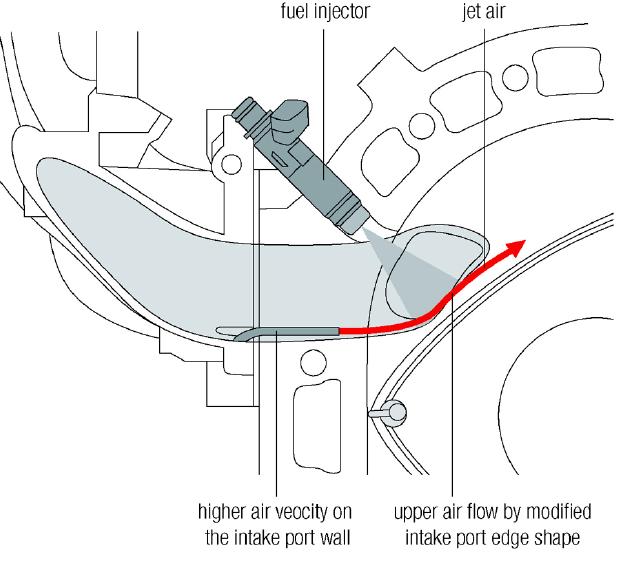
The same atmospheric pressure air supply is used for this
fuel injector enhancers called Jet Air-Fuel Mixing System.
"RENESIS is equipped with a new Jet
Air-Fuel Mixing System that strongly promotes the dis-
persion and mixing of fuel. The system utilizes air
bleed in the intake port to effectively speed the flow of
air over the intake port walls and boost atomization of
fuel particles adhering to them." [Works well at part
throttle only. Not much good for aircraft use where the
throttle is wide open most of the time.]
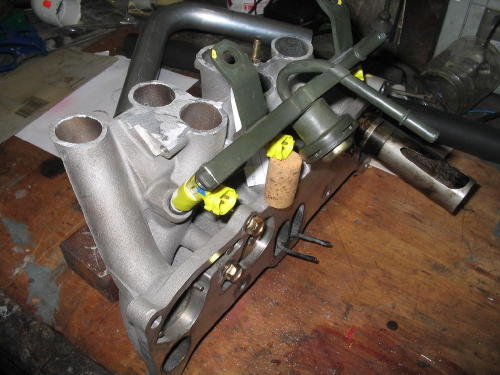
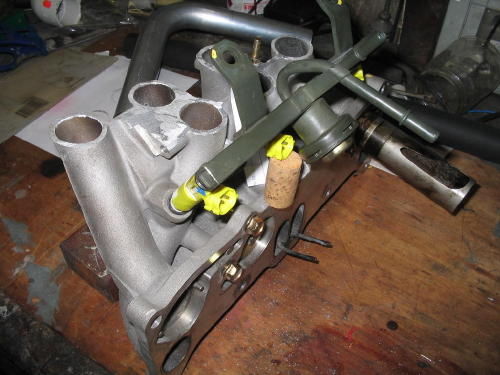
Here is a picture Ian's RX8 high power manifold sent showing
the two tubes protruding from the intake manifold into the
primary ports.
BTW this jpg also shows Ian's RX8 manifold cut down. Ideal
for welding on pipe or tubing bends to gain a low profile
aircraft intake manifold.
Paul Lamar
The Rotary Engine NewsLetter. Powered by Linux.
ACRE NL web site.
http://www.rotaryeng.net
Copyright 1998-2005 All world wide rights reserved.