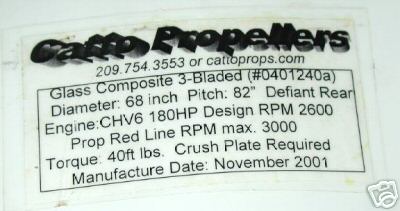
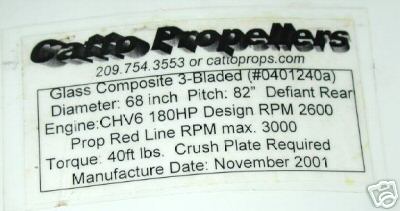
I doubt this 180 HP prop will absorb the HP of a turbo or p-port rotary/
Paul Lamar
Paul, my friend has Velocity with IO-360 200HP and can not develop RPM for
safe flight. It has way too much pitch and wider blades than his standard
Performance prop.
Bulent
++++++++++++++++++++++++++++++++++++++++++++++
200 HP is a long way from 250 to 275 HP.
With only 68 inch diameter and pitch of 82 it still sounds like it is
too small.
Dave Leonard what diameter and pitch are you now running?
Paul Lamar
Guys that's 68x82 ->> 3 Blade <<-
That's a lot of prop!
Mike McGee, RV-4 N996RV, O320-E2G, Hillsboro, OR
13B in gestation mode, RD-1C, EC-2
Why then did he rate it at 180 HP?
Paul Lamar
Don't know where the 180 figure came from but the Ebay ad says it's for an
O/IO-540 at 250-300 HP. Max RPM is 3000. Sounds perfect for a Turbo 13B,
2.85:1 RD-1C powered canard.
Dave, you should call Craig Catto and ask him if it would work on your
plane with the 2:17 turning the other way up front. I suspect it's too
much prop for the RV-6.
An 82" pitch turning 3000 rpm? That's moving out...
Mike McGee, RV-4 N996RV, O320-E2G, Hillsboro, OR
13B in gestation mode, RD-1C, EC-2
Mike, is that 82" times 3000 RPM or 246,000 inches per minute?
246,000/12 = 20,500 feet per minute? 341 feet per second?
Rule of thumb 20% slip 273 feet per second? 186 MPH?
82 inch pitch does not seem like that much.
If it had 88 inch pitch is 200 MPH by the same criteria.
At an optimistic slip of only 10% those numbers are 209 MPH
and 220 MPH.
Also 3000 RPM at 68 inches diameter is also questionable.
53,407 feet per minute tip speed. 890 feet per second.
Mach one is 1117 feet per second or Mach .8 at 59F.
Up in the high drag area for prop tips. I have no doubt
it will absorb 250 HP at a tip speed of Mach .8 is
hitting a brick wall. The question is what is the
prop efficiency (If any. :)) at Mach .8?
http://hyperphysics.phy-astr.gsu.edu/hbase/sound/souspe.html
The numbers on this prop including the 180 HP printed on the label
just don't add up.
Paul Lamar
I think there is more to it than 82" being just the advance ratio of the
helix. For instance, my 70x79 aluminum Sensenich on my 150 HP RV-4 will
get me 180 mph at 2600 give or take a little depending on altitude. I
think the airfoil on the prop will pull it faster than the 82" figures on
paper. That's probably measured on the flat bottom of the airfoil. Also
the third blade might reduce the slippage a bit. Someone with more prop
knowledge than me will need to answer this.
I agree that at 3000 rpm it would certainly soak up 250 hp. Probably
spitting out 30 hp worth of noise. The blades on these are mostly carbon
fiber so they're nice and thin and probably a laminar flow airfoil near the
tip that will make the rpm advertised. The tag says it was designed for
180HP at 2600 rpm. The attached pic has Catto's phone number on it.
Mike McGee, RV-4 N996RV, O320-E2G, Hillsboro, OR
13B in gestation mode, RD-1C, EC-2
Good Point Mike.
OK we will add 3 inches for the true angle of attack in the future.
A fuction of the blead thickness. How thick is your Sensenich.
I guess we really need to do a helix drawing.
BTW I talked to the Sensenich engineer at OSH.
Sensenich (Plant city FL) has agreed to test their new ground adjustable
strain gage instrumented carbon fiber blade on the Tracy Crook's RX8
engine under static conditions in Bell FL. If the static RPM tests look good
perhaps they will let Tracy flight test it. They already recognize the fact
that the rotary is less hard on a prop than the Lycoming.
Paul Lamar
The Rotary Engine NewsLetter. Powered by Linux.
ACRE NL web site.
http://www.rotaryeng.net
Copyright 1998-2005 All world wide rights reserved.