How does one tell a flywheel from an automatic 13b vs. a flywheel from
a manual 13b?
I began adding Tracy's RD-1C & Jerry's Shertz Beam to the engine
today, only to be stopped on the 2nd step. Tracy makes clear that an
automatic flywheel is necessary. On step 2 I was unable to get the
dampener plate to sit flush on the flywheel I have -- so I am
suspicios that it is the "wrong" flywheel.
Besides now having to probably find a new flywheel, am I at risk of
also having to change anything else? i.e., the counterweight?
Mark & Mark
Real easy. One you can pick (the auto TX flywheel (flex plate)) and
the other one is glued to the ground :)
The automatic has a bunch of small holes in it and is made from
sheet metal.
Definitely on the counter weight. Send email to Dave Lemon
at Mazdatrix on which counter weight to use as he built the engine.
He might have
one in stock.
Another problem: the end of the e-shaft (where the nut is) has some
sort of residue inside of it. In order to mount the redrive, the
pilot has to be able to fit into the e-shaft & it is currently binding
on this residue. I have tried zapping it with solvents, but no dice.
Any hints on what this stuff is & how to get rid of it? I am not
excited about sticking a grinder in there, since I would no doubt
screw up the interior finish. Maybe a heat gun?
Mark
Also ask this question of Dave. I think it might be some sort
of Loctite product.
A heat gun might help.
Paul Lamar
The interior finish is not as critical as you might think. There is a
pilot shaft on the RD series drive that goes into the hole on the
Eshaft. This pilot shaft rotates WITH the eshaft and flywheel, so there
is little relative motion.
On mine I ended up having to grind out the inner bearing race on the
inside of mind, and had a small score on the inside face. A little bit
of axle grease makes all better.
As for flywheel, the best description of what an automatic transmission
flywheel on a 13B engine is: a thin piece of metal plate with a ring
gear on the periphery. It's more properly referred to as a flex plate.
The flex plate is paired with a SEPARATE flywheel counterweight that is
bolted to it.
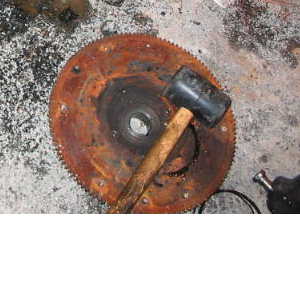
A manual tranny flywheel is a heavy, steel chunk of metal that resembles
a barbell weight and has an INTEGRAL flywheel counterweight built into
it, with a large "pizza plate" flat surface for the clutch to engage.
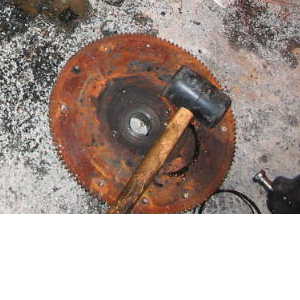
Pictures are attached.
One is the manual flywheel, in my pics, all rusted out on the engine I
threw away.
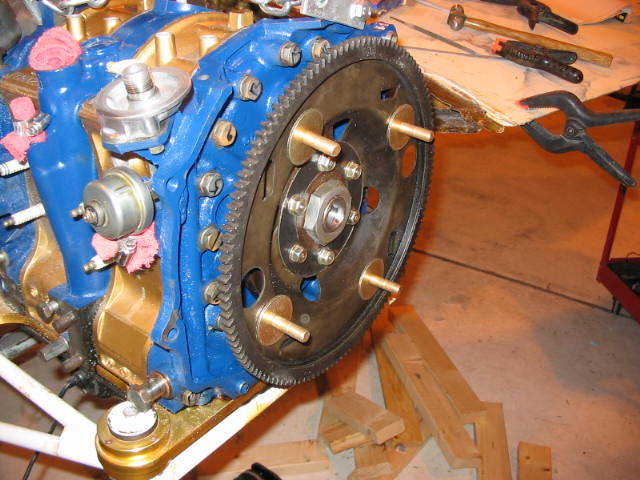
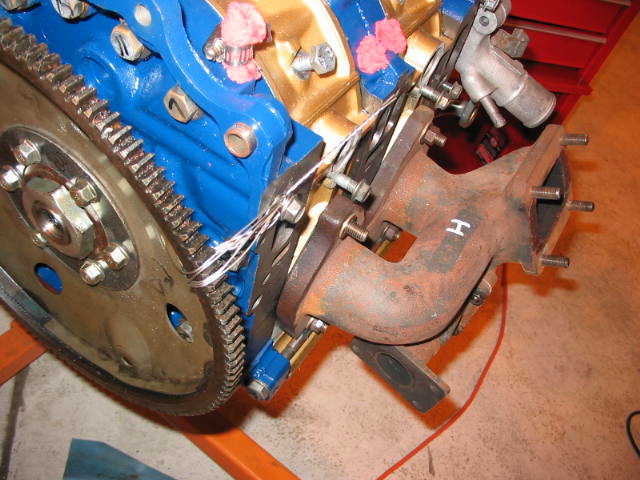
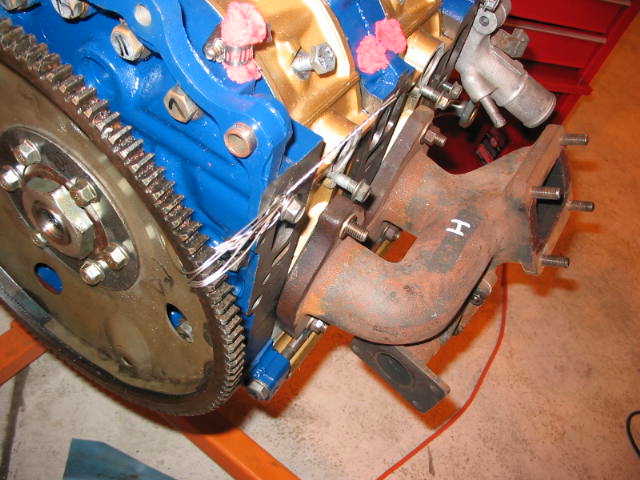
Another is a 3rd gen auto flex plate: It has bolt holes that are of the
wrong spacing pattern and there are several round lightening holes.
The RIGHT flex plate is the 2nd gen auto flex plate. In the pic you see,
I have the damper attach bolts in place. Difficult to see but present
are rectangular tabs stamped/bent out of the flex plates metal. Perhaps
they serve some sort of cooling/fan function or stiffening.. but they
are the visual signature of the proper plate. The 4 bolt holes are of
the proper spacing to mate with the RD series damper plate.
I apologize if this is late or already addressed. I have been off the
grid for a few days.
Dave Staten
--
The Rotary Engine NewsLetter. Powered by Linux.
ACRE NL web site.
http://www.rotaryeng.net
Copyright 1998-2005 All world wide rights reserved.