> I wonder if anyone can shed some light on this issue. I had
assumed that
> the rotary would have considerably less torsional vibration than a
> piston engine -- for a number of reasons -- but I have heard this may
> not be so.
>
> Also, how does the single-rotor engine fare in this regard?
>
> Regards,
>
> Gordon Arnaut
> Ontario, Canada.
>
>
> The two rotor is better than a four cylinder. About the same as a six
> cylinder.
> The one rotor is a real beast. See the attached graphics.
>
> Paul Lamar
I had my 13B run for few seconds on one rotor and it was shaking so
bad, my
teeth were rattling:). If one rotor quits you'll know it.
Bulent
I have heard that said and on the other hand Tracy and I were watching
Joe Schiferl start up his Power Sport 13B powered Velocity at
OSH and Tracy supposed it was running on only one rotor from the sound
it was making. It did not seem to be shaking.
Many one rotors have been built and when properly balanced they don't
apparently shake. They appear to be smooth. I don't really think you
can feel or see torsional vibration at anything over 1500 RPM or so.
The prop connection sees it for sure as that is why a Lycoming is so
hard on props. In theory there is no up, down or back and fourth
shaking forces.
Perhaps there is something else going on in your engine.
Its a mystery.
next message ------------------------------------------------
Duh! I just think I figured it out. When the two rotor runs
on one rotor the pulse rate is below Tracy's rubber torque pulse
isolator
resonant frequency. Tracy's latest rubber torque pulse isolator is
smooth down to 1000 RPM or so according to Tracy running on two rotors.
The Power Sport PSRU uses a direct connection to the gear box. No torque
pulse isolator.
The old Ross clutch spring plate torque pulse isolator had a higher
resonant frequency and therefore one had to keep the engine idle above
1800 to 2000 RPM or it would shake and shutter badly.
Come to think of it when we were running the p-port engine on
the dyno recently it would occasionally run on one rotor for various
mixture
issues with no apparent vibration. It too of course was directly
connected
to the dyno water pump load with no torque pulse isolator.
Paul Lamar
What exactly is the source of the vibration and at what rpm. I would
assume it has to do with the moment of the rotor in that elliptical
path?
I was surprised to hear that the single-rotor requires the same heavy
gearbox used on the two-rotor. Why not use the proper damping tuned for
the appropriate rpm of the resonance and size the gearbox or belt
according to torque output (downsize and lighten)?
Regards,
Gordon.
First there is no elliptical motion. The CG of the rotor rotates
around the center of the e-shaft in a perfect circle while at the same
time rotating about its own center. Much as the earth rotates about
the sun
while rotating about its own axis. That is why the Wankel is sometimes
called a planetary engine.
See the animations on the web site
http://www.rotaryeng.net/
..... Principles of the Wankel (in German)
and also
..... An excellent movie animation of how the Wankel works created
by Gene Nomicos. .
Also read;
..... How The Wankel Works Paul Lamar. Text.
The torsional vibration is caused by the two rotor engine firing twice
per output shaft revolution just like a four cylinder four cycle
engine. The firing impulses causes no vertical or horizontal
vibration unlike what happens with all piston engines.
The rotary engine is nearly as smooth as an electric motor.
Yes a dampener specifically designed for a one rotor engine is
a good idea.
Paul Lamar
Thanks, Paul.
From what I can see from that movie, the cg of the rotor does indeed
move in a perfect circle -- however, its axis is offset from the cg of
the output shaft by the amount of eccentricity in the shaft. Also the
rotor tips obviously track an ellipsoid, due to the e-shaft offset.
I would assume that the e-shaft offset, while not as big as a crank
throw by any means, is enough to cause some vibration in the radial plane.
Also, on that graph of the torque spikes, I can't make out whether the
2-rotor engine dips below the zero axis. I would assume that it does,
since four and even six-cylinder pistons go into negative territory.
Regards,
Gordon.
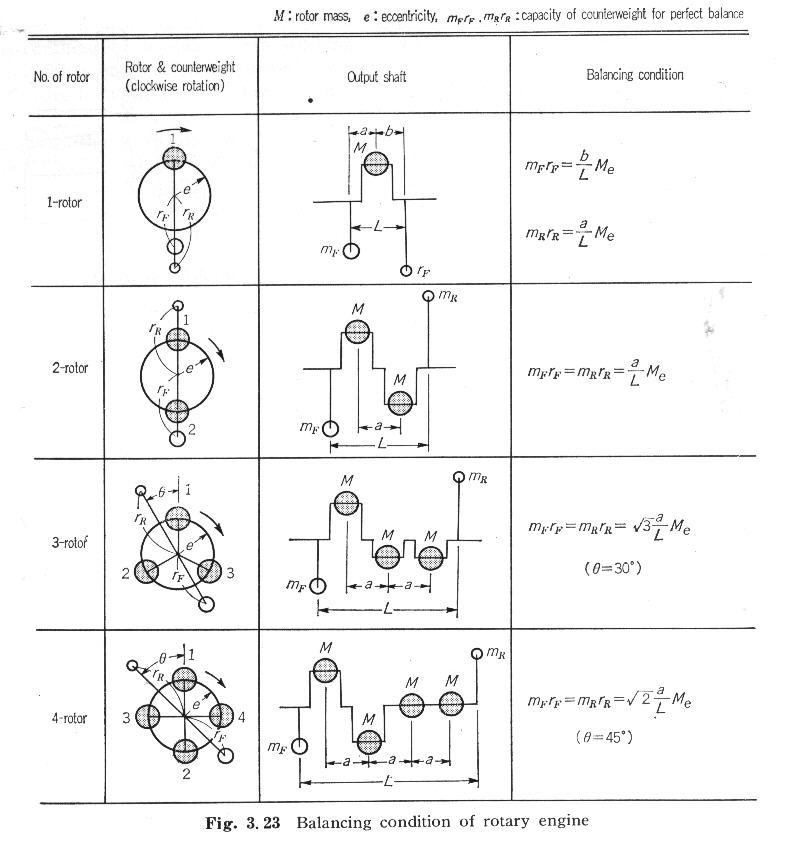
It causes no vibration but it does generate a centrifugal force
on the rotor bearing. It is also balanced by the second rotor
180 degrees out of phase on a two rotor engine. What is left
is known as a "couple". The couple is caused by the two rotors
not being in the same plane. That is the function of the front
and rear counter weights. They remove the couple completely.
A similar situation arises when balancing a tire. The balance
weights must be centered on the rim width (in and out) or a couple
will be generated. This is sometimes referred to as
dynamic balance.
In the case of the one rotor the front and rear counter weights
balance the weight of the rotor. In all cases the Wankel rotary
engine is in complete balance unlike a piston engine that always
has parts rocking back and fourth such as connecting rods and valves.
Here is a mathematical balance chart for rotary engines.
The two rotor engine does not dip below zero but the one rotor
engine does indeed dip below zero as does a four cylinder four
cycle engine.
Paul Lamar
The Rotary Engine NewsLetter. Powered by Linux.
ACRE NL web site.
http://www.rotaryeng.net
Copyright 1998-2005 All world wide rights reserved.