> It causes no vibration but it does generate a centrifugal force
> on the rotor bearing. It is also balanced by the second rotor
> 180 degrees out of phase on a two rotor engine. What is left
> is known as a "couple". The couple is caused by the two rotors
> not being in the same plane. That is the function of the front
> and rear counter weights. They remove the couple completely.
> A similar situation arises when balancing a tire. The balance
> weights must be centered on the rim width (in and out) or a couple
> will be generated. This is sometimes referred to as
> dynamic balance.
>
> In the case of the one rotor the front and rear counter weights
> balance the weight of the rotor. In all cases the Wankel rotary
> engine is in complete balance unlike a piston engine that always
> has parts rocking back and fourth such as connecting rods and valves.
>
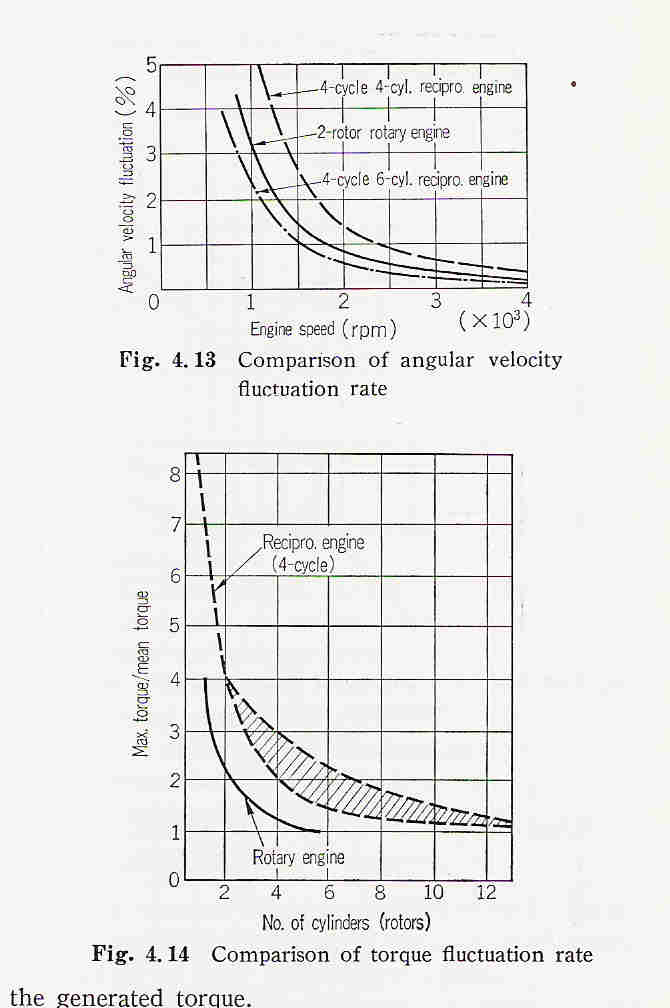
> Here is a mathematical balance chart for rotary engines.
>
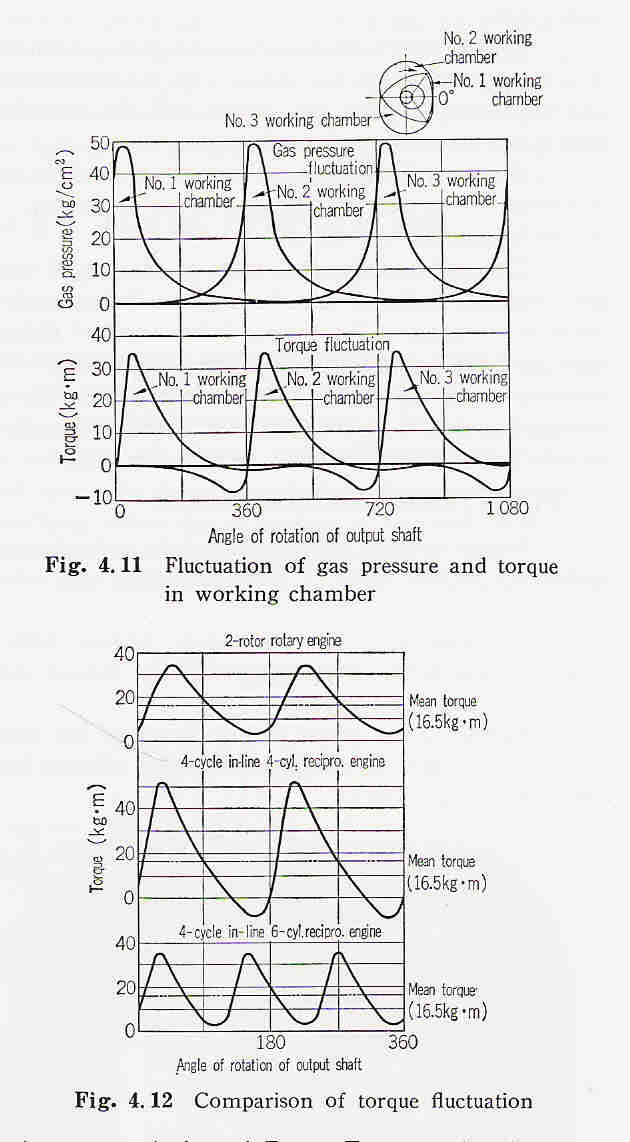
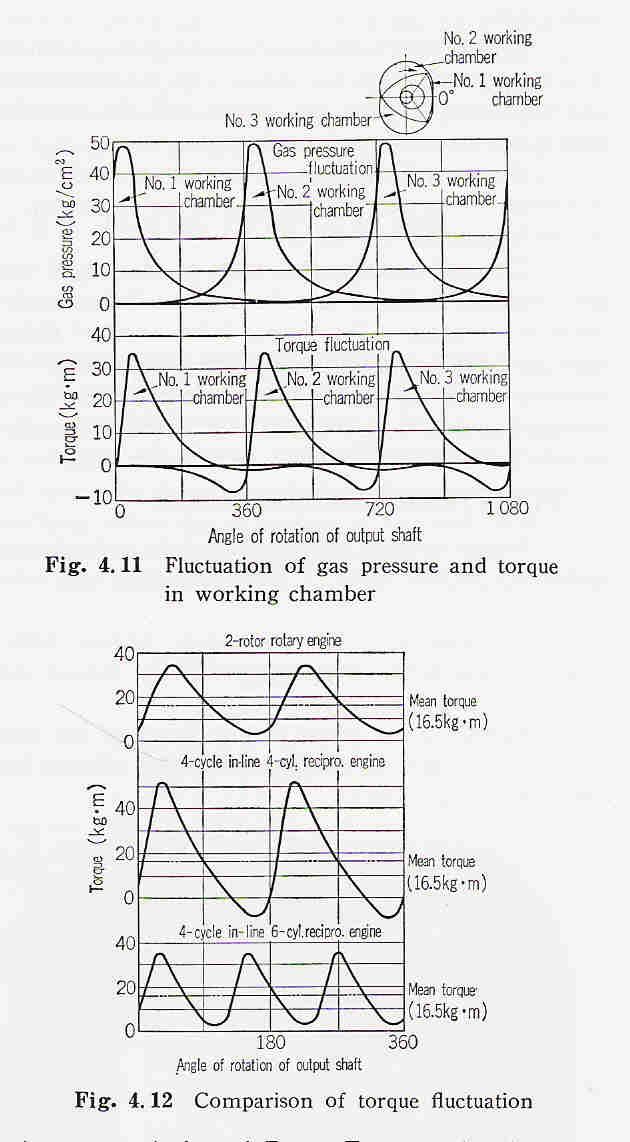
> The two rotor engine does not dip below zero but the one rotor
> engine does indeed dip below zero as does a four cylinder four
> cycle engine.
>
> Paul Lamar
Good dissertation Paul.
I cover Static, Force, Couple, and Dynamic in my seminars
at OSH.
Archie
--
Thanks, Paul.
-*
You mention the four-cylinder piston going into negative torque, but the
six-cylinder piston will too, although at about half the amplitude
(approx -50 percent of mean torque, compared to -100 percent on four).
Only when you get to the eight-cylinder with its power pulse every 90
degrees does instantaneous torque stop going into negative territory. So
in that respect, the 2-rotor is better than a piston six and closer to
an eight.
Regards,
Gordon.
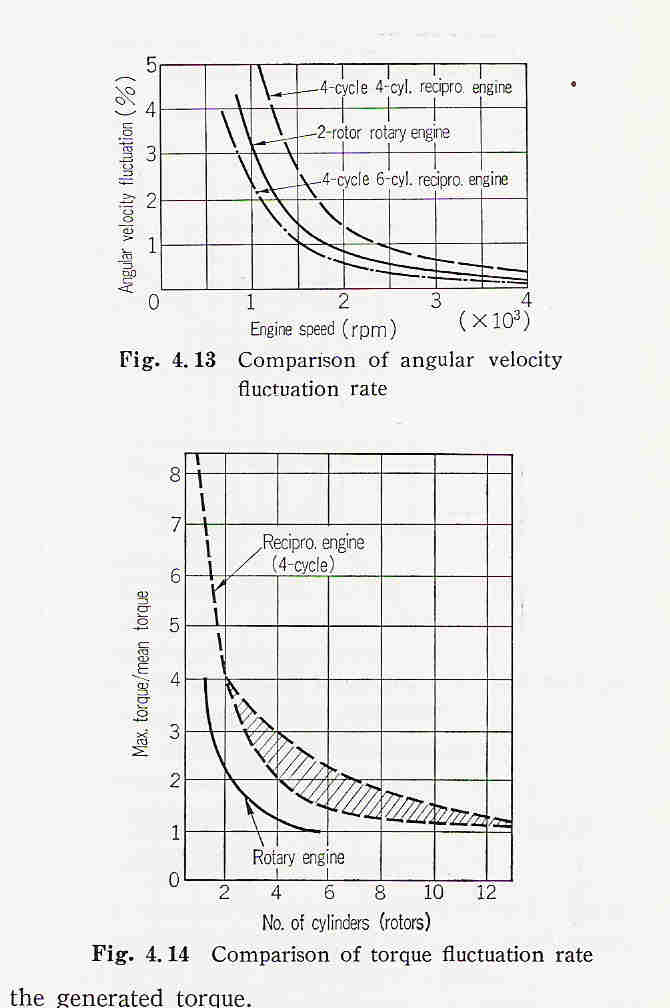
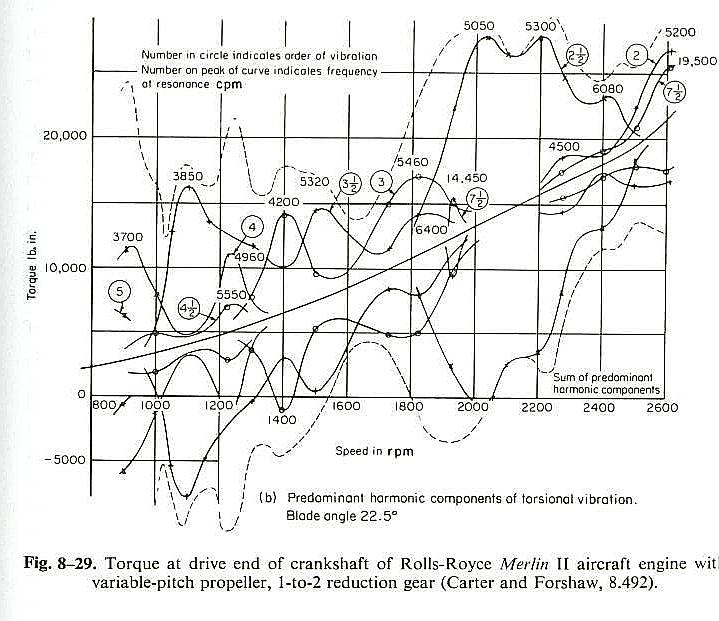
No I think you are wrong about that. Here are some more charts from
Kenichi Yamamoto's 2nd book, also called Rotary Engine, published
by Mazda in 1981.
BTW I forgot to mention the fact that the rotary engine, in all
of its configurations, one, two, three or four rotors has never
required a torsional dampener. Almost all six cylinder and above
piston engine are equipped with torsional dampeners. Even the
vee eight cylinder engines. My original six cylinder O-470 engine
in my C182 had only two. With the second 1500 hour overhaul the
crankshaft was a mass of cracks. When I traded it in
to Continental and picked up my newer version I specified the 2000 hour
TBO engine version with four dampeners instead of just two.
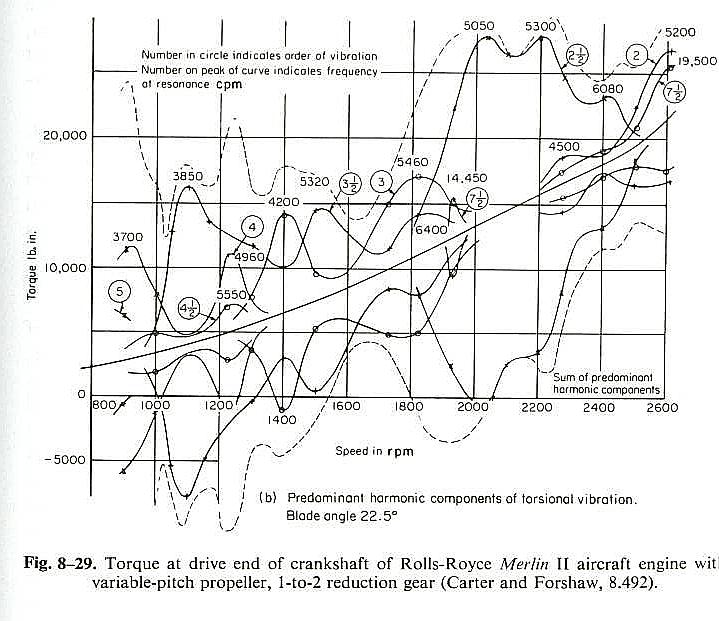
The last chart is of the Merlin which was a night mare for RR
to develop.
Paul Lamar
The Rotary Engine NewsLetter. Powered by Linux.
ACRE NL web site.
http://www.rotaryeng.net
Copyright 1998-2005 All world wide rights reserved.