Flyable Porsche as opposed to a roadable airplane.
Structurally speaking high buck cars and airplanes are
converging. This is about what I had in mind for a roadable
aircraft fuselage. The weight on this chassis is 175 pounds
plus 45 pounds or 220 pounds. Not bad for a fuselage.
Also in this article I might add Porsche got it right for weight
distribution and aerodynamic down force distribution. See the attached
OCR text. This correlates well with what I said back in 1968.
http://www.rotaryeng.net/who.html
It is hell to be 40 years ahead of your time :)
Mazda and the dumb automotive press are still hung up on
50:50 weight distrubtion. What they should have done is move
the Mazda 3 power train to the back of the Miata. The next
thing after that would be a front drive Mazda 3 with a rotary
and then a new mid engine rotary powered sports car.
But no... what we get is a warmed over 1950's English sports car
with a four cylinder boing boing..
HIGH-PERFORMANCE Composites July 2005
"Aerodynamics and downforce One of the main considerations for a race car design is
aerodynamics, two components of which are lift and drag. At the Carrera GT's top
speed of 330 kph/205 mph, aerodynamic lift forces could significantly reduce
stability. To develop sufficient downforce without creating a negative influence on
the car's drag coefficient, Porsche designed a carbon fiber underfloor cover based on
its years of racing experience and then optimized it in wind tunnel trials. The
carbon undercover is bolted to the chassis, engine frame and stainless steel crash
structure, and features diffusers, ventilation channels and air fins. The system,
which includes the undercover, front air ducts and rear automatically adjustable
spoiler, is designed to ensure not only strong downforce (4,000 Newtons/900 Ib), but
an optimum 30:70 distribution of downforce between front and rear axles, respectively."
Paul Lamar
As a member of the automotive press you recently defiled, let me remind
you of a few facts:
1 I've been doing this for 34 years. What have you done that long?
2 I told you years ago there would be no rotary in the MX-5 (no longer
Miata)
3 I have never been a fan of 50-50 axle loading. I constructed my own
mid-engined kit car in 1969-70 and drove it cross-country upon
completion. One of my favorite all time rides was in the Mercedes C111,
the last interesting car built by DB
4 The next rotary application by Mazda is likely to be a 2+2 two-door
coupe revival of the RX-3. Transferring left to right, front or back,
will be difficult due to a tall tunnel
5 The Porsche Carrera GT is well constructed but costs $450,000 and
weighs more than a $68,500 Corvette Z06. The two are comparable in
performance.
out, DS
I was not talking about you. I was talking about R&T and Larry Webster
in C&D Sept 2005 page 69. You are relatively well educated in this
regard since you came to my race car engineering seminar in 1973 :)
You know exactly what I have been doing.
They can change the name all they want it is still a Miata.
If Mazda designed a front drive transmission for the rotary there would
be no problem "Transferring left to right."
612 HP, 124 MPH in 9.9 seconds and 205 MPH top speed is hardly
comparable to a Corvette Z06 not to mention 225 pounds of downforce
at 100 MPH. I'll admit the $444,000 price is a bit much :)
BTW I saw your mug on the Speed Chanel recently when you went aprox
180 MPH in a Chevy econo box something or other at Bonneville.
Not bad for an old man :).
PL
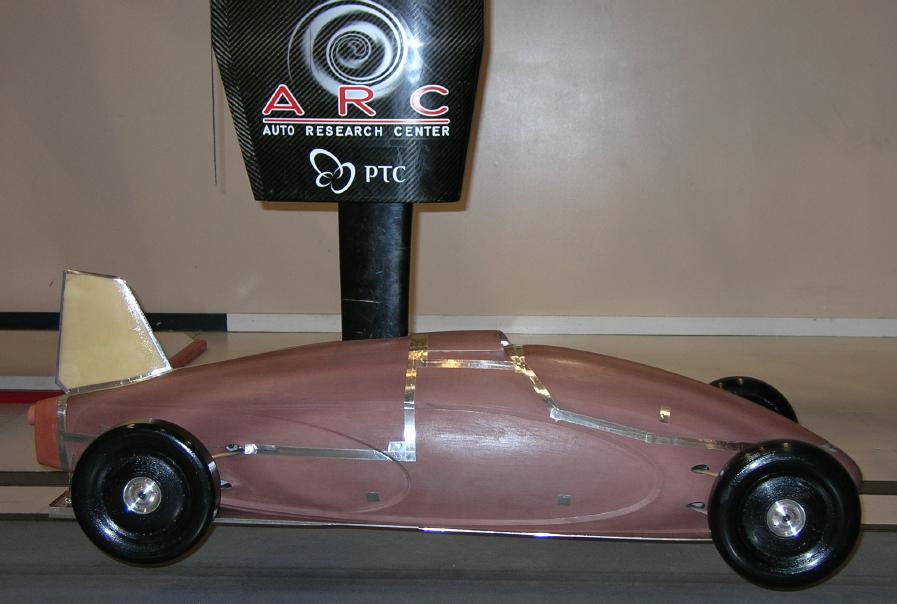
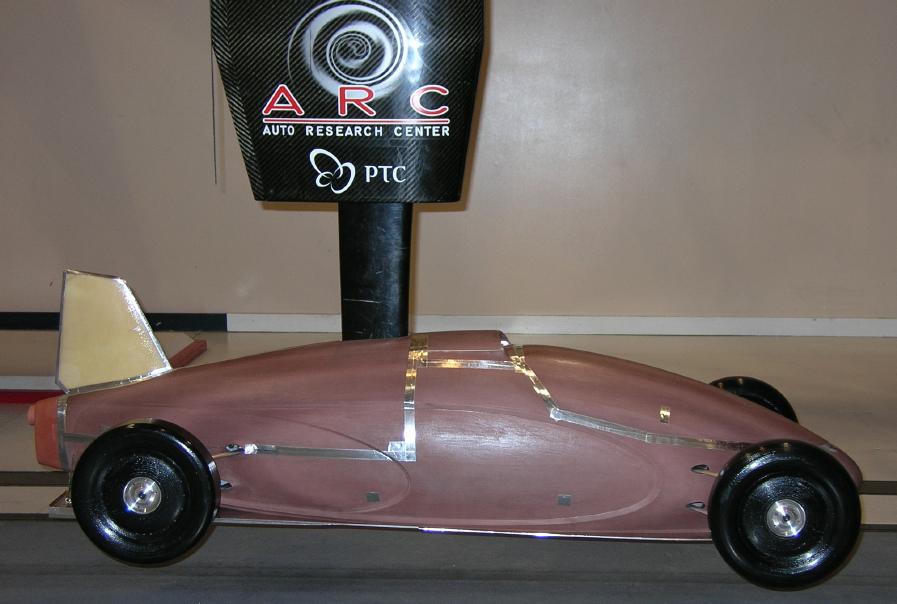
I spent last weekend doing coast downs in Arizona. It's a belly tank
lakester with supercharged ecotec power, not a Chevy econobox. A
40-percent scale model was built and tested extensively in a high-dollar
Indianapolis wind tunnel. It has a splitter in front and diffuser in
back. Plus a giant weather vane to keep it straight. The tunnel said
the vertical fin added neglible drag.
I drove it with one hand to 185 last year. With more power and reduced
drag--such as smaller diameter tires--we are aiming for 200+. I already
have my club hat so it's only to update my membership for the 21st
century. You are welcome to attend if you've got a composite plane that
won't rust after landing on the salt. ds
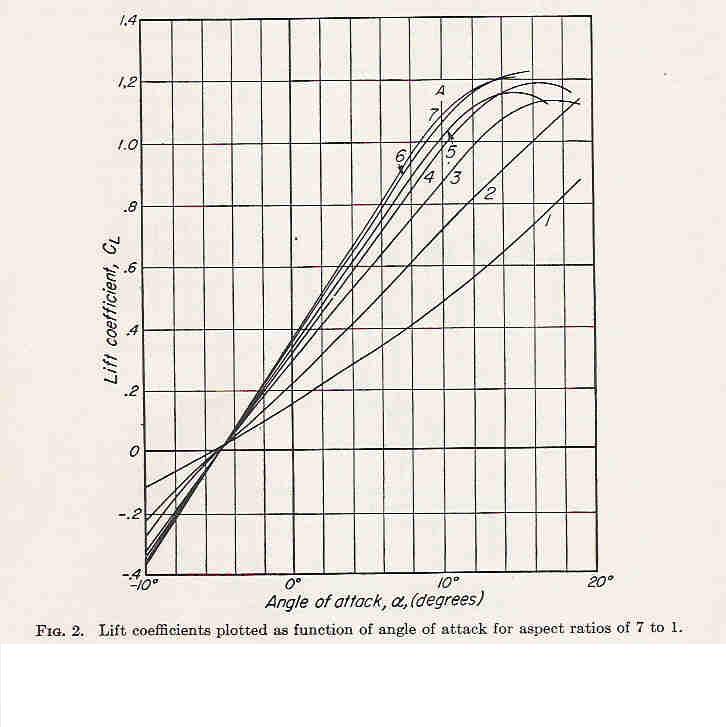
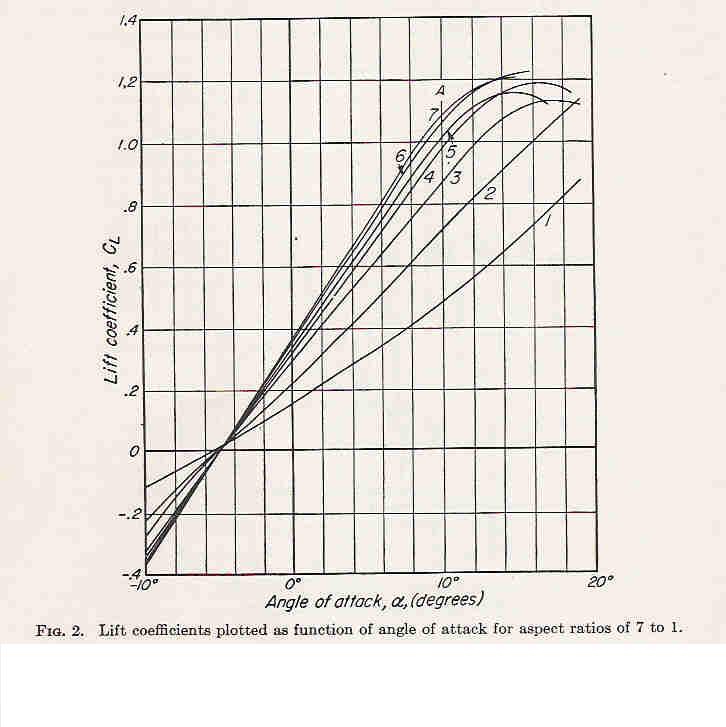
I think you are going to need a little downforce in the back.
That fin will not have enough aerodynamic stiffness to keep
the car straight enough. A fin with an aspect ratio of one or two
will not generate a lot of restoring side force until
the car gets several degrees side ways. See the attached chart
from Von Doenhoff.
The rear tires on the other hand, with a bit of downforce to
compensate for the loss in cornering stiffness due to the
traction required to go 200 MPH, will provide the needed
cornering stiffness. You should know that.
Craig Breedlove learned the hard way in his rocket powered
land speed record car when he removed the wings between
the body and the rear wheels I had designed. The car subsequently
crashed. Fortunately he was not seriously hurt.
I hope I can say the same thing about you.
Paul Lamar
------------------------------------------------------------
I am not planning on crashing. We're putting a mere 300 hp through the rear tires.
We have ample rear down force from the diffuser. a few tunnel shots are included. ds
--------------------------------------------------------------------------
300 HP at 200 MPH (293 FPS) is 563 pounds of tire thrust.
One HP is 550 pound feet per second.
If the salt coef is .5 that is about wheel spin conditions for the
1000 pounds of weight you have on the rear tires. That small fin will
not come close to saving your bacon. Run the numbers on the fin Donald.
Figure the area and the aspect ratio of the fin and calculate the
restoring force and moment as a function of yaw angle. It won't
be much.
I would measure the downforce full scale you have on the rear wheels.
Don't rely on the wind tunnel. You will need quite a bit of downforce
to handle the reduction in rear tire cornering stiffness.
Make it adjustable.
Run the numbers Donald.
In case you have forgotten take another look at what happened
to Jim Medere.
http://www.rotaryeng.net/
>>>>
ROTARY VIDEOS/SOUNDS
>>>>
..... I told him there was too much downforce on the nose! Bonneville RX7 crash.
next message.......................
Mount a five foot square wing running at up to a -10 degree angle of attack
on top of the fin to form a T-tail. Make the length the total width
of the car to maximize the aspect ratio and minimize the induced drag.
Say the car is six feet wide than the wing should have a 10 inch cord.
The dynamic pressure is 100 pounds per square foot at 200 MPH
so with a C sub L of one you will get up to 500 pounds of down force.
Paul Lamar
We have the best aero boys at GM on the case. The 150-100 mph coast down tests had
LVDTs to monitor wheel travel/loading. We have plenty of wheel load and stability.
We don't need no stinking drag producing wings. It's a belly tanker not an air
plane. ds
Well then how much down force have you got?
They may be aero guys but they no nothing about tires. That is the trouble
with GM engineering. They keep forgetting what they learned the previous year.
The drag of the wing will be minuscule if you make it as wide
as the car. Induced drag coef. of the wing at -5 degrees will
be .25/ pi X A or .011 times 50 X 100 or 55 pounds drag worse case.
29 HP at 200 MPH.
That diffuser will have more drag. No downforce is free.
If diffusers were more efficient than wings no airplanes would have wings.
They would have diffuser instead. GM assigned you a bunch of wet behind
the ears engineering puppys.
OK don't say I did not warn you.
BTW the .5 salt coeficeint is a high number. I am giving
you the benefit of the doubt.
Paul Lamar
The Rotary Engine NewsLetter. Powered by Linux.
ACRE NL web site.
http://www.rotaryeng.net
Copyright 1998-2005 All world wide rights reserved.