Doug,
If you adviser tells you this it goes against the advise of all the
experts
that balance Rotaries.
I take hart that Hayes send out their engines for balance.
The rotors are indeed FULL of oil when in the engine, they do have their
oil
replenished via e-shaft jet. Only when the rotor is full does the oil
dribble onto the stationary gear ( the other side).
See Photo's attached.
Now only when the individual rotor volume ( weight) has been established
can
the assembly be truly balanced ( DRY).
It may be that they don't disclose this step to everyone or Hayes don't
even
know it's part of the process. Engine balancers do keep their secrets -
believe me when I say it has to be done.
I do hope you appreciate the insight into this process, it's very
important
to understand the steps. For instance if you were to have the engine
balanced by an engine balancer who normally didn't understand this
process - it wouldn't turn out too good. Even if the balancer were to use
ONE single volume weight, it won't turn out so good. Every series and
different compression rotors have different volumes, therefore different
weights.
The next step is, what else is added to this volume weight for balancing
purposes, side seals, corner seals etc.
George ( down under)
Do me a favor George and fill the rotor with oil. Measure how much
it takes and divide by four.
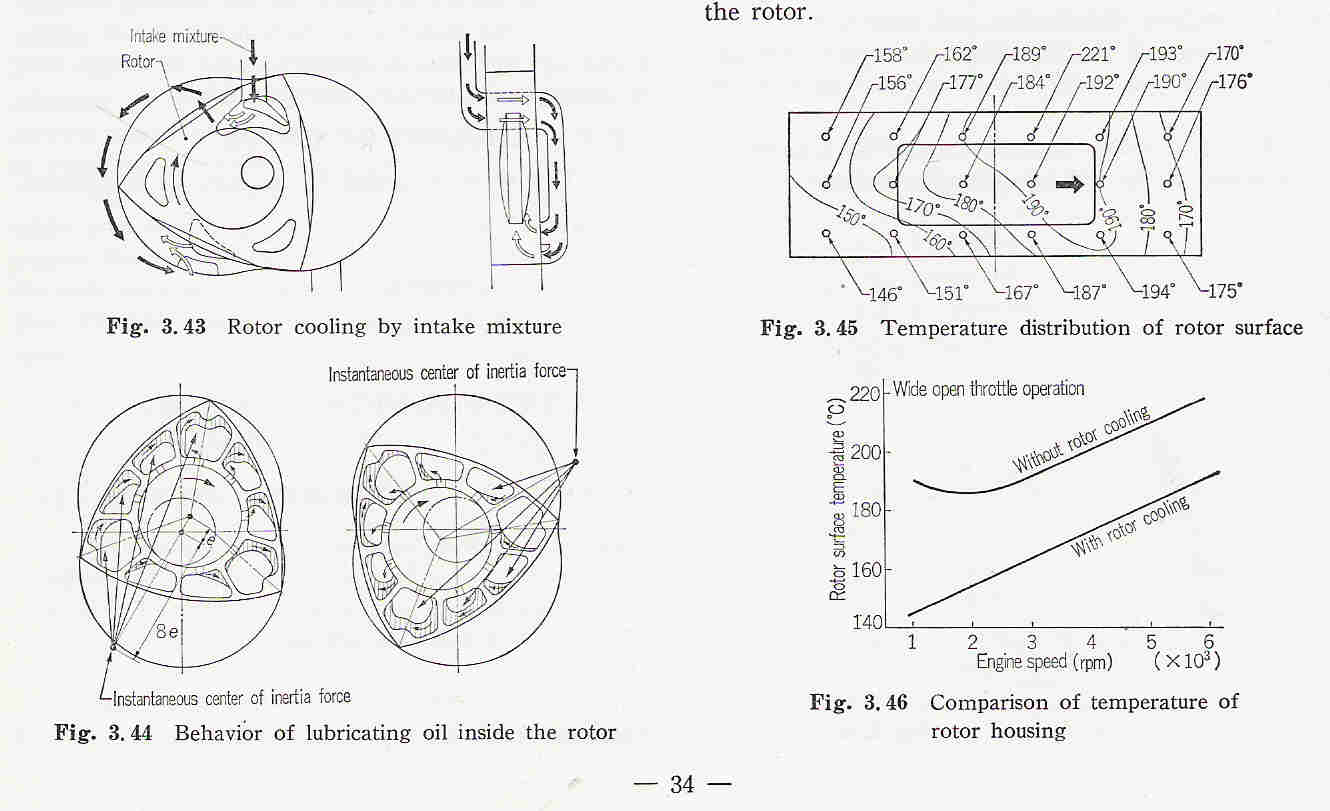
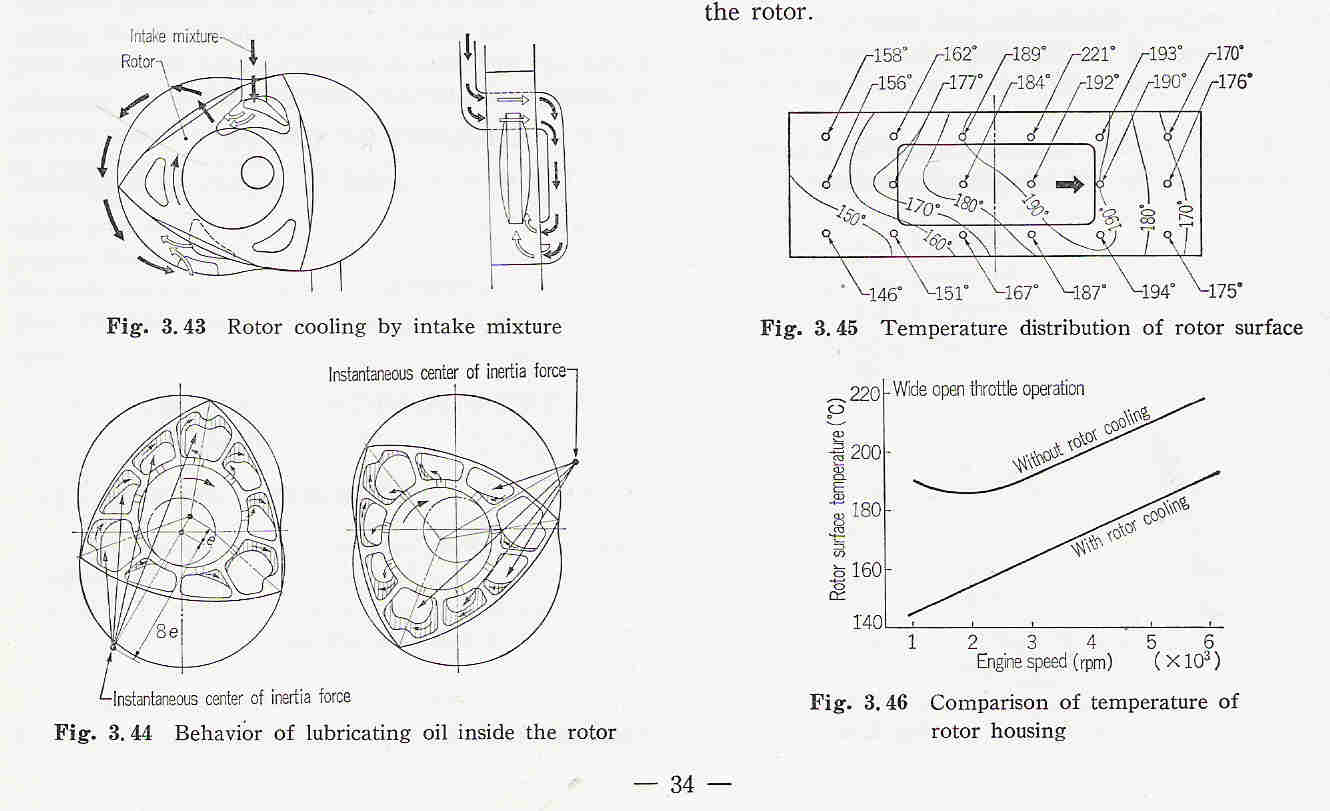
This is an illustration from K. Yamamoto's book Rotary Engine
1981 edition published by Mazda of how much oil is in the rotor
at any given moment. It changes degree by degree as the e-shaft revolves.
It is impossible to perfectly balance the engine by loading a
quantity of oil in the rotor.
Paul Lamar
Paul,
If you want a rule of thumb try 450 grams ( for oil only). This IS different
for different rotors. Filling the rotor is different statically as compared
to dynamically. Dynamically get the centrifugal force to place the oil where
it would be in motion in the engine, this provides the pass for the oil to
escape the rotor through the stationary gear side and gives the best full
rotor volume weight.
Why would you want to divide by 4?
The rotor stays FULL OF OIL, once full and running, by way of centrifugal
force i.e. My advice is the volume does NOT change with position, other than
when it stops.
Your right Paul it is impossible to balance the assembly by just filling the
rotor with oil, all the other steps have to taken into consideration as
well.
BTW these are not my opinions but those who balance the rotary assembly
professionally.
It is true I am yet to establish this myself, however I'm more prone to
accept the professional advice, than to accept what has been supposedly
stated by Hayes, when he sends his out for balancing.
George (down under)
I think you missed seeing the illustrations I sent.
These were done by the designers of the Mazda Wankel engine.
Here they are again. This is what the oil in the rotor looks like when
the engine is operating. It is a long way from full of oil. This is
fact and not opinion. Probably done by a transparent plastic
engine rotating at high speed and captured with a high speed
motion picture camera.
BTW there are a lot of "professionals"
out there that may have balanced many engines and rebuilt thousands
but have never seen nor understood the engineering information
on the rotary available in many SAE tech papers and the tech books
and manuals provided by Mazda over the past 45 years. One does
not need to understand the Wankel on an engineering level in
order to take it apart and put it back together.
Let me say this again in a slightly different way.
The amount of oil in the rotor and its position at any given moment
changes degree by degree as the e-shaft revolves. It is impossible
to perfectly balance the engine by loading a quantity of oil in the
rotor. If one truly understands the motion of the rotor and Newton's
laws of motion one will know this to be true.
Paul Lamar
--
The Rotary Engine NewsLetter. Powered by Linux.
ACRE NL web site.
http://www.rotaryeng.net
Copyright 1998-2005 All world wide rights reserved.