Very well, Paul, here are my first rotary engine questions to throw your
way. I should admit at the onset that I do not have an engineering
degree, but I have always been obsessively fascinated with all types of
engines and related engineering and to the extent that one can
self-teach these things I think I understand the principle of operation
of the brilliantly elegant rotary/Wankel design.
In any case if I can get this bottled-up set of questions unloaded, I
promise to settle down with the density of future questions! Here goes:
1. As to the standard convention of how displacement is defined for a
rotary engine, I am curious whether it is (using one rotor in this
example for simplicity):
(a) the displacement for one of the three apex-to-apex volumes
multiplied by 3, i.e., the total displacement for 1 complete rotation of
the
_rotor_, or
(b) just the displacement of one of the three apex-to-apex
volumes, i.e, the total displacement for 1 complete revolution of
the
_eccentric-shaft_ (or 1/3 of a complete rotor rotation).
It would seem to me that the above approach (a) would be
the more logical way of defining it...or at least for an
apples-to-apples comparison with other positive-displacement engines
like the piston geometry...since one could simply view the eccentric
shaft for this purpose as a built in 1:3 step-up gearing that the piston
engine lacks. If using approach (a) what is the displacement of the
stock RX-8 engine and the associated maximum horsepower per liter?
2. I understand that gas flow resistance and/or inertia typically limit
maximum mean piston speed to somewhere around the 8-15 m/s range, give
or take. This is supposedly pretty much irrespective of engine size,
and so to me makes redline rpm a poor-quality comparative piece of
information as max rpm should then basically scale inversely with engine
scale for a given geometry to maintain the same mean speed. I read that
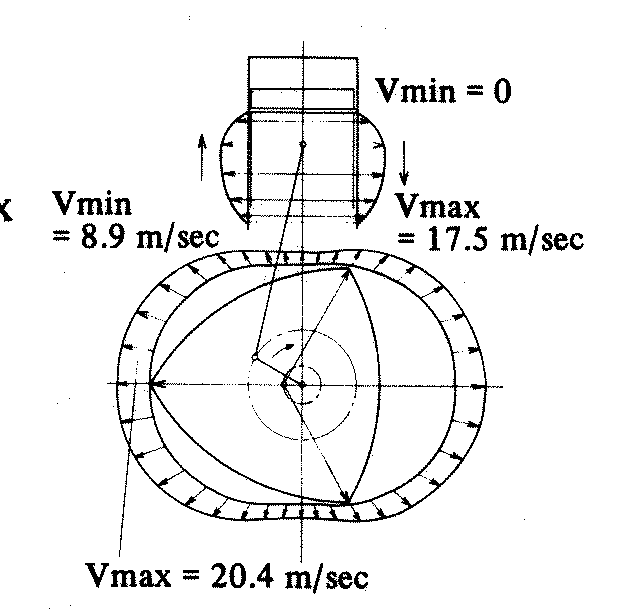
redline for the RX-8 engine is 3000 rotor rpm, making for a 9000 rpm
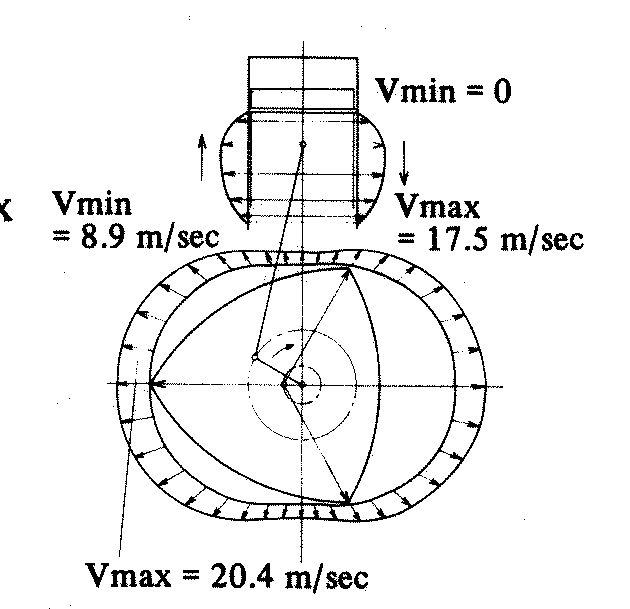
output eccentric shaft. At this redline speed for the RX-8, what would
be the approximate mean apex-seal tangential velocity (mean over the
cycle)? I am very curious how that mean tangential apex tip velocity
speed compares to the mean piston speed of a high performance piston
sports car just to get a sense of comparative max sliding
velocities within the two types of engine geometries. Also, is the max
tangential speed of the rotary engine mainly limited by gas flow
resistance, component stresses, friction, wear, dynamics...?
3. Wankels are rotary engines in that all the primary parts amazingly
rotate. Nonetheless a single rotor/chamber is inherently dynamically
imbalanced from an inertial standpoint as I understand it. The CG of
the rotor is revolving around the axis of the output shaft,
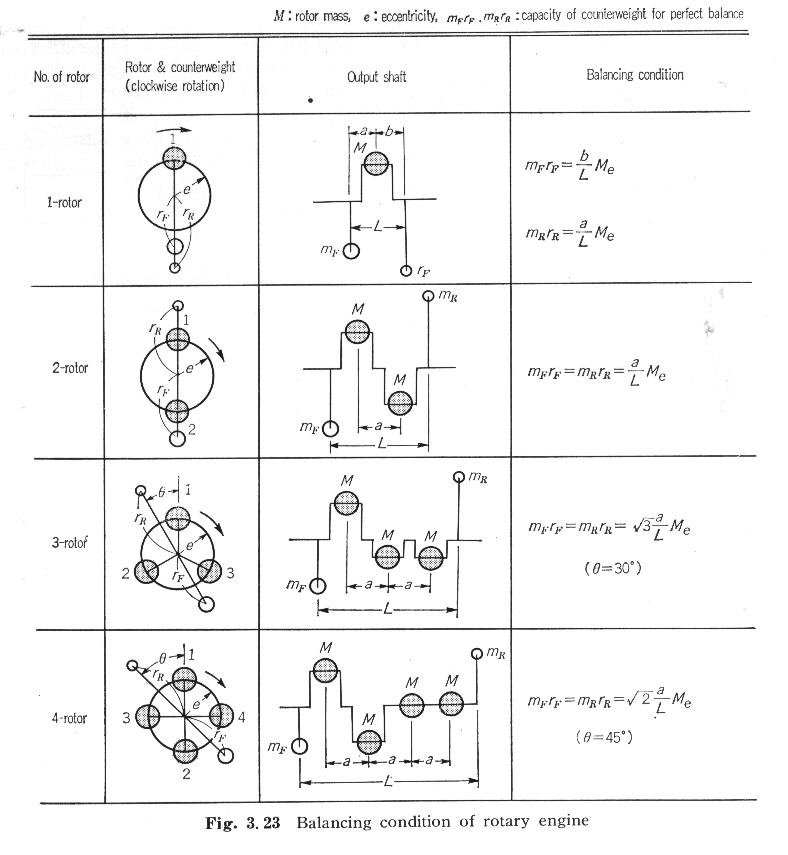
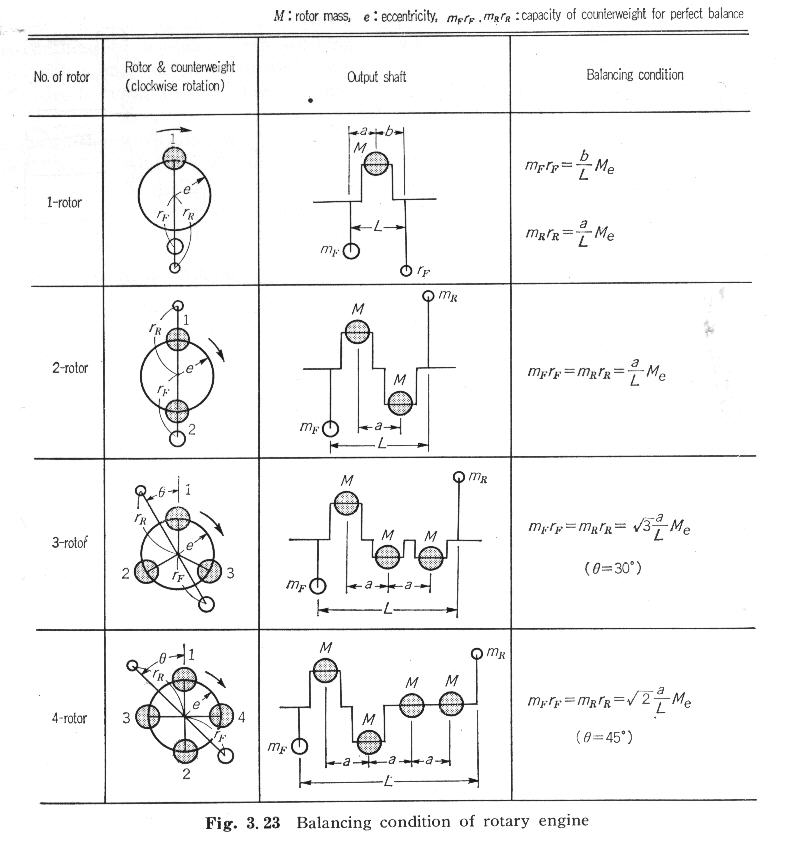
creating the dynamic imbalance. Is this correct? If so, is it possible
to inertially dynamically balance a Wankel in all axes and across
varying speeds by using two or more chambers in line that are
out-of-phase, as I understand is a pretty normal arrangement?
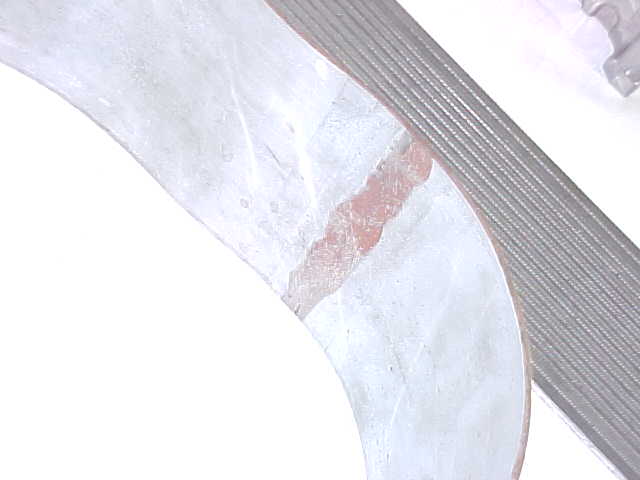
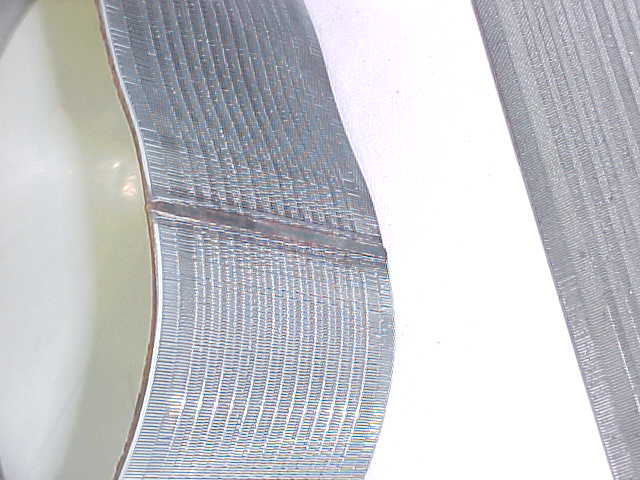
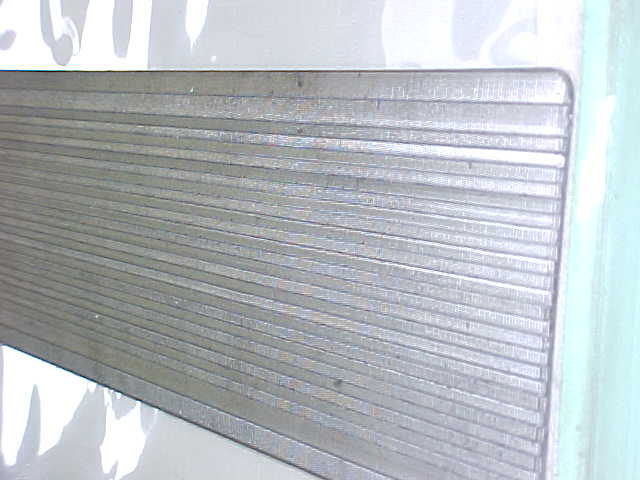
4. I once looked up close at a later model RX-7 center housing in a
shop and saw that the inner surface of the chamber sure seemed like a
different material than the rest of this part. At each axial end-face
near this different looking inner surface was a tiny zigzagging toothed
pattern at the interface between this inner surface material and
the main material for the housing. I assumed this inner surface was to
reduce wear or friction from the apex seals, but that tiny zigzagging
tooth pattern at the ends really threw me and I'm wondering if you could
explain what is up with that. Was this inner chamber surface material
sprayed inside, or a separate piece that was pressed in, or just my
imagination? Does the RX-8 chamber surface have the same sort of thing?
Sorry if I'm misguided with any or all of these questions -- I look
forward to the light of truth -- whenever and to the extent that you
have time.
Thanks much, Sandy
1. The displacement is taken as only one chamber. Displacement is always
measured on how much air is theoretical pumped (displacement) per rotation
of the output shaft. In other words one rotation of the 13B e-shaft is equivalent
to a 2 cylinder 2 cycle 1.3 L engine or one rotation of a 4 cylinder four cycle
2.6 L engine. All three engines fire twice per revolution
of the output shaft. Another pieces of evidence to support this contention
is a 2.6 L four cylinder four cycle engine with four valves
per cylinder (good breathing) will generate about the same HP as the 1.3 L or
2.6 L Wankel at about the same RPM. Of course the HP per cubic inch of displacement
is really irrelevant. Only racing organizations and tax agencys are concerned.
What really counts is the ability of the engine to generate continuous high
power for long periods of time while weighing as little as possible. That
is the real forte of the Wankel engine.
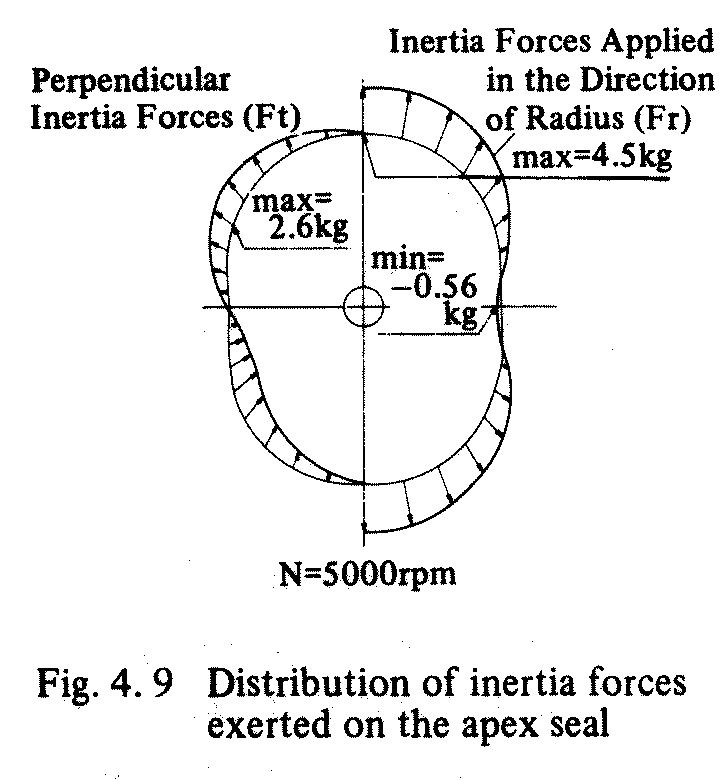
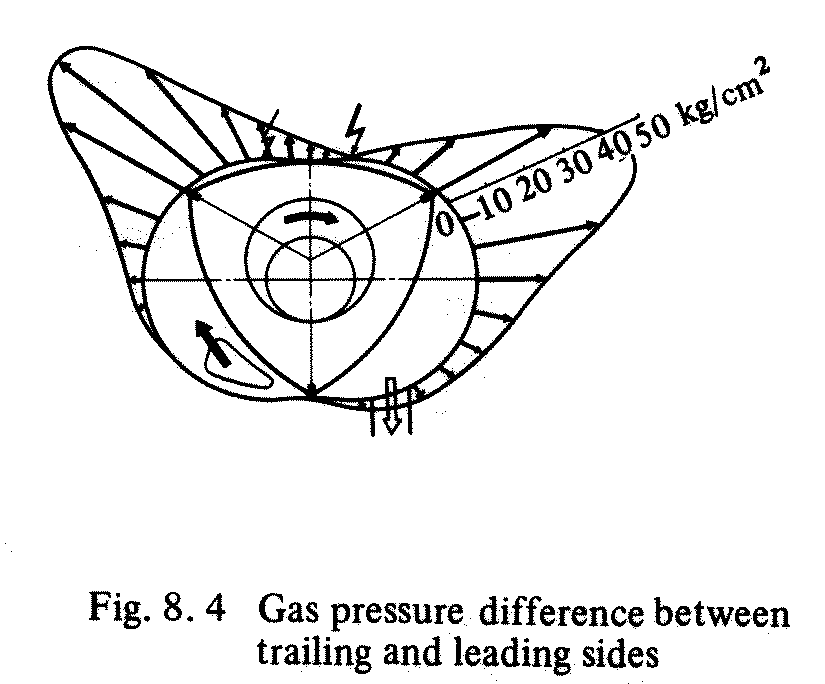
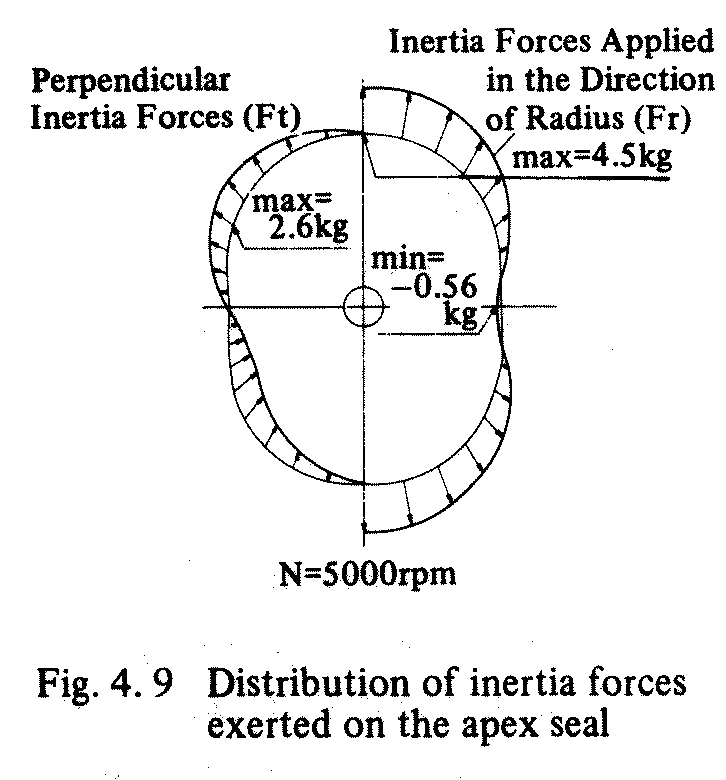
2. There are three major issues here. The sliding velocity of the seals,
the inertial load of the seals on the surface of the rotor housings
and the inertia load of the rotor on the rotor bearings. It would
take a real long dissertation on my part to compare these three
factors to a piston engine. The best I can do is refer you to
a book on the subject. "The Wankel RC Engine" by R.F. Ansdale
published by A.S. Barnes and Company 1969 Lib of Cong # 69-18692
Also The Rotary Engine by K. Yamamoto published by Toyo Kogyo
both the 1969 and 1981 editions. I will say at the current time
the rotor inertia loads limit the RPM of the 13B and RX8 engines
to about 11,000 RPM. Apex seal velocity and inertia loads do not
seem to be a problem at the current state of the Wankel art.
Particularly with the low density high strength silicon nitride
ceramic apex seals.
3. Yes. It possible to completely balance the rotary engine except
for a tiny bit of cooling oil that moves around inside the rotors.
See the attached illustration.
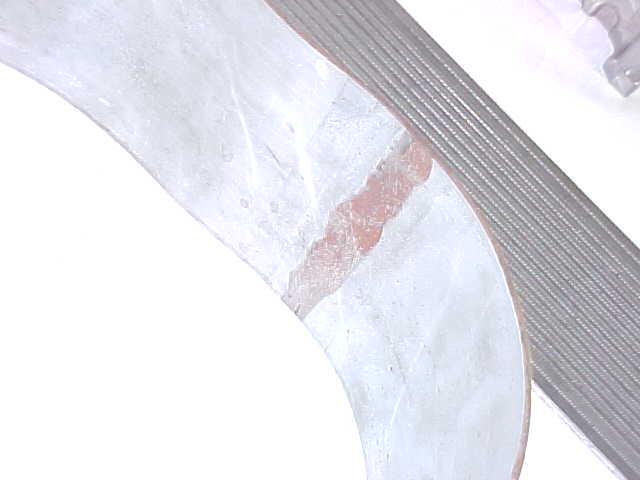
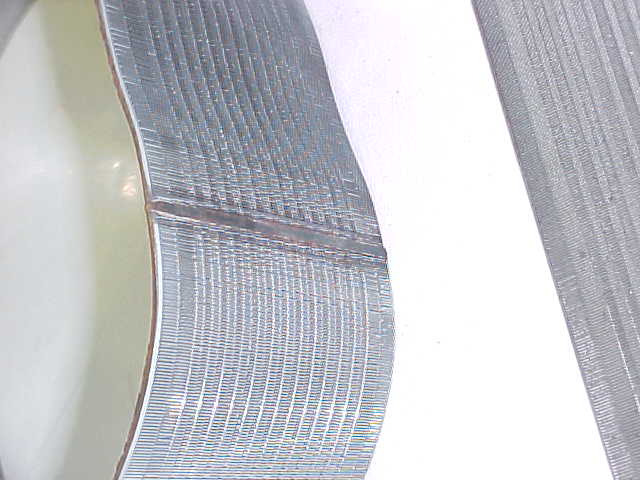
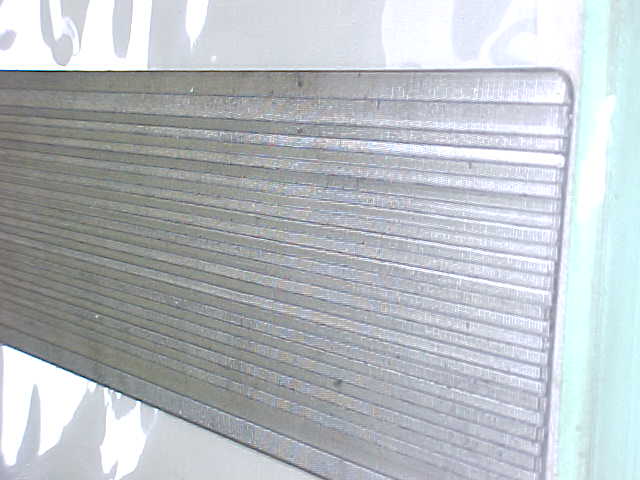
4. Tiny fins are formed on the steel rotor housing liner before it
is inserted into the high pressure die casting mold. This locks the liner
into the aluminum rotor housing casting. Yes the RX8 engine is
the same. The steel liner is then porous chrome plated and coated
with a thin layer of Teflon.
Also read:
http://www.rotaryeng.net/Intro.html
Paul Lamar
The Rotary Engine NewsLetter. Powered by Linux.
ACRE NL web site.
http://www.rotaryeng.net
Copyright 1998-2005 All world wide rights reserved.