All,
Having followed this list and reviewing a number of rotary engine
websites for several months now and I am beginning to form some ideas of how
I might want to power a Cozy Mk IV derivative aircraft. Power requirements
will be in the 260-280 hp range so lets round it off to 300 hp for
discussion purposes. Although that output can be readily, if not
inexpensively, obtained with a turbo 13B two rotor engine, I would "prefer"
to use a normally aspirated engine if possible and practical. So, my
thoughts are now converging on a 20B three rotor power plant. The following
questions are "thrown out" for review, comments and guidance.
Power at altitude concerns.
How much does a rotary engine's power output suffer at altitude,
lets say in the 15,000 - 18,000 ft range, in comparison to a Lycosaurous or
even auto-derivative piston engines? Should one simply "over specify" the
nominal power rating so that a nominal 400? hp naturally aspirated engine
would still yield 300 hp cruise power levels? Temporary use of the "power
headroom" would certainly help take-off and climb performance with a fixed
pitch propeller - CS propellers are unjustifiably expensive to me and it
seems that they are also somewhat fragile in pusher configurations! Or
would a turbo be better to compensate for the power losses at altitude -
probably giving better fuel economy than the "over specified" normally
aspirated engine? If the turbo is the recommended route what would be the
preferred control parameter for the waste gate opening control, turbo speed
or air pressure (a direct function of altitude)? Clearly a waste gate is
needed or a turbo with the turbine section subject to full exhaust flow
would overspend at altitude due to the reduced loading of the compressor
section in the thin air at altitude.
Rotor Seal Lubrication
From my reading it appears that the "best" way to lubricate the
rotor seals is to add a good quality two-stroke oil to the fuel and get the
"misting" effect that this allows instead of using the Mazda oil metering
pump arrangement which uses sump engine oil and "dribbles" oil unevenly on
the rotor seals. Perhaps I am making more of a concern about this than is
really necessary but I worry about keeping the oil-fuel emulsion properly
suspended and distributed in the fuel tanks - and hence ultimately
maintaining even and continuous lubrication of the rotor seals. Certainly
during flight conditions the fuel-oil is adequately agitated by "sloshing"
to keep the emulsion properly distributed. (In many cases engine vibration
would also help agitate the fuel-oil emulsion but the rotary is sufficiently
smooth - one of it's many benefits - I wouldn't want to rely on that!) But
when the plane is parked and the fuel-oil emulsion is not agitated for an
extended period of time between flights then how much does the oil separate
from the fuel? Would it be necessary or even "good engineering practice" to
have a "circulating pump" in each tank that could be run for an appropriate
period of time to agitate the fuel-oil mixture back into an emulsion prior
to start-up (eg 5-10 minutes of circulation before starting the EFI boost
pumps and then the engine)?
Finally, are there recommended suppliers for aviation ready Renesis
engines or is it better to buy parts/systems individually and assemble them
oneself? I am perfectly capable of the build-up but "matching and
integrating" various parts and systems from disparate suppliers is almost
always far more of a challenge than the actual engine build-up?
Thanks and Cheers
Good Building and Flying
Carl
Carl P. Lindon B.Eng., CD.
Lieutenant (Navy)
DGIIP/DIRAP
Work
e-mail:
lindon.cp@forces.gc.ca
Home
e-mail: carllindon at rogers dot com
Power at altitude concerns.
Same as any other ICE. About 80% at 8000 feet
and on down from there as you go higher. Yes over powering does work
but you pay the weight penalty from the larger engine. A 3 rotor
is a bit heavy for a Cozy. People are still working out the best turbo
configuration and tuning. Dave Leonard just located a HKS manifold
for his TO4 turbo so we should see some reports soon. Looks like the TO4
is going to work fine. You would be on the cutting (bleeding) edge
right at the moment. It does look like you will need to street port the
engine and have a good intake manifold if you expect to get much more than
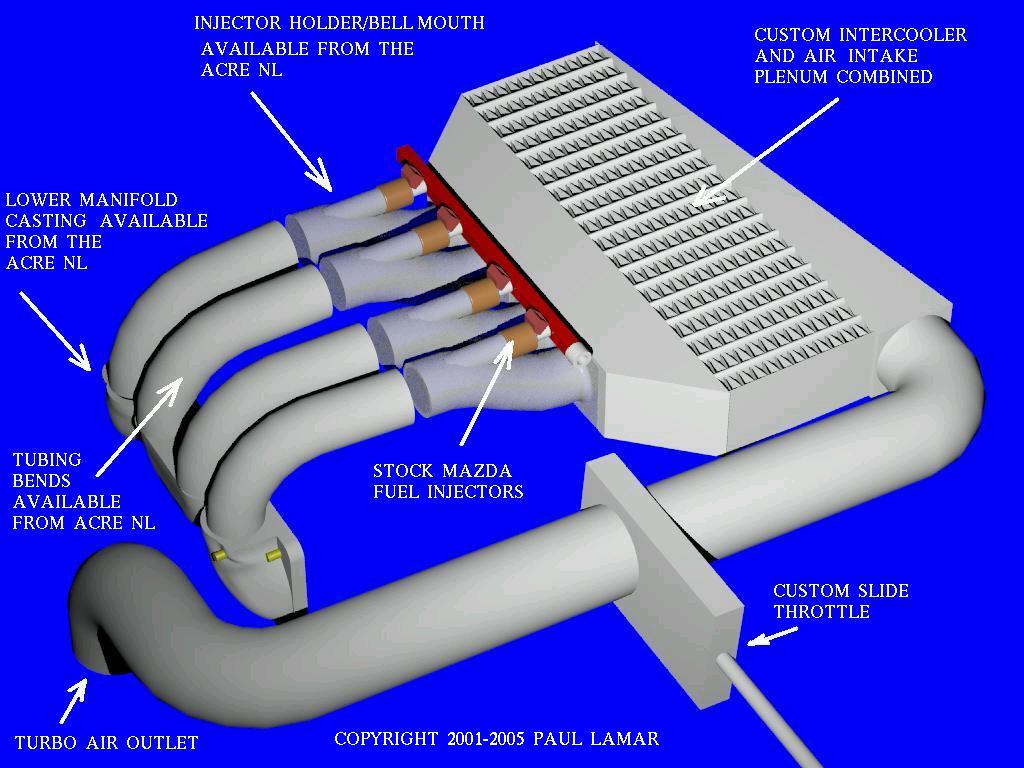
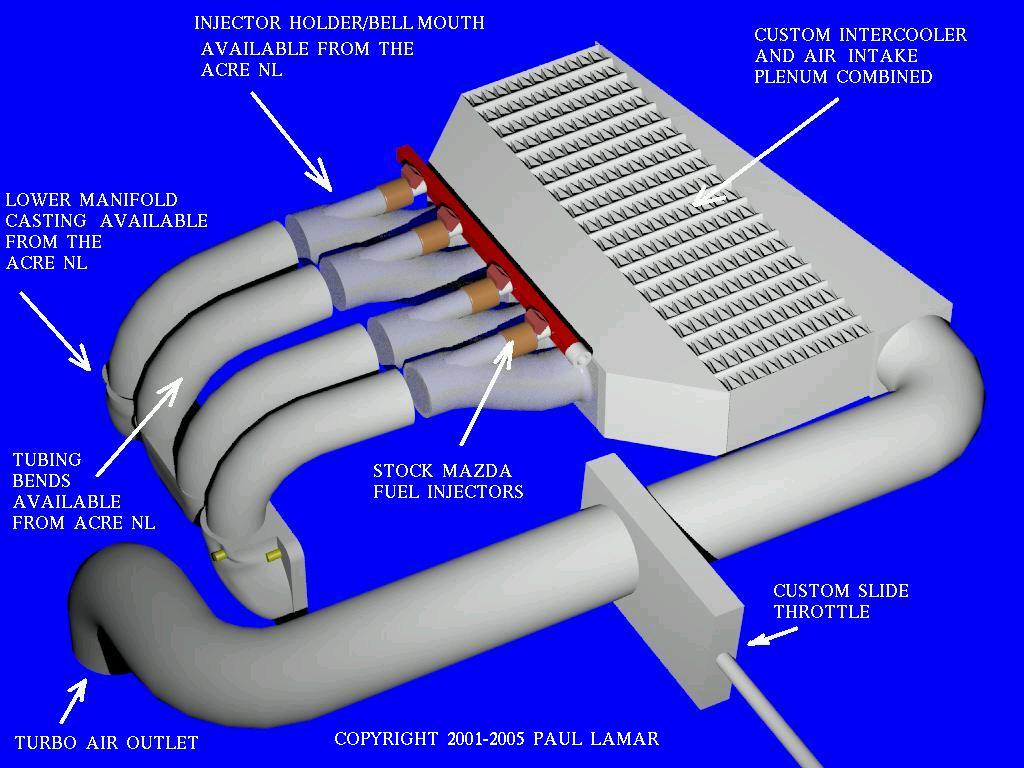
about 200 HP at SL with a turbo. Here is my suggestion for that.
http://www.rotaryeng.net/intake.html
Low pressure loss integrated plenum/intercooler turbo intake system.
Uploaded to this web site in 2001. the parts are sold out but
they can be fabricated from billet and tubing.
Rotor Seal Lubrication.
Mixing 2 cycle oil with the fuel works no
problem. No circulating pump needed. You can also use the stock metering
pump with an adapter made by Richard Sohn that brings 2 cycle oil in from
an aux tank. Richard Sohn
<unicorn@gdsys.net>
I recommend Mazdatrix Signal Hill CA to build your engine for you.
They will run it on the bench for free and on the dyno for more money
if you wish. They know what they are doing. BTW it is not possible to
build an RX8 style side exhaust port 3 rotor right at the moment. Well anyway
not using a stock 3 rotor e-shaft. The one you see racing on the speed
channel is really an old 3 rotor p-port engine. Also not possible to build
an RX8 style effective turbo engine unless you use third gen low compression
rotors.
Paul Lamar
--
The Rotary Engine NewsLetter. Powered by Linux.
ACRE NL web site.
http://www.rotaryeng.net
Copyright 1998-2005 All world wide rights reserved.