>
> Hi
> Anyone have any idea where small ferrous metal shavings average 1\16 of
an
> inch would be coming from? The engine has 32 hours on it. I dropped the
oil
> pan to check the pressure relief valves for dirt. The reason I dropped
the
> oil pan was because the oil pressure had dropped. That's when I found
the
> metal filings in the valve. I found almost a tablespoon of these metal
> filings in the oil pan. I would appreciate any ideas on the seriousness
of
> this situation and suggestions of what to do about it.
>
> Thanks,
> Scott Trask
>
> Well sounds like the oil pump. Who rebuilt the engine? The oil pump
> is a bit tricky to get the key in the right place. Other than the gear
box.
> Which gear box do you have?
>
> Paul Lamar
>
Hi Paul
Thanks for the reply. Atkins is who I bought the engine from, but I was
not
impressed with his work at all. I have the Power Sport gear box that he
installed on the engine. I had metal particles in the oil pan after about
1
hour of running the engine. The reason for me to remove the oil pan this
first time was that he had placed the oil drain for the turbo in the wrong
location. With some helpful advice from Tom Parks, I placed the drain
correctly in the oil pan. That's when I first found some metal filings in
the oil pan. Atkins figured the filings were nothing to be concerned
about
at that time. Later, 15 hours into flying the time off, the gear box had
an
oil leak. Got a new seal from Ray at P.S. which he gave me for free.
After
flying 32 hours off the plane, I began to have problems with the oil
pressure and dropped the oil pan again--finding about a tablespoon of
metal
this time. I had sent Atkins some of the filings. He said it looks like
it
was a spring. On the damaged seal that I had replaced, there was no
spring
that I could find (it was missing off the damaged seal). Ray at PS seems
to
think that the seal may have been damaged when it was first installed by
Atkins.
I could even write more about this fiasco but I'm pretty disgusted with
the
whole mess right now. Atkins will not confess to his possible error here,
so I'll be investigating it myself to see if there is any more damage on
the
engine. Maybe I could ask you--could a guy buy a new engine directly from
Mazda and use all the components that I'm currently using on this engine
(exhaust, intake, turbo, etc)? Thanks for any help you can offer.
Scott Trask
I think investigating yourself is a very very good idea. Could be any
number
of things. If you let the cat baby sit the canary you never will get
straight answer from the cat. It sounds like a second gen turbo engine so
Mazda probably does not sell new second gen engines anymore. My
suggestion is take the gear box off the engine so you can inspect
the gear mesh. If there are no obvious problems there Check the
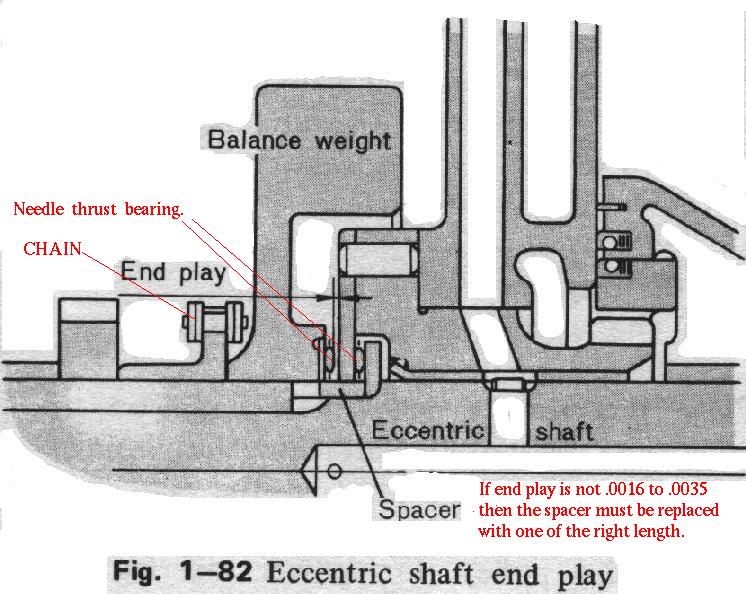
e-shaft end play. If it is not .0016" to .0035" then you have a
thrust bearing problem for sure. Take the front cover off the
engine and inspect the oil pump, oil pump chain, apex oil metering
pump gear drive (if it is still there) and last but not least the
thrust bearings.
It is kind of tricky putting the front cover back on and getting the
thrust bearings set up right but a shop manual helps enormously. It
must be done with the engine vertical.
Front cover on top. See the attached illustrations.
If you are not confident in taking
the engine apart yourself I suggest you send it to Mazdatrix.
I can go down there and watch them take it apart. They are
really good at rotary engines. If you are not comfortable taking
the gear box off I can supervise that as well at Mazdatrix.
I'll take pictures of what ever I find.
Paul Lamar
Hi Scott,
I'm catching this thread late but I think I know what the problem is. What
occurs
is this: Of the two thrust (needle) bearings, the front thrust bearing
(opposite side of the
thrust washer) will side off of the thrust spacer that rests in the center
of the thrust
plate. There are needle bearings on either side of this thrust plate and
the front one
will be the culprit in sliding off. The rear one will never slide off
because it's got the
thrust washer holding its back place. However, the front can slide off if
the front
counterweight is dislogded or moved forward towards the front of the
crankshaft.
During assembly, as Paul has stated, it is best to have the engine vertical
with the
front of the crankshaft facing straight up. This is how I do all of my
assemblies, as
well. It prevents the front thrust bearing from sliding off of the thrust
spacer and
lodging itself in between the spacer and the back of the front counterweight,
thereby
reducing crankshaft endplay to 0.000". Once the thrust bearing is
destroyed, the
end-play dramatically rises and the crankshaft will eventually destroy the
front gear
bearing, the rear thrust bearing, the thrust spacer, and the thrust plate.
The crank,
off-balance, will then start to wobble around and eventually destroy the
rest of the
crankshaft bearings as well as itself. I shipped an engine to a customer
once that
did not originally have the front crankshaft bolt. I should've been more
stern about
not wanting to ship one w/o that bolt, but I made the mistake of letting it
go as-is.
The exact same failure took place and was evident at just under 1,000 miles
in
an automotive setting. The problem that this has happened after assembly is
extremely slim to none; it was done during assembly more than likely. Also,
as with
crankshaft bearings of unknown history, new thrust bearings should also be
used
during every assembly. If any copper bits are showing up in the oil pan,
then it's
evidence of the destruction of a crankshaft bearing.
Are you sure that there was oil in the engine when it was first started?
Did you make
sure to follow proper lubrication and starting procedures prior to cranking
her over?
One more cause of failure that will eventuate in the same chain reaction of
events is a failure to properly press the front stationary gear bearing in
its land
fully. If the tail end of it is sticking up even just 1mm, then the entire
thrust assembly
up-front will be crushed because the thrust washer will not be resting flush
with the
stationary gear, producing the same short endplay stack problem.
B
The Rotary Engine NewsLetter. Powered by Linux.
ACRE NL web site.
http://www.rotaryeng.net
Copyright 1998-2005 All world wide rights reserved.