I have been thinking about the problem of turbochargers Overheating ,
Over running, in most set ups, in the AC rotary conversion . My ideal
is to locate the turbocharger farther Down Stream of the exhaust
manifold where's theirs less heat and pressure to contend with . It's
my understanding that the car manufacturers mount them as close to the
manifold. as possible to reduce Turbolag which isn't as much a
problem in AC as it is with cars .
Clifton
The P47 had the turbo in the tail cone.
Paul Lamar
Was the exhaust pipe pipe on the P47 insulated?
Turbos recover heat and mechanical energy from the exhaust. Moving the
turbo further downstream will reduce the heat energy recovery. I don't
know how efficient turbos are at recovering heat energy in this type of
application. How much cooler is the exhaust stream after running through
the turbo (as compared to running through a locked turbo)?
Regards, Matt
Good question Matt. I only have half an answer.
Dave Leonards exhaust after the turbo runs about:
> Second pic is MAP 37 Engine RPM is 5560.
> Dave has a 2.17:1 gear box. EGT exiting
> the turbo is 766 centigrade or about 1410 F.
So the regular NA 13B exhaust temps run 1600 to 1800 F.
Dave does not have a thermal couple on the inlet to the turbo
so I am not sure what his TIT is.
Paul Lamar
Clifton, your idea is correct, the turbo should be installed some distance from
the engine.
Locating the turbo directly on the engine à la Mazda has a few advantages:
1. Minimized turbo-lag (not an issue in aviation)
2. Compactness of the whole powerplant
3. No primary exhaust manifold and pipe (which are under pressure and can
create a serious problem very quickly in case of a crack)
However, in aviation applications it has two huge drawbacks:
1. At our typically high power-settings, postcombustion is happening within
the turbine housing (no matter how lean a mixture you run... and believe me,
Mistral has been experimenting with the leanest possible mixture settings!).
While we have the same EGTs as Dave's (around 750°C [1382 F]) just out of the block,
the temperatures are way higher (>1,000°C [1832 F]) within the turbine housing and
will fry the wheel within a few dozen hours. A turbo, with all of its
mixing, is a very efficient thermal reactor, but a bit of a sensitive and
expensive piece of equipment to be used as such!
2. The hot section could conceivably be built in exotic Ni alloys resisting
much higher temperatures than the materials used in regular turbos.
However, building a customized hot-section in high-T materials is an
outrageously expensive proposition.
The imperfect but sensible solution is to locate the turbo enough downstream
from the engine so that postcombustion is complete, and the peak in EGT
passed, before the gases enter the turbine. Not too close to give the
turbine a living chance, and not too far (I think the tailcone is an
exaggeration! :-) ) so as to recuperate a good portion of the energy. How
far is far? We'll tell you in a few weeks. It's a question of volume of
the "thermal reactor" (exhaust manifold + primary exhaust pipe) and
therefore of throughput time, more than a question of distance.
We regret this change to our design (because of advantages 2 and 3 mentioned
above), but it seems to be a fact of life and of physics. Hard to argue
against!
We'll keep you informed.
Francois Badoux (Mistral Engines)
Interesting data Francois. Sounds like you are on to something significant.
It never ever occurred to me the exhaust gas temp in the turbo would be actually
higher than the exhaust gas temp coming out of the block. Thanks for that
great info. Explains a lot of what we are seeing.
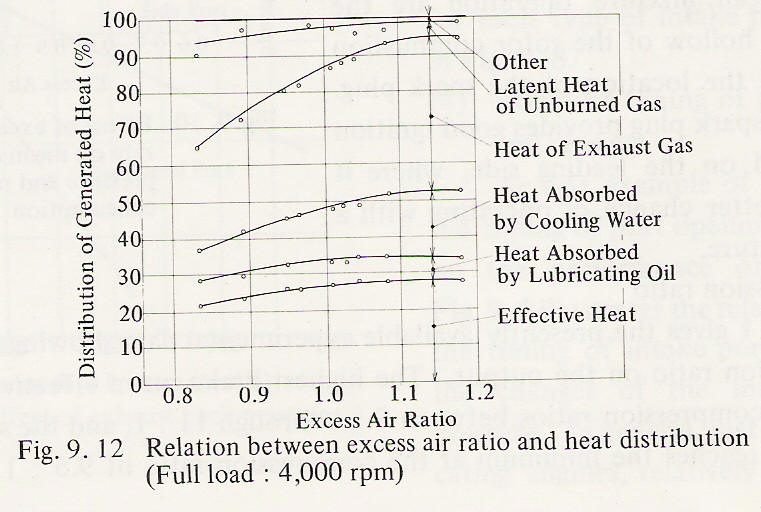
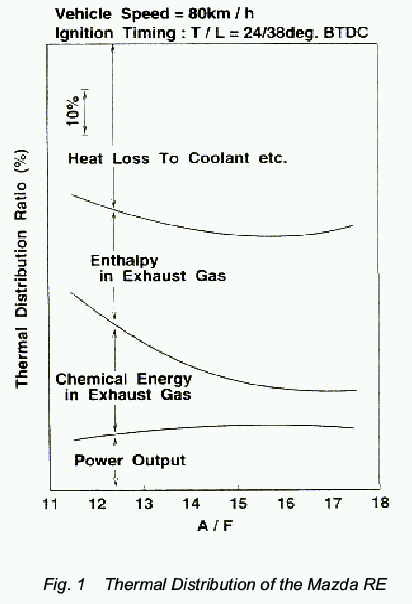
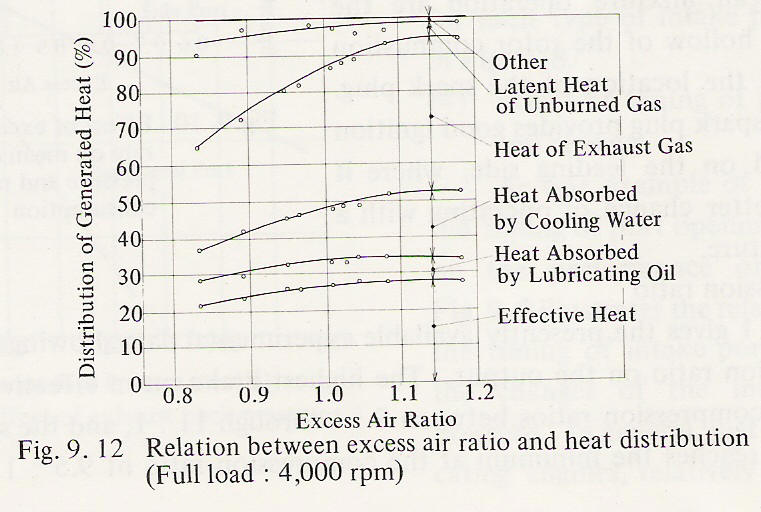
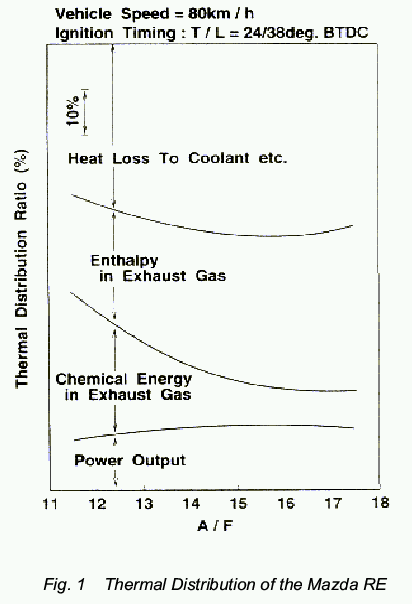
BTW Here is a heat balance chart for
a 2nd gen rotary configuration. Note the high percentage of unburned
hydro carbons labled Latent Heat of Unburnded Gas. The RX8 engine with it side
exhaust ports should be better. The second chart for the RX8 engine is
unfortunately given at a much lower power level (80 Km or 50 miles per hour
probably only about 25 HP?) so it cannot be directly compared with
the first chart.
Paul Lamar
The Rotary Engine NewsLetter. Powered by Linux.
ACRE NL web site.
http://www.rotaryeng.net
Copyright 1998-2005 All world wide rights reserved.