The last time I looked at Mercury outboard spec sheet, the DI was
down on power -cleaner lean burn DI uses up some of your
vol eff and encourages stratified charge - NOTHING is all good good
Vance
Vance,
Good to see you bouncing back and I hope your feeling much better.
Thanks for that info - interesting point on reduced power and
volumetric efficiency, I don't quite understand why - perhaps the much
greater atomised charge takes up more area for less fuel?
However encouraging stratified charge is what I thought we were after
- my understanding of stratified charge was that there was a greater
and more dense charge surrounding the ignition point, which leads to
better ignition and burn of a leaner charge?
George ( down under)
Actually, I bet the DI setup is power limited because you can't get a
single injector with enough dynamic range. They're going for emissions
so they pick an injector which will deliver just a whiff of fuel while
at idle state, but can't flow enough to make big horsepower. Staged
injectors might be a good answer. One DI injector for idle and low
power cruising, and a fire hose in a conventional location to make
launches more fun.
I wonder if the VE numbers are lower because they used an engine with a
little lower compression ratio to control combustion speed - still going
for emissions - lower NOx. Nah. Vance is probably right here..
Turbulent intake leads to better stiring, but lower mass of air injested
for a given operating condition (throttle setting/RPM).
Total speculation on my part.
I think aircraft and especially rotaries can benefit from DI - put the
well atomized cloud of fuel close to the spark plugs, and so that it
pushes the rotor in the right direction equals less crevice loss, better
BSFC. Probably forget the stratified charge intake..
Paul, does the combustion event on the rotary happen slower than it does
on a piston engine for a given output shaft RPM (intake to intake for a
single rotor face)?
Regards,
Matt-
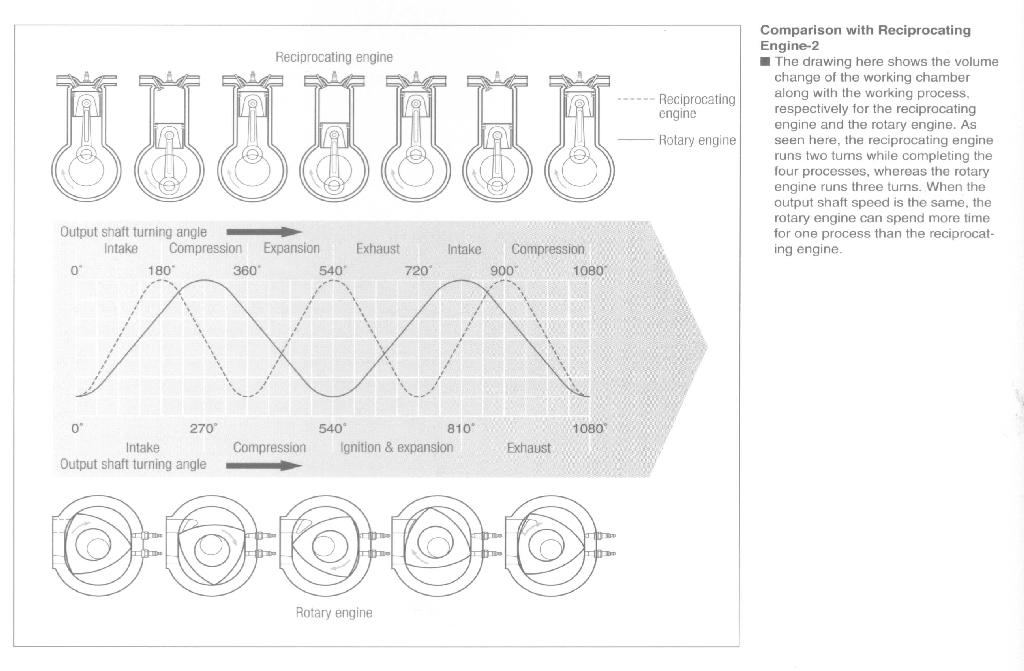
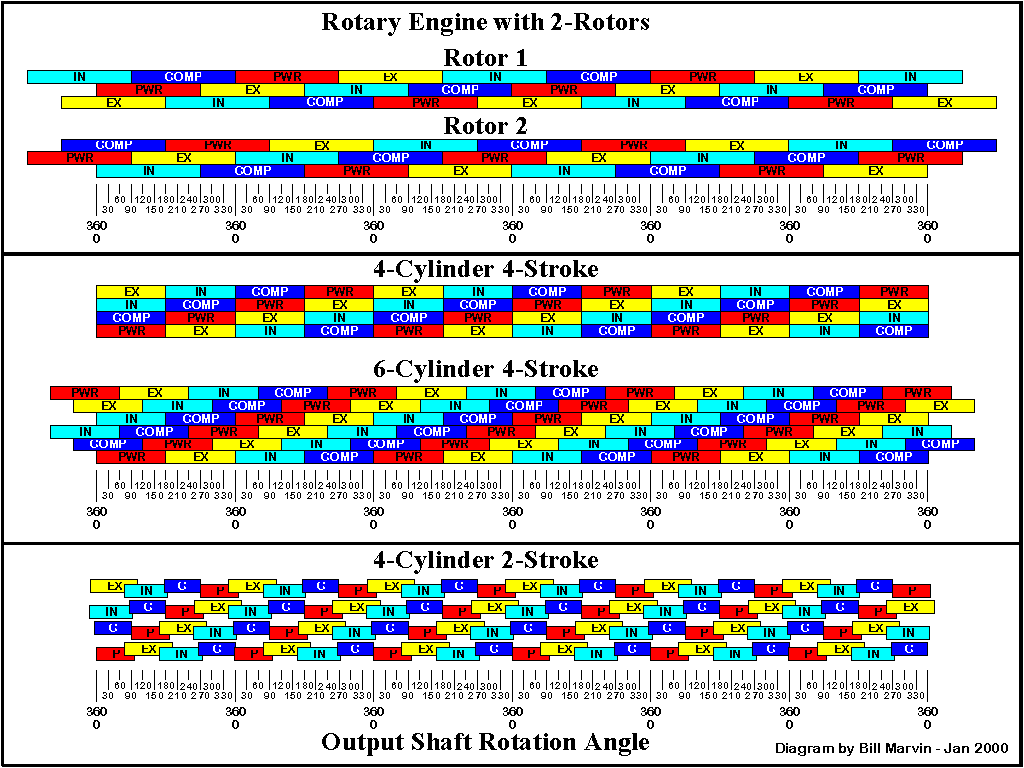
That is a good question. Chapters have been written on the subject. I
suspect there is no direct analogy with a piston engine because
of the moving combustion chamber. Here is some stuff from Yamamoto. Also
a drawing of an old idea I had. Won't work as it will suck
HP to compress the air required. Unless of course the air compressor is
run off the waste exhaust energy alone.
You may be on to something about injector dynamic range.
It might take two direct injectors to get the full benefit.
I can hardly wait to see what Mazda does. A lot of other people
that have tried DI have failed to significantly improve the rotary
engine BSFC.
Paul Lamar
Interesting stuff. Do you have the rest of the text from the first image?
I asked the wrong question.. At 6000RPM output, the rotor is at 2000RPM.
A particular rotor face starts past the intake port at that rate - every
30ms. On a conventional engine at 6000RPM, the piston hits TDC twice for
every opening of the intake port. That's opening the port every 20ms -
effectively 50% more often. Am I thinking about this right? I realize a
single rotor can sort of be compared to a 3 cylinder conventional engine.
Regards,
Matt-
It is three or four pages Bill. You need the book :)
Whole tech papers have been written on the subject.
A single rotor is equal to a 2 cyl four stroke or a one cylinder
two stroke.
After thinking about it some more my air injection idea above
won't work as combustion pressure will leak above the apex seal across
the air injection hole. It is going to take some real ingenuity to
get stratified charge to work on a moving combustion chamber.
I can't wait to see what Mazda comes up with :)
Paul Lamar
The Rotary Engine NewsLetter. Powered by Linux.
ACRE NL web site.
http://www.rotaryeng.net
Copyright 1998-2005 All world wide rights reserved.