Paul
Your comments on a rotary package to replace the turbine in the legend was
very intriguing. What will the turbine Legend really do?
And what does it appear to take to do it ? I do not Know if any were flown
wit V8s to compare.
Incidently equal speeds are in ,And my old friend Parker squeezed past
Greenameyer at 361 and the both beat out the NXTs
Vance
Glad to see you are up and about Vance. I was going to go to Reno but changed my
mind. What does Parker fly? I also take it Jim Wright is flying his NXT.
The Legend was originally designed for the Chevy big block. It flew for
awhile but the cooling passages in the heads, among other things, were not up to it.
The designer, Jeff Auckland and I had a long talk about it at Copper State a few
years ago. He gave up and put a turbine in it.
I was at this Symposium below. I talked to the engineers at Orenda there about their
failed $50 million dollar effort to get the Chev big block to work. They told me they
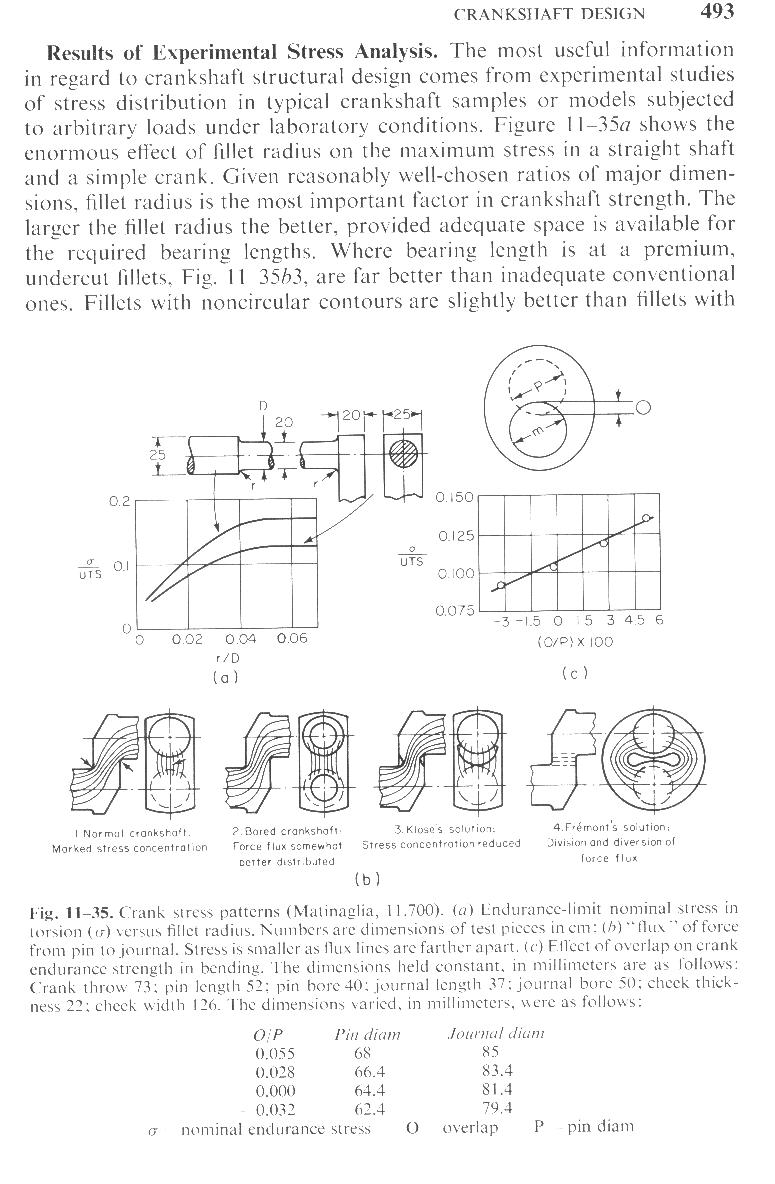
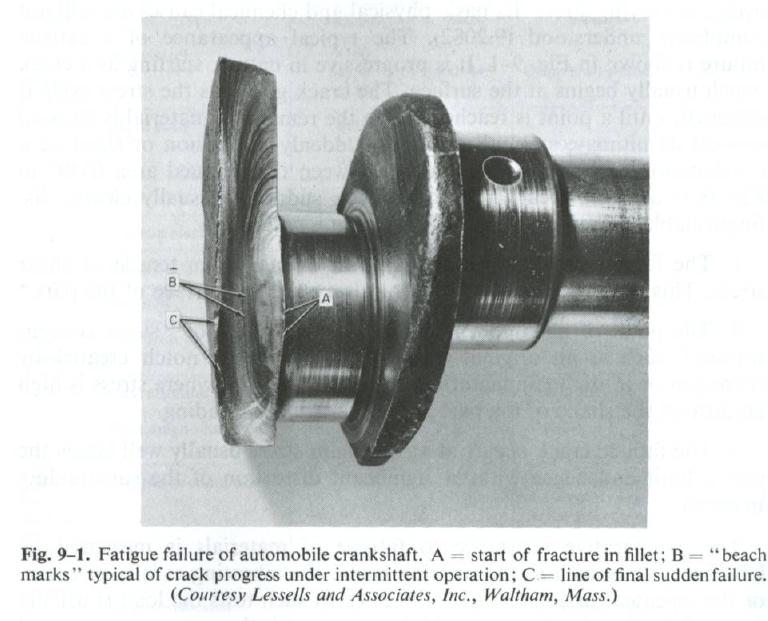
would kill their grandmothers for 1/4 inch more bore spacing so they could put real
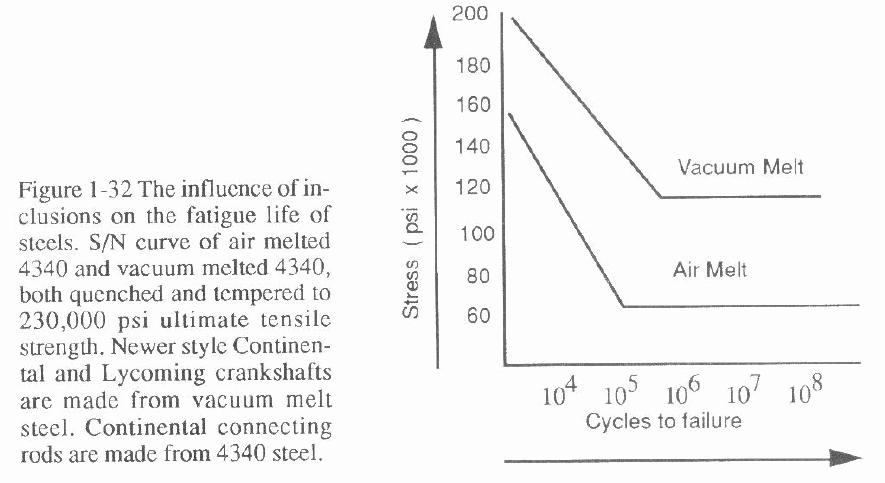
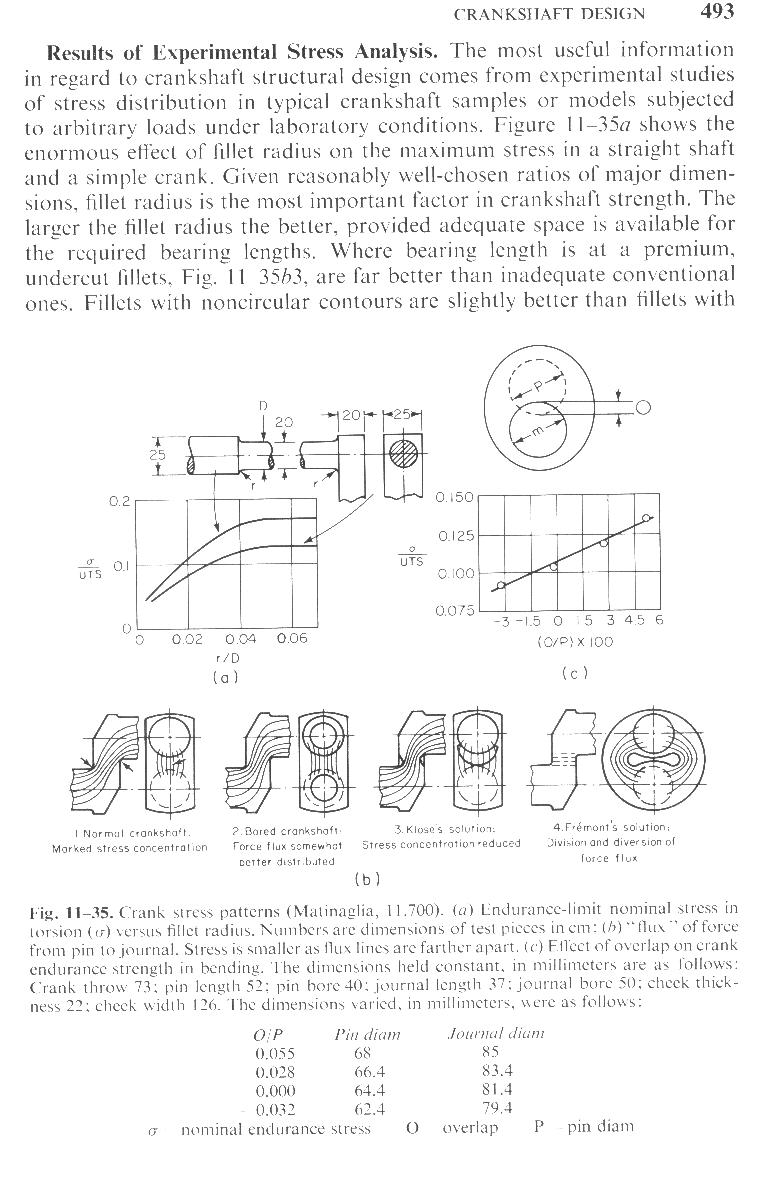
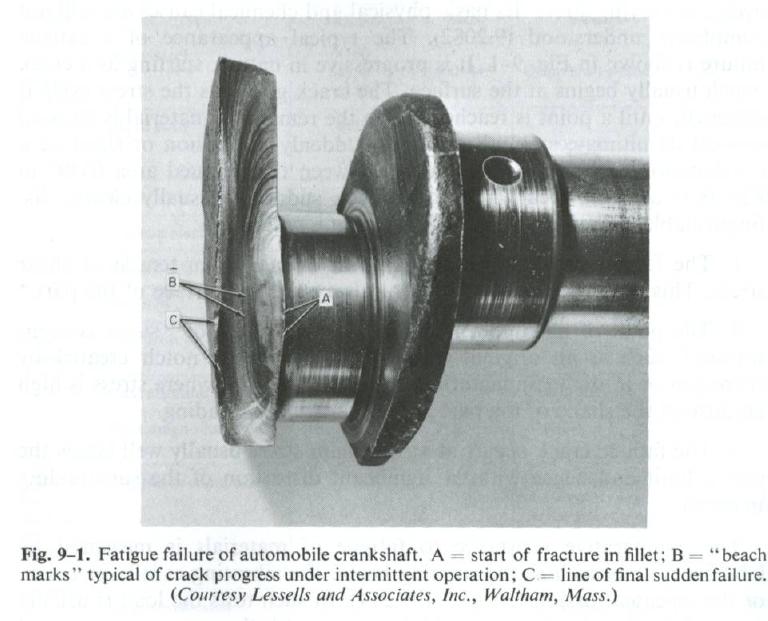
aircraft engine style fillets in the main and rod journals :)
Paul Lamar
-------------------------------------------------------
http://members.eaa.org/home/flight_reports/legend.html
" LEGEND
BY BRIEN A. SEELEY, C.J. STEPHENS AND THE CAFE BOARD
This report documents the extremely high performance capability of a new prototype
aircraft, the Legend. It is an all composite, 500 hp V-8 powered kitplane. Jeff
Ackland, the builder of this aircraft and president of Performance Aircraft in
Olathe, Kansas, brought the prototype Legend to the CAFE Foundation flight test
facility primarily for the purpose of setting a new all-time high score in the CAFE
Triaviathon. However, he also prepared the aircraft with the necessary equipment for
a complete Aircraft Performance Report.
The Legend's visit to Santa Rosa served as the stimulus for a world-class gathering
of engine experts at the CAFE Foundation's Reno Air Racing Engine Symposium on March
22, the same day the Legend flew for the Triaviathon record. The Legend is built from
molded composite sandwich skins using graphite facings and nomex honeycomb core. Its
engine is a 620 cubic inch Donovan "high deck" aluminum block, fuel injected
derivative of the big block Chevrolet. It uses steel cylinder sleeves, four-bolt main
bearings and Brodick single-plug cylinder heads.
The propeller turns at 1/2 engine speed through a Hy-Vo 2"wide, chain-driven speed
reduction unit designed by Fred Geschwender. An excellent summary of the development
of the Legend appeared in the October 1996 issue of Sport Aviation.
For the future, Jeff plans to standardize the Legend on a 541 cubic inch Donovan
block Chevy-based V-8 with a shorter stroke crankshaft than that in the prototype
N620L. It is possible that the new engine will use a different cylinder head which
may include dual spark plugs.
TRIAVIATHON FLIGHTS
Jeff Ackland performed his Triaviathon record attempts solo with reduced fuel to
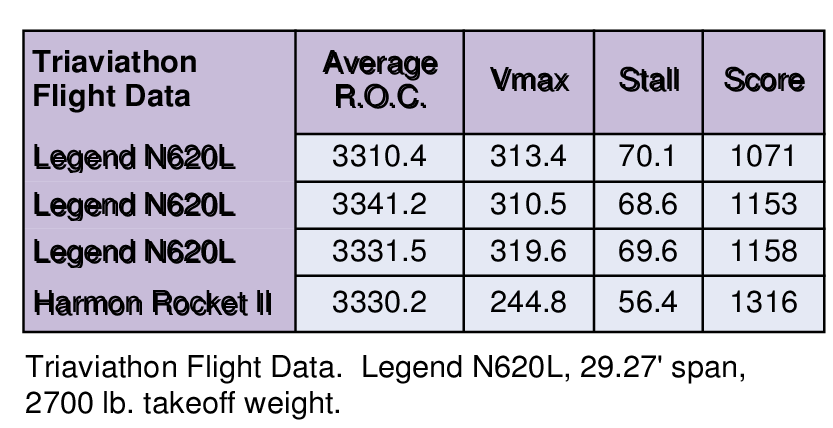
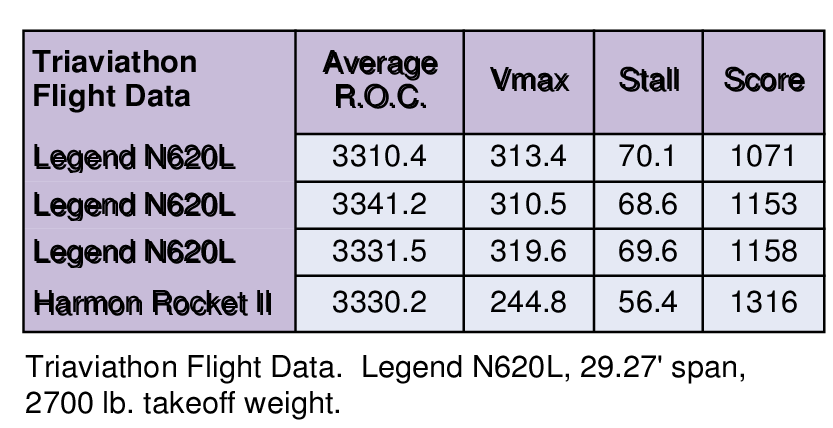
improve the climb and stall speed performance. The current record score of 1316 was
set by John Harmon in the Harmon Rocket II on May 8, 1993. The table shows how the
Legend performed.
The Triaviathon scoring formula is:
28110625 x [Vmax x ROC]2
Score = [4100625 + Vso4] x 109
This formula rewards aircraft which combine a high maximum speed, a rapid rate of
climb and a low stall speed. It is a curve fit in which stall speeds between 35 and
70 mph are rewarded somewhat proportionately. Stalls below 35 mph do little to
improve the score and stalls above 70 mph impose a progressively stiffer penalty upon
the score. The measured rate of climb is converted to be that for the altitude window
of 2500'-3500' in standard day atmosphere.
It is remarkable that the Legend's stall speed is so low. Only 1300 prop rpm were
used during these stalls, which were approached at 1 G. The flap system and Viken
airfoil on the Legend are apparently delivering exceptionally high lift at low speed.
Although the Legend did not break John Harmon's CAFE Triaviathon record, the
computations show that the Legend could break the record with only minor
improvements. Jeff Ackland said that he hopes to soon have a new supercharged 800
horsepower engine installed for another assault on the record.
Jeff has plans to race the N620L at the Reno National Championship Air Races in
September 1997.
FLYING QUALITIES REPORT
BY C. J. STEPHENS - CAFE Foundation Test Pilot
A 'Legend' In Its Own Time
By the time the Legend arrived at the CAFE Foundation's test facility in Santa Rosa,
rumors about its upcoming Trivathon record attempt had been circulating at the
airport for several days. This was exciting.
At first look, it was apparent that the Legend designer had done a beautiful job of
making a good looking ship with clean lines.
The 620 cubic inch aluminum block V-8 under the cowl made a throaty sound with its
short stacks protruding directly from each cylinder. The sound reminded me of the
Merlin engine that hangs on the front of the famous P-51 Mustang.
Most of the planes tested by the CAFE Foundation have had conventional aircraft
engines. This has lent a lot of commonality from one test airplane to the next. It
also has given me confidence, as the test pilot, to fly behind conventional engines
that have proven to be reliable in many years operation. Because the Legend uses an
unconventional V-8 engine, I was very attentive during all of Jeff's briefings
regarding each feature of this airplane. There were a number of unfamiliar systems
that had to be studied and related to one another.
GENERAL IMPRESSIONS
The landing gear system and the wing design (with the exception of the airfoil) were
similar to the Glasair III design which was the subject of our last report (see Sport
Aviation Feb. '97). The tires and brakes were slightly larger (6.5"x6") than those of
the Glasair III. The tricycle landing gear was powered hydraulically and the flap
operation was by electric motor. With the propeller length necessitating long landing
gear legs, a large step up onto the wing was required to gain access to the cockpit
without stepping on the flap. A no-skid step area was conveniently located on the
wing root.
The large clamshell canopy fits perfectly flush to the outer surfaces of the
fuselage. Gas shock struts hold the canopy in the open position for easy cockpit
entry. During all engine running operations it is necessary to either manually hold
the canopy nearly closed or to completely close and lock it to prevent damage caused
by the significant propeller wash.
COCKPIT IMPRESSIONS
The Legend is a two-place craft with a tandem seating arrangement. This puts the
pilot in the middle of the cockpit with an equal field of view over each side of the
cowling. Both the front and rear seats have adequate shoulder room and lots of elbow
room, giving an overall feeling of spaciousness. One CAFE member who is 6'3" fit
comfortably into the rear seat with his knees just touching the forward seatback.
The cockpit layout was beautiful, with a conventional throttle quadrant on the left
in a very natural location. Instruments were only installed in the front cockpit;
however, many of the instruments could be read while sitting in the rear seat. Rudder
pedals were fairly standard, with toe brakes which lacked a provision for leg length
adjustment.
I felt that the mixture control was a little too sensitive and required too little
movement to achieve the required settings. The fuel system included a panel-mounted
fuel shut-off knob. Dual boost pumps were used during all operations below 1,000',
with each pump connected to a separate battery. Above 1,000' it was acceptable to
operate with only one boost pump. There was no mechanical fuel pump and the engine
would die quickly if both boost pumps were turned off. There was a fuel flow
measuring system which automatically subtracted the fuel burned from the total fuel
amount, which the pilot could set before engine start. By our measurements it
provided better than 0.7% accuracy for fuel flow. The panel-mounted analog fuel gauge
would only read approximate fuel status and then only when the fuel remaining was
below the top of the sensor (about 2/3 tank remaining).
The ignition system was interesting in that it used dual batteries and inductive
pickups, but only a single distributor. There was a single spark plug installed in
each cylinder. No flop tubes were installed for inverted flight.
ENGINE START
The plane started quickly after minimal priming. It had to be started with the boost
pump off (to prevent overpriming), but the pump then had to be turned on immediately
after start to prevent fuel starvation. After a couple of starts the procedure proved
to be manageable. In about four minutes the engine was warm enough to complete the
preflight run up. The tachometer displayed the engine crankshaft rpm, rather than
propeller rpm. Simple arithmetic would compute the propeller rpm as one half the
engine speed, given the speed reduction ratio of 2 to 1. During run-up, both
ignitions and both boost pumps were independently checked for function on each
battery position at 2,000 rpm. This important step to ensure maximum redundancy of
these critical systems was emphasized in my briefing on the aircraft's operation. The
propeller was cycled at 2,500 engine rpm using very conventional methods.
GROUND OPERATIONS
Even with full tanks, the plane can be moved about on the ground by one person using
a tow bar connected to the nose wheel. Refueling of the single fuel tank can be done
through either fuel cap located near the wing tips. Since the airplane is mostly
carbon fiber, adequate static discharge grounding can be accomplished by connecting
the grounding wire to the nose wheel strut. During taxi operations the castering nose
wheel worked very well with only light braking required for directional control. The
tricycle gear afforded a good view of the pavement ahead.
TAKEOFF
Everything checked perfectly at run up and the flaps were visually set to
approximately 15 degrees. The plane was taxied into position for takeoff. As the
throttle was advanced, the hefty V-8 sounded like the throaty purr of a big racing
boat or a Merlin engine. With one last scan of the engine gauges, the brakes were
released and the throttle was advanced to the forward stop. The sensation was
exhilarating as the 500 hp engine accelerated the plane down the runway like a high
performance Corvette. Only slight right rudder was required to keep the nose wheel
tracking straight down the center line of the runway. As the airspeed approached 90
mph, slight backward stick pressure was applied and the plane lifted off smoothly at
95 mph. Gear and flap retraction were normal with only slight rocking of the wings as
I adjusted my hand to the sensitivity of the ailerons. The airspeed rapidly increased
to and stabilized at 160 mph for the climb.
WATER COOLING
It was necessary to use somewhat unconventional cockpit procedures for proper
operation of the Legend's water cooled V-8 engine. The radiator was evidently sized
very well for this application. Both the oil and engine coolant circulate through the
radiator for cooling; therefore, coolant door operation directly affects the
temperature of both fluids. We did not evaluate any long duration ground runs, but
all normal ground operations had plenty of cooling available. During the takeoff,
climb, and all high-powered flight regimes, the cooling door was left in the open
position and both the oil and coolant temperatures remained normal (Water: 180*
F/Oil: 210* F).
Upon leveling off at a cruise power setting, the coolant door could be closed and
temperatures remained normal. On the brief full power Vmax run with the coolant door
closed (minimum drag) the temperature began to rise but recovered as soon as the 5
minute run was complete and the door was opened. The door had to be activated
manually. I think that its operation should be automatic. While no intermediate door
position indicator was available, there were limit lights that indicated when the
door was fully open and fully closed. An emergency "T" handle was provided to release
the door to trail freely in the event the electric drive motor failed. During cruise
and descent the door was left in the closed position. It was opened in the traffic
pattern to anticipate any event in which a high power setting would be needed. With
the door open a very slight aerodynamic vibration could be felt throughout the airframe.
At first I felt that the time required to monitor and operate the engine cooling
system caused an excessive added work load for the pilot. As I got more used to the
systems that level of distraction was reduced. With practice, or on flights that had
fewer speed and power changes, the pilot workload would be tolerable.
The Legend?
The answer to a question we've received several times in the last year (will the
Legend be at Reno '98?) landed and whined it's way past where Mark and I were taking
a break from the 100+ deg temps that graced this weekend at Reno...... the answer is
a very big YES, but not as a race entry. Those of you who attended this year's Sun 'n
Fun EAA Fly In probably already know the answer to this one.... The V-8 powered
Legend, seen at Reno last year, has undergone a very exciting conversion....Jeff
Ackland and the people at Performance Aircraft have hung a 650 hp turboprop on the
nose of this already fast airplane! Slated to share pace plane duties with a factory
Lancair for this year's Sport Class events, it will be a real head turner!...(there
is something sexy about an airplane that can taxi backwards:) trust us..... this is
one E-X-C-I-T-I-N-G airplane! (More on this one in a later update!)
The Rotary Engine NewsLetter. Powered by Linux.
ACRE NL web site.
http://www.rotaryeng.net
Copyright 1998-2005 All world wide rights reserved.