>
Ok, so I know this subject has been beaten to death many times.
However, I'd like to bring it back to life again, just to get
current-thinking vs. what we've gone round & round about in the past.
It's time for me to start buying radiators/coolers for our M2 build.
What are the current best-bet parts to be considered? Mazda original
equipment, vs aftermarket? Are we still all convinced that pivoting a
radiator off the s-beam & hanging it below the cowling is the best
way
to shed heat? On the oil cooler front, I see that Jerry's latest
scheme is to mount it behind the engine & bring cooling air straight
down the firewall. Given that the air will have been heated by the
engine / exhaust manifold on it's way there, I wonder whether the
delta-T in this configuration will be sufficient to provide the
proper
cooling.
On the more mundane side, what are good sites to order hoses & what
not
from? Paul, how about the clamps you believe are must-haves?
As you can see, we're transitioning from "get the engine built"
thinking
to "get the engine installed" mode. Heck, it's been a whole 3 days
since I last exercised the credit-card for airplane parts.. wouldn't
want
it to go stale or anything... ;-)
Mark & Mark
Mark, I have recently updated the "How to Cool your Wankel" so that
is my position on the subject.
http://www.rotaryeng.net/how-to-cool12.html
If you have any questions please let me know as I am getting ready
to publish it in book form.
Have you taken a look at lulu.com <http://lulu.com> Paul? It is a
publish-on-demand service which is free to the author. They print up a
book when an order is received. I think they take a 20% cut on each
book, and return 80% to the author. Could be wrong tho.
Mark & Mark
The silicon hose and constant torque clamps can be had from McMaster
Carr.
Thanks for the tip Mark. I was going to go with a friend in Florida but I
will
look into it. I am a control freak so I was going to call out everything,
paper stock, format, binding etc. etc. In my experience with a couple
of books in the past they tend to sell for years. I wrote a chapter or
two
in How to Hot Rod Volkswagen Engines 30 years ago and it is still selling
:)
Paul Lamar
Paul,
I'm just getting to the point of thinking about firewall forward
components.
I plan on putting the Renesis in my RV-8. Current thought is to get the
mount from Creative Concepts, the alternate rotary cowling from James
Aircraft, the control unit from Tracy Crook and the engine built by Bruce
Terrentine.
Since I'm new to the ring, I'm sure there have been lots of discussions on
which components to use. Is there somewhere I can go to get info like the
size of the heat exchanger I need? Which components are others using?
How
have other RV-8 builders installed & ducted? I have the same type
questions
for the oil cooler too. It sounds like the stock cooler is the right
choice, but has anyone ducted it all under James's cowling?
I ordered the finishing kit last week, and will probably start ordering
firewall forward parts before the year is out.
Thanks,
Chris Mallory
Most people use the stock 2nd gen oil cooler. You will need about
a 600 cubic inch rad. Available from many car racing radiator sources.
The first thing you need to do is either construct
a full size detailed mock up or do a 3D of the proposed layout. This
will save you a year and the time making parts over again. I can do that
for free if you wish. That will determine the dimensions of the rad within
the
600 cubic inch parameter. IMHO you will save lots of money and get a
better
motor mount from Jerry Hey. I have the dimensions of the Will James
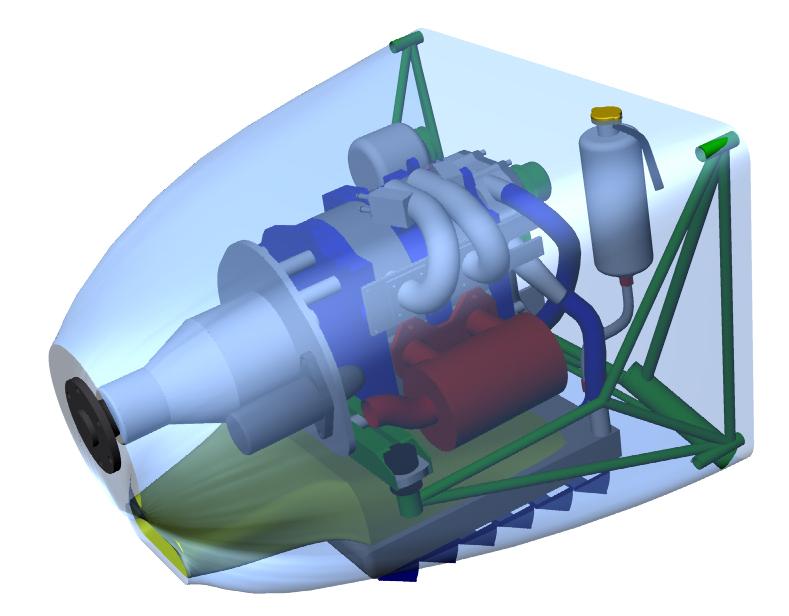
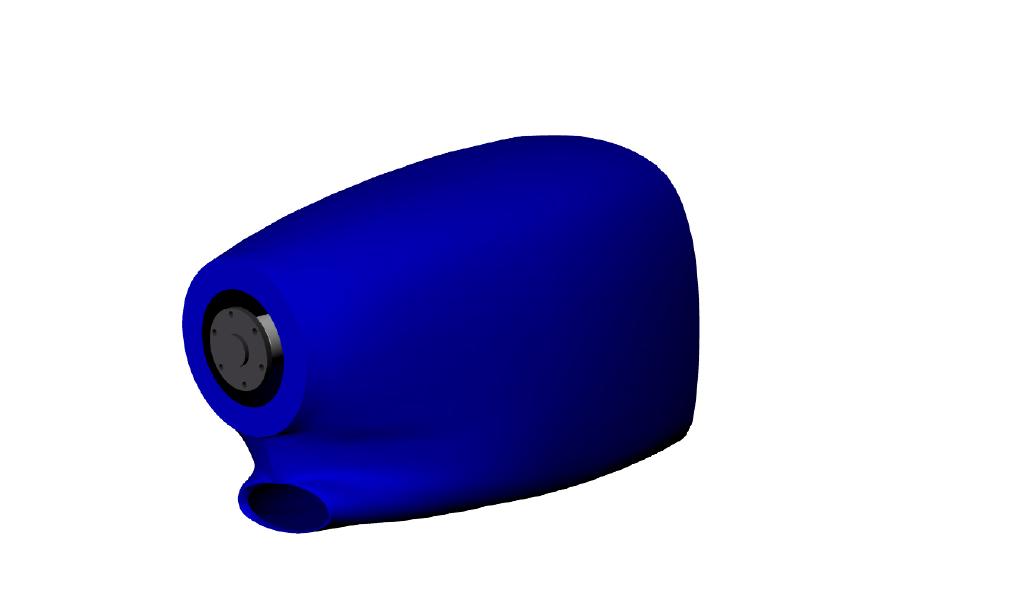
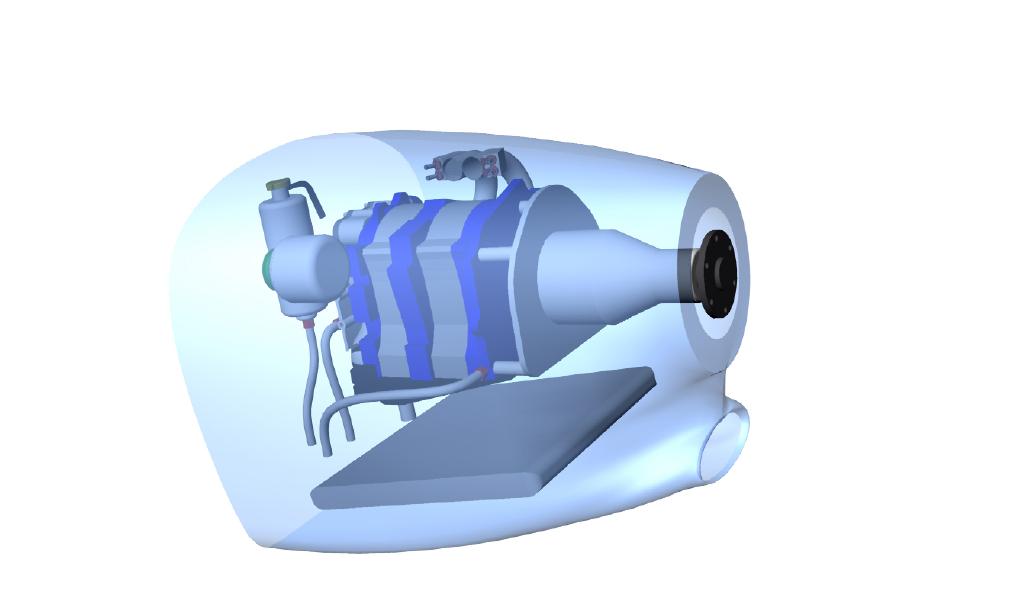
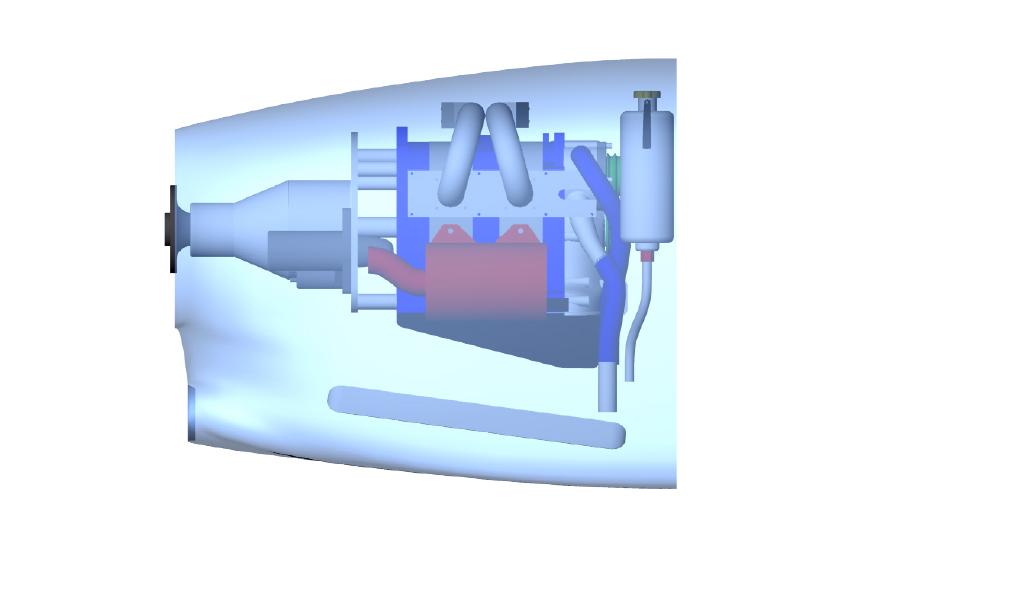
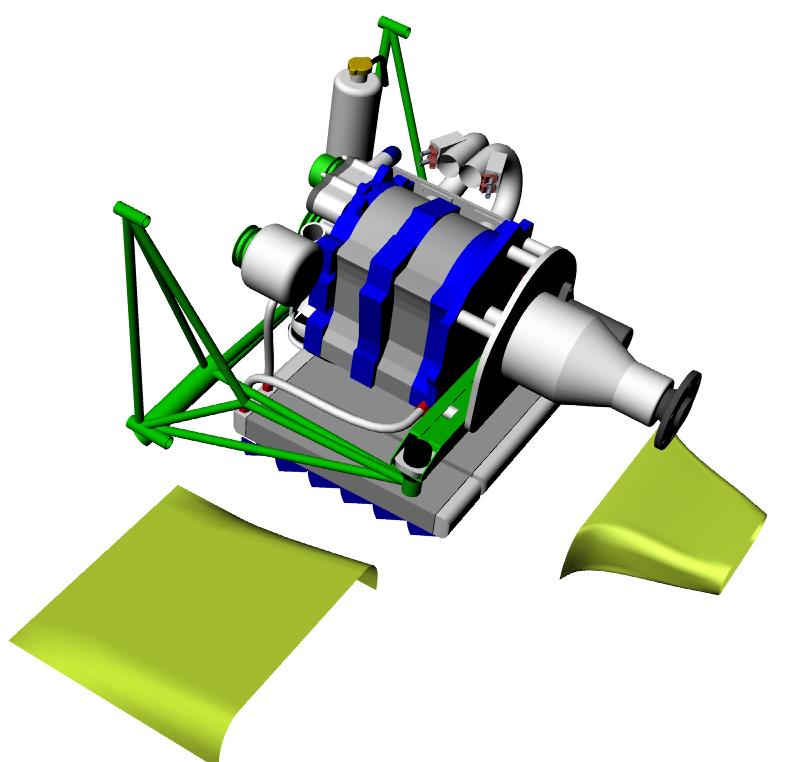
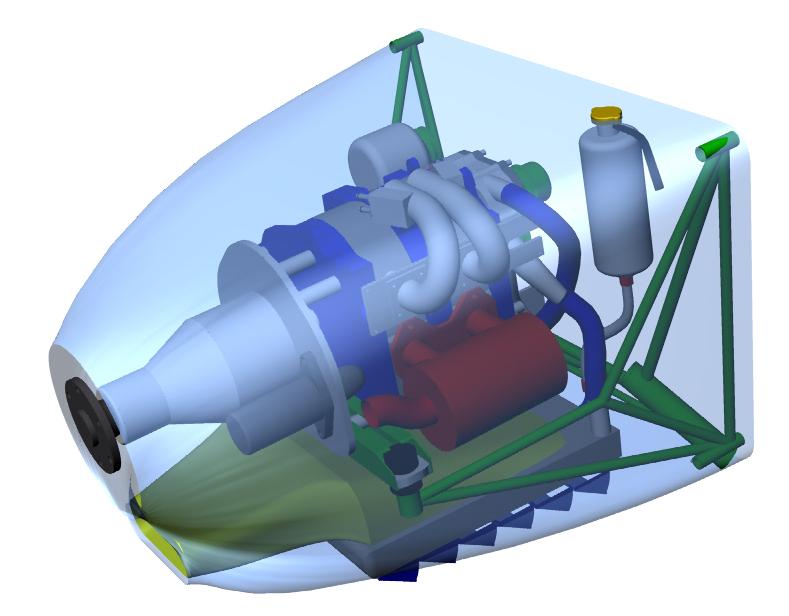
cowl so I can fit everything in. Here are three RV8 3D's that will give
you some ideas. None of these meet all the ideal criteria in
http://www.rotaryeng.net/cooling.html but they are close.
Namely:
A. Feed cold air only to the rad.
B. Makes sure there is nothing behind the rad to impeded the air flow.
C. Make sure the back side of the rad is shielded from the exhaust.
D. Make sure the rad duct is the proper shape.
Once you make a decision on the exact configuration stick to it come hell
or high
water as that will minimize the time required to get it finished.
Paul Lamar
I forgot to mention the the intake manifold. The exact layout you choose
depends on what intake manifold you have. As far as I know there is
no off the shelf manifold for the RX8 engine. That means you will
have to make one. Tom Webber is making slide throttle parts and Jim
Poole is boring rotor housings for peripheral ports. That makes a p-port
RX8 engine about the most powerful normally aspirated rotary there is
other than a 3 rotor of course. It is also about the easiest manifold
to make as there are only two runners rather than six.
The last decision is what kind of muffler you want to go with.
Paul Lamar
Paul,
I'm initially liking the idea of radiator and oil cooler under the engine,
or radiator below and splitting the duct to go to the oil cooler and intake
on the right. Since you have the info in your computer, can you answer a
few questions for me.
1. What are the dimensions of the inlet opening of the james cowl?
2. How long from opening to firewall?
3. How much space below engine? Height and width?
Thanks,
Chris
5 inches high and 12 3/4 inch wide smiling oval.
Cowl is 37 inches long.
What sort of PSRU? The thrust line is 20 inchs up from the bottom
of the cowl at the back. Assuming a planetary gear box my guess is 8
inchs with a 2nd gen oil pan and about 10 or 11 inches with a RX8 oil pan
under the front of the oil pan. However you don't need all that clearance.
All you need is 4 inches at the front of the rad core to get the air
in over the top of the rad and under the Schertz Beam. You could use
an RX8 oil pan or a custom welded aluminum pan to give you the needed
clearance.
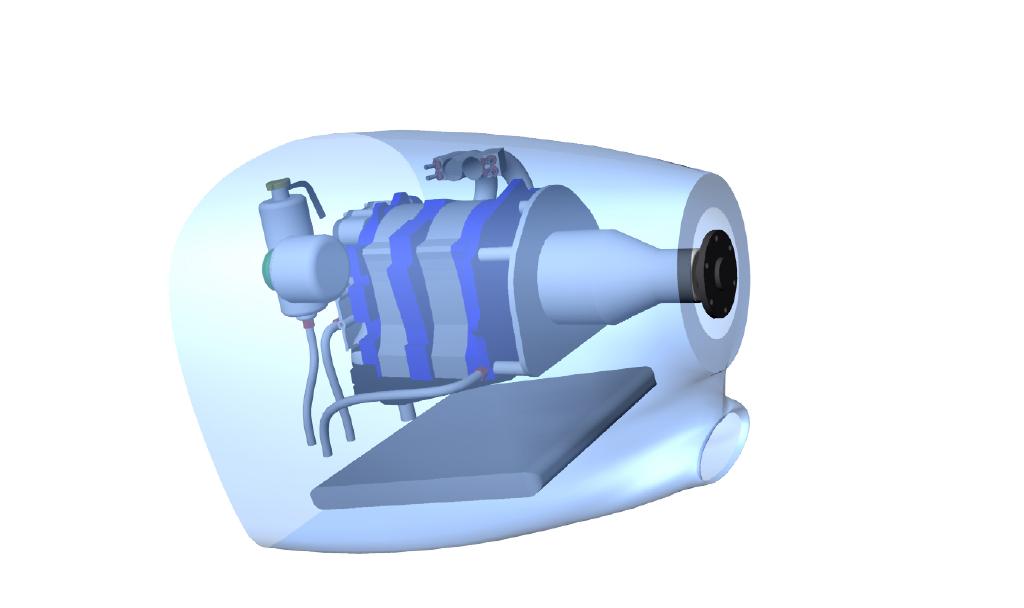
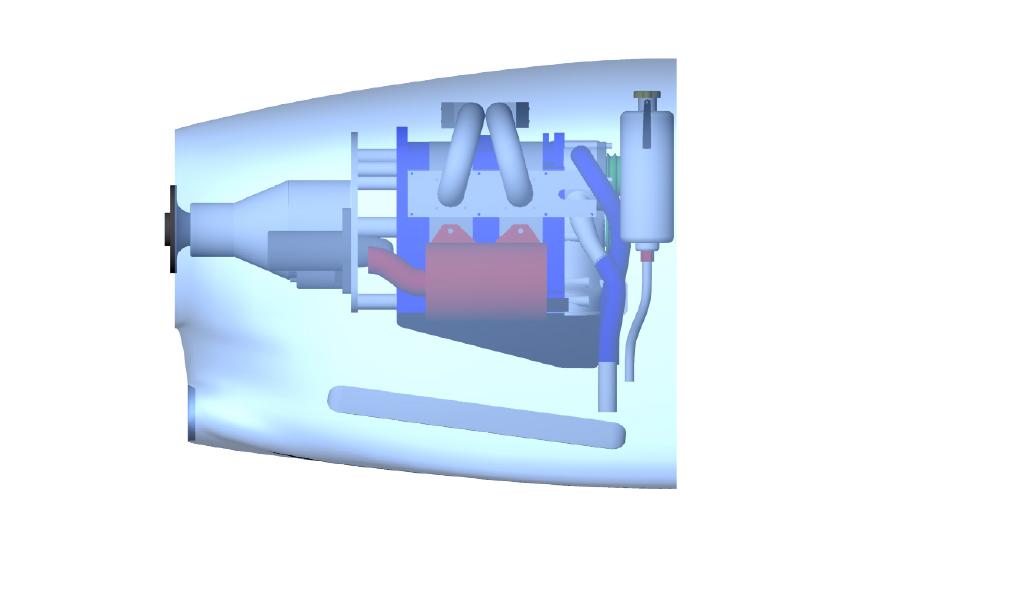
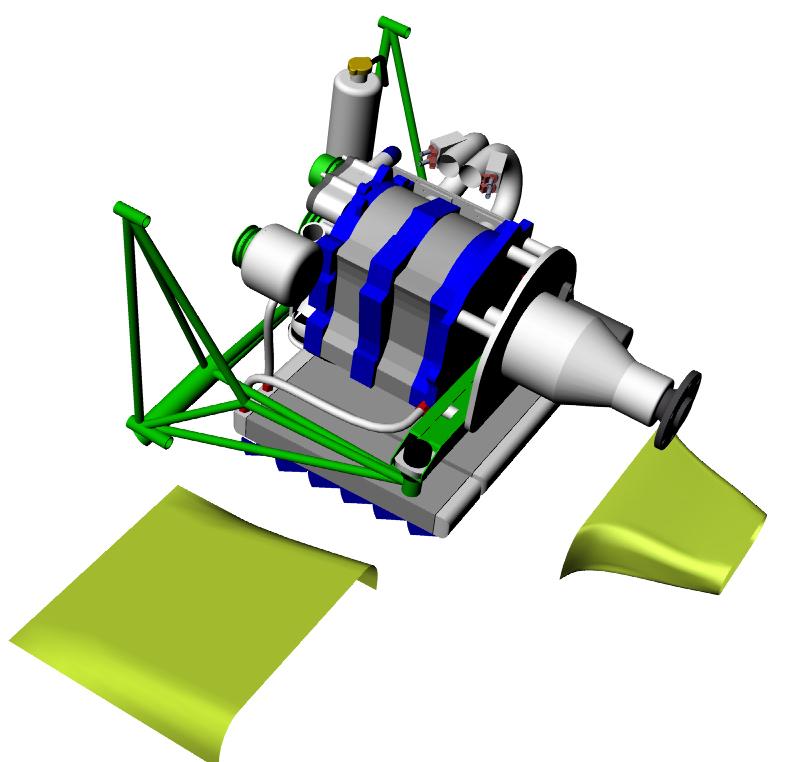
If you tilt the rad up a little like this and place it here you can get a 5 inch
wide 2nd gen oil cooler right next to a 18 inch wide by 20 inch long rad core.
You only need one scoop and one duct/diffuser bringing the cold air in over the
top of the rads. There probably is plenty of room under the rad to get the air out
straight the back. Will James added a bulge down there. If not you can check the
pressure under the rad with a water manometer and if it is not low enough (near
static) you can place a louver or two near the front of the rad in the bottom skin.
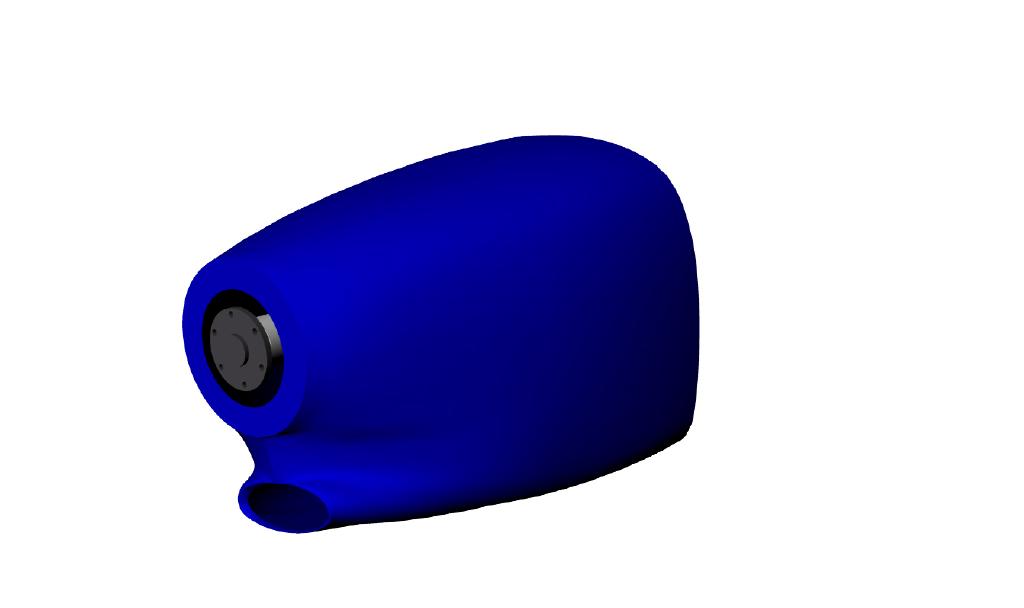
This cowl roughly has the same dimensions as the Will James cowl. I can't show you
the actual Will James cowl because it is copyrighted :) (I don't know how
they expect to sell it :))
In any event just about any RV8 cowl is very voluminous.
The last two 3Ds shows the general method of arranging the ducts and is not
a Will James cowl. Just something I had lying around.
Paul Lamar
The Rotary Engine NewsLetter. Powered by Linux.
ACRE NL web site.
http://www.rotaryeng.net
Copyright 1998-2005 All world wide rights reserved.