Geir asked:
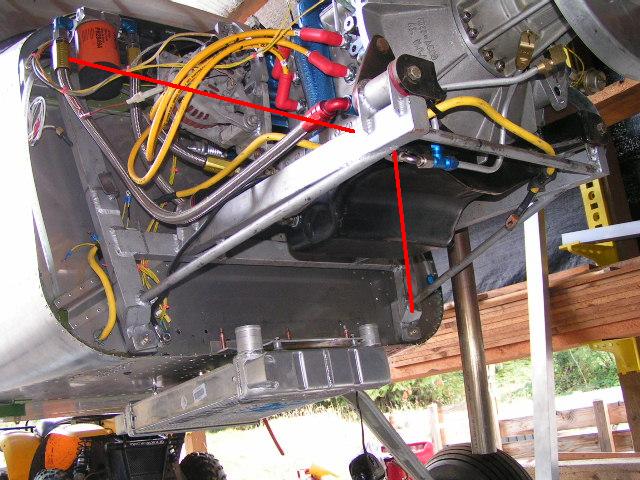
I am finally able to proceed with the Elite project.Please take a look
at pics and let me know what your thoughts are on the engine mount.I
would also like to know the outcome of the P-port project.Is it done
or work in progress.
Paul Lamar responded:
The vertical rectangular member parallel
to the firewall is in severe bending. Good thing you stripped
it down and took pictures. I am very surprised.
Pretty easy to fix but you may have to move some plumbing around.
Here is a modification to the picture. Use 5/8th .049 wall 4130
tubing where the red lines go. Both sides. Send me a picture of the
other side. Zoom in and get just the motor mount.
No kidding. Not only that, that mount looks
*HEAVY*. Plus the bracing
tubes to the bottom of the firewall are in severe compression; I would
expect them to crumple in a hard landing. Paul's brace (in tension)
will relieve much of that.
Paul,
The bottom braces (there are two) seem to be positioned to restrain
lateral movement of the motor mount. Do you think the bottom cross
member you suggest is really needed?
I happened to meet the FAA women that signed off on this airplane.
She is obviously incompetent as a structural engineer.
Now, now, Paul. You're assuming that the FAA/DAR sign off is testimony
that the aircraft is well-engineered, when in fact it is merely
testimony that it won't kill you (or others) instantly. :-) For all
you know she could very well have told the original builder that the
motor mount wasn't adequately braced (for
*our* safety standards;
apparently it was ok for the original builder's).
The rad position looks good. Just drop the front of it down about
3 inches.
Actually, if you can forgo the bottom bracing member (see my comments
above), then you can move the radiator inside the cowl under the oil pan
(angled as Paul suggests). Use a Kays & London (wedge) diffuser.
Russell Kent
You are probably right on the diagonal brace. As it is now
the lateral rectangular tube that the horizontals butt up against
back near the firewall have some strength in bending that might take
care of lateral forces. I would put in the diagonal tube to be on
the safe side.
Yes the fixed/repaired mount is far heavier than it need be but
it is a lot less time and money to fix it rather than replace it.
You might not kill your self instantly. It should take about
3 or 4 seconds if you pull a couple of G's in a turn :)
I still need a picture of the other side of the engine as it
may not be possible to put in a simple diagonal brace from
the top of the firewall down to the horizontal.
The reason I mentioned this is the same FAA person came over to
approve my one time STC on my O-470 installation in my C182.
She was looking at my KIS Cruiser and she asked me what kind
of engine that was. I said; "you just signed off on one over
at Camarillo and you don't know what kind of engine it is?" :)
Of course she did not know what she was looking at on
the O-470 either. Other than looking at the engine plate it is
hard to tell the difference between a -U and a -S from the
outside. I could have swapped plates and gotten away with
it no problem.
Paul Lamar
The Rotary Engine NewsLetter. Powered by Linux.
ACRE NL web site.
http://www.rotaryeng.net
Copyright 1998-2005 All world wide rights reserved.