You are not serious. My GOD the rotation of the rotor or the number
of pistons an engine is equipped with has absolutely nothing to
do with the amount of air the engine pumps. Displacement has been
defined since the beginning of the internal combustion engine as
the amount of air the engine pumps at a VE of 100% in one revolution
of the output shaft. It is arbitrary. It is not good nor bad or here
nor there... it is the LAW! It could just as easily have been cubic
feet of air per second or the size of a hole that all air must
pass through.
The phasing gears are NOT transmitting any torque. Zero torque in
case you are using that argument. They are merely positioning
the rotors. It could be cams or four bar linkages that position
the rotors. They are not "speeding" up the "output shaft" which is
the silly argument you guys are making.
Cubic feet of the intake chamber per one revolution
(torque changing gearing on the output shaft not with standing) is
how displacement is DEFINED! PERIOD! End of story!
Of course displacement has nothing to do with the power
to weight and power to physical volume of the engine
which is all that counts in an aircraft engine.
Come on guys give it up. It is not a 3.9 liter six cylinder
by any stretch of wild imagination.
Paul Lamar
Paul,
The displacement of an engine is not arbitrary. It is the VOLUME the engine
is able to process mechanically if the entire swept volume is filled with
working fluid. This is a thermodynamic property of an engine I don't give a
crap what type of mechanical Rube Goldberg mechanism you use to make it
happen. Volumetric efficiency is defined as the actual amount of working
fluid processed vs. what could theoretically be processed. The definition is
NOT arbitrary.
You are stuck on the hardware and using it as a definition. The definition
of a thermodynamic cycle is based on what is done to the working fluid. It
is compressed, heated, and expanded. This is one cycle. The amount of work
produced during expansion minus the work done to intake, compress, and
exhaust the working fluid is the work out.
An arbitrary engine has a fixed volume of working fluid it can process
during one cycle. If it is completely filled with atmospheric air the
volumetric efficiency is 100%. If it is very efficient you might get a few
percent more over a narrow band through intake tuning. But to get 120% VE
requires supercharging. What the crank shaft, eshaft, scotch yolk, or
whatever is doing during this cycle has nothing, absolutely nothing to do
with volumetric efficiency PERIOD. It is merely a function of the physical
manifestation of that particular engineering solution to make a given cycle
work.
What about a free piston engine Paul-how would you define VE for that?
It has no crank.....
Rebel Flag waving Southern Redneck and proud of it you bloody WANKER!
This is a joke for those with terminal humor deficiency.
Monty
"It is the VOLUME the engine is able to process mechanically if
the entire swept volume is filled with working fluid."
I am not stuck on the hardware. I agree with you precisely.
"If it is completely filled with atmospheric air the
volumetric efficiency is 100%. If it is very efficient you might get a few
percent more over a narrow band through intake tuning. But to get 120% VE
requires supercharging."
Not true. The p-port rotary routinely gets above 120%. Otherwise
you would not be getting 350 HP out of a 2.6 liter engine.
Paul Lamar
Please explain to me how its possible to fill a one gallon bucket with 1.2
gallons!
Waiter
The words "bucket" and "gallon" imply liquid and non compressible
while air is a gas and is compressible.
Air has inertia because basically it is made of of tiny marble.
Once you get these marbles moving in an intake tube they want
to continue moving. In organ tuning techniques the length of the
intake runners have resonant frequencies at certain RPMs. It is then
possible to have pressure waves in the intake runners that overfill
the rotary engine.
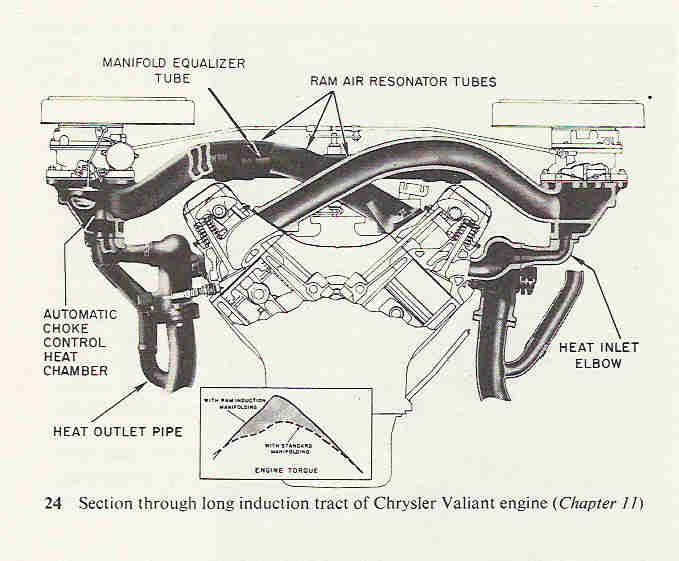
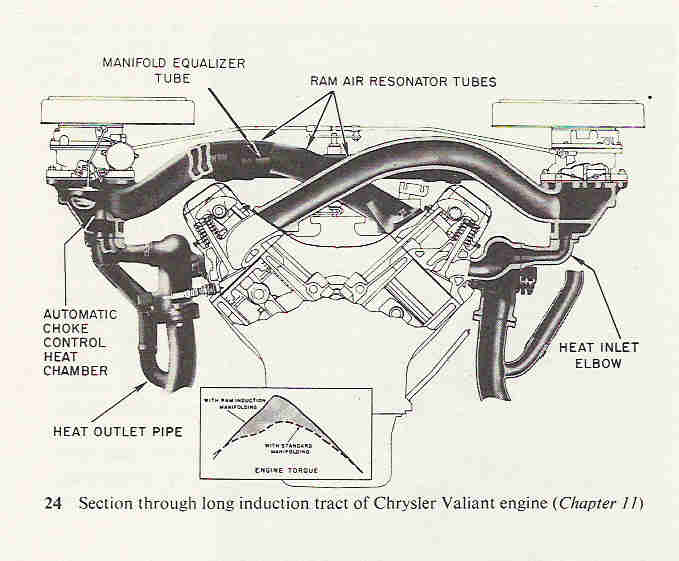
Nothing new. Dodge did this years ago with both V8 and in line
sixes. I think they called it Ram Charging and they still use
the term in their advertising. It is also universally used in
almost all engines designed in the last decade to improve
the volumetric efficiency of piston engines. Now days
the long V8 runners are wrapped up in a spiral. Here is
a picture of the Dodge Ram charger manifold.
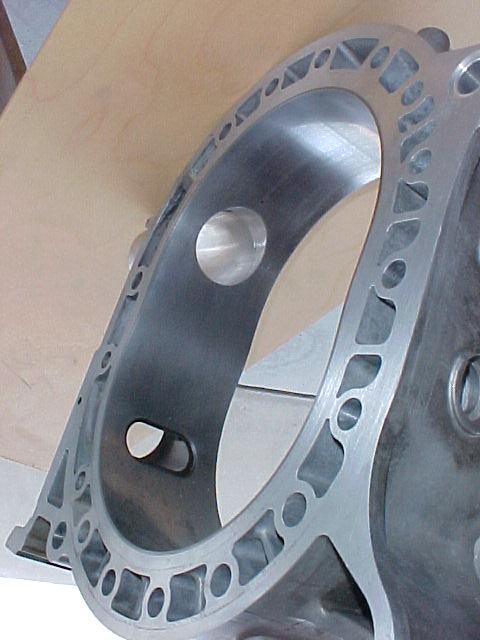
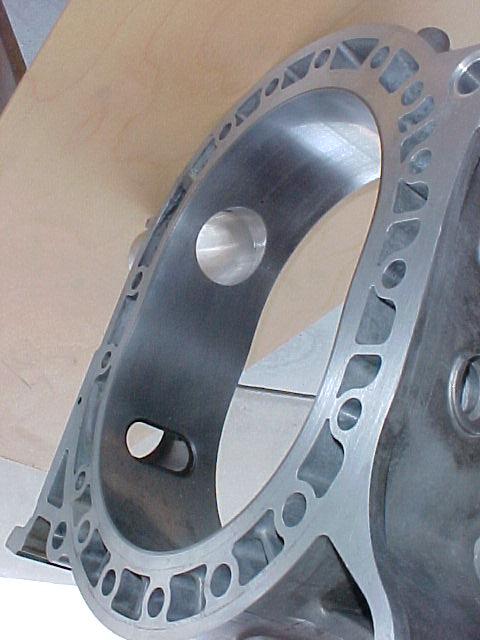
It works much better in the p-port rotary as there are no
intake valves to get in the way.
Paul Lamar
The Rotary Engine NewsLetter. Powered by Linux.
ACRE NL web site.
http://www.rotaryeng.net
Copyright 1998-2005 All world wide rights reserved.