Paul Lamar wrote:
Note that Audi was able to gain only 8 to 10 % in fuel
consumption reduction but that including upping the
compression ratio by a point.
Uh, I think you missed something important. The text reads:
The adoption of direct petrol injection allowed
the compression ratio to be lifted a point and gave
a fuel reduction of 8-10%, a torque increase of 9%
over a wide RPM range and quicker starting and better
driveability.
It appears that fuel consumption went down while HP output (torque at
RPM) went up. A 9% increase in HP output at the same fuel consumption
is equivalent to a 9% improvement in BSFC (right?), so that is
equivalent to a combined 17-19% improvement in BSFC. I'd say that's
pretty significant. I'd like to see the dyno graphs.
Therefore without upping the compression ratio of the rotary you
won't see nearly the improvement in fuel consumption.
Now we're just outright guessing. I'll agree that the BSFC improvement
probably depends in part on the compression ratio increase, but I think
it's a wild guess to speculate on how much.
Every little bit helps however. My question so far
unanswered is what happens to the NOX and how
is it reduced to meet EPA rules? As far as I know
and as I recall NOX is greatly increased when engines
are run lean.
Agreed. But I think NOx production is also dependent on combustion
temperatures. If the stratified charge mode can decrease the combustion
temperatures, then that might offset the lean burn increase in NOx
production.
Russell Kent
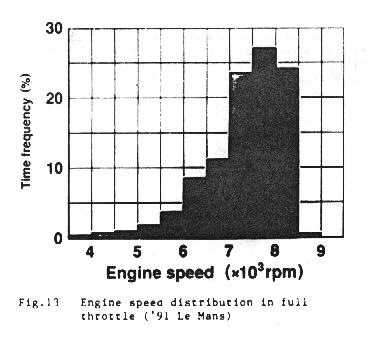
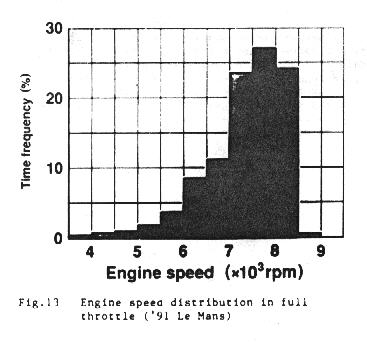
The problem here is you don't know the duty cycle. It is all a
big guess. Here is the RPM histogram on the Mazda 4 rotor 1991 winner.
My point was engines run mostly at high power during the Le Mans
race.
BTW I am not disparaging this approach. Far from it. It is just
what the rotary needs for car use. Namely lower fuel burn
in the city cycle. Ironically shutting the engine off at stop
lights addresses the same operating conditions more or less.
Aircraft use however may not show the same gains. Tracy
is under the impression the rotary has natural stratified charge
and that is why it is capable of running 200 degrees lean of
peak. In other words he is already using stratified charge
techniques so high pressure fuel injection may not be worth it.
I still think turbo compounding will yield the best results
for us.
Paul Lamar ...No rotor no motor.
The Rotary Engine NewsLetter. Powered by Linux.
ACRE NL web site.
http://www.rotaryeng.net
Copyright 1998-2005 All world wide rights reserved.