An advanced new form of idle-stop system
To achieve ever-lower carbon-dioxide emissions from its engines, Mazda constantly
develops and refines technologies that enhance fuel efficiency. Among such
engine-related technologies are idle-stop systems. An idle-stop system saves fuel by
automatically shutting down the engine when the driver brings the vehicle to a halt
(at traffic lights, for example) and automatically restarting the engine when the
driver subsequently wishes to pull away.
A conventional idle-stop system uses an electric motor to restart the engine.
However, Mazda recently devised a new, more efficient means of performing this
function. Known as the Smart Idling Stop System, it injects fuel directly into the
engine’s cylinders while the engine is stationary and ignites the fuel to create
downward piston force that serves to start the engine.
The direct-injection-based Smart Idling Stop System not only saves fuel; since it
does not use an electric motor, but it also restarts the engine more quickly and
quietly than a conventional idle-stop system.
Technologies and benefits of the Smart Idling Stop System
Reverse engine operation for restart
Direct-injection technology makes it possible for fuel to be supplied directly to the
engine’s cylinders while the engine is stationary and then ignited to turn the engine
over. However, since the cylinders soon return to atmospheric pressure when the
engine stops a special technique is needed to achieve enough expansion energy to
restart the engine. Consequently, the Smart Idling Stop System operates as follows:
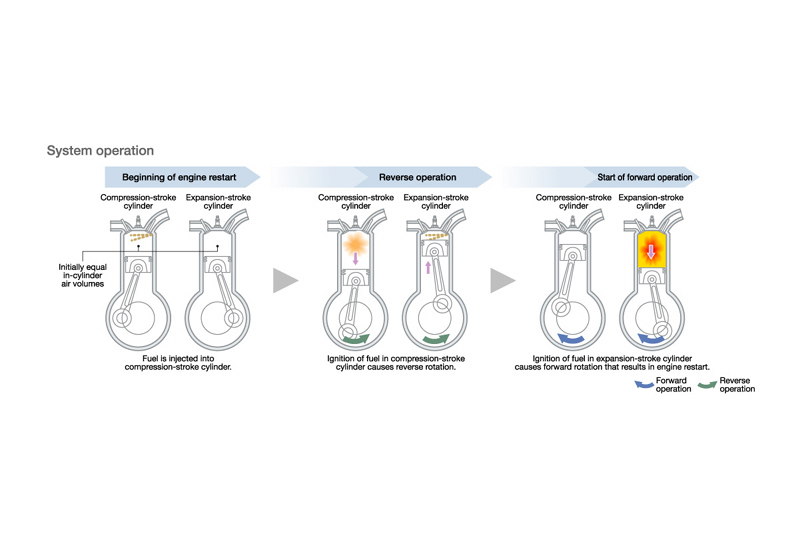
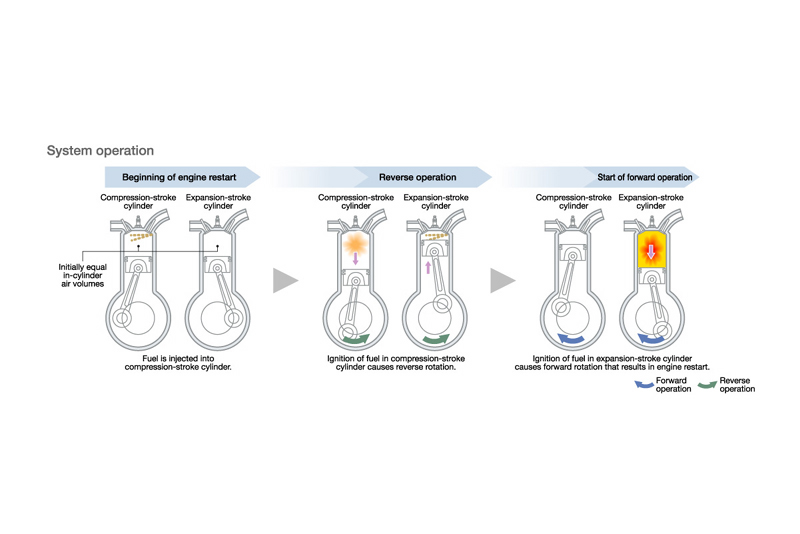
First, the system injects a small amount of fuel into the cylinder whose piston is
part-way through its compression stroke. The system ignites this small amount of
fuel, causing the engine to run slightly in reverse. Then, the system injects fuel
into the cylinder that has begun to undergo compression owing to the engine’s reverse
operation. Finally, the system ignites the latterly injected fuel, causing powerful
expansion that drives the engine in the forward direction, thereby starting the engine.
Piston-position control during engine shutdown
For the engine to be startable through the aforementioned reverse operation, it’s
vital for the compression-stroke piston and expansion-stroke piston to be stopped in
positions that create the right balance of air volumes. Consequently, the Smart
Idling Stop System effects precise control over the piston positions during engine
shutdown.
Benefits of the Smart Idling Stop System
The Smart Idling Stop System realizes the same main benefit as a conventional
idle-stop system, i.e., superior fuel efficiency. But, since it starts the engine by
means of combustion rather than using an electric starter motor, it’s quicker and
quieter than a conventional idle-stop system. Also, the absence of a starter motor
makes the Smart Idling Stop System structurally simple. Consequently, the system has
the reliability needed for frequent engine restarts.
Hisakazu Imaki
Representative Director, President and CEO
I assume this will be applied to the DI rotary engine. I see no reason
why not.
Paul Lamar ....No rotor no motor.
The Rotary Engine NewsLetter. Powered by Linux.
ACRE NL web site.
http://www.rotaryeng.net
Copyright 1998-2005 All world wide rights reserved.