The current rotor is about 6.86 inches apex seal
to apex seal. The width is 80 mm or 3.15 inches wide.
The area of the combustion chamber not counting
the depth of the walls is therefore twice 6.86 X 3.15 or
about 43 square inches. Adding .2 inch high 4 square
inch walls the total area would be 47 square inches.
The volume assuming .2 inches average depth
would be about 8.6 cubic inches.
Surface area to volume ratio would then be about 5.46.
The same numbers for the 100 mm wide 16B would be
58.45 square inches and a volume of 10.8
Surface area to volume ratio would then be about 5.41
What? When Vance Jaqua first told me this I did not believe
him. It was counter intuitive to my ex way of thinking.
OK round (piston engine): 8 inches in diameter A = 50.26
Volume = 10.052
S/V = 5 !!!!!!
All these years the Wankel rotary has been kicked around
by everybody and his brother because of the alleged
terrible "surface to volume" ratio. The first thing
I heard at the show out of the EDITOR-IN-CHIEF's mouth
was the alleged terrible "surface to volume" ratio :)
What really happens is the flame front tends to be circular so
it just fits better in a round or square combustion chamber
than in a rectangular combustion chamber. The wider rotor
16B is therefore an improvement in this regard. The ideal rotor
would therefor be about 6.86 inches or 174 mm wide. The same
as one length of the rotor from apex seal to apex
seal. That of course would result in a 5.6 liter 2 rotor
engine. Obviously the size of the rotor would have to
be reduced for the required smaller displacements of today's
automotive engine needs.
-------------------------------------------------------
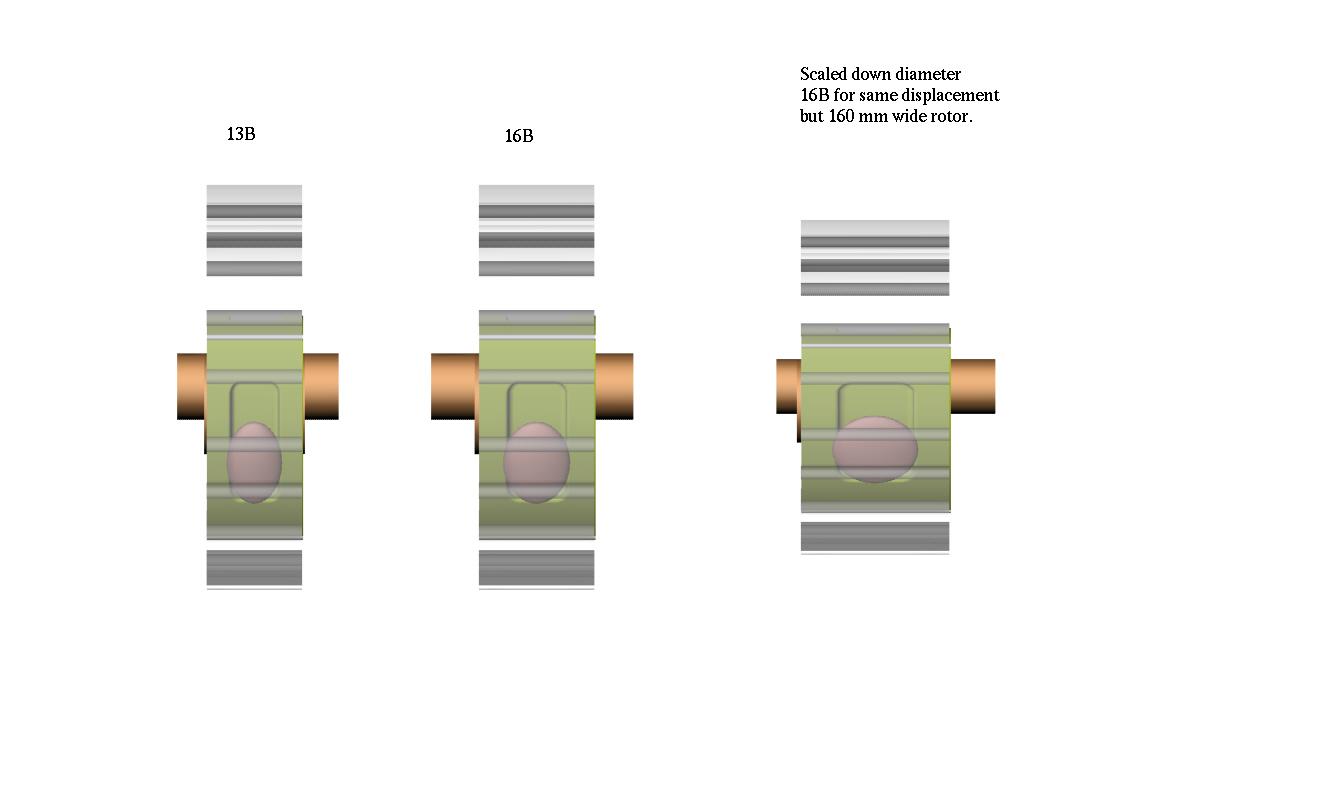
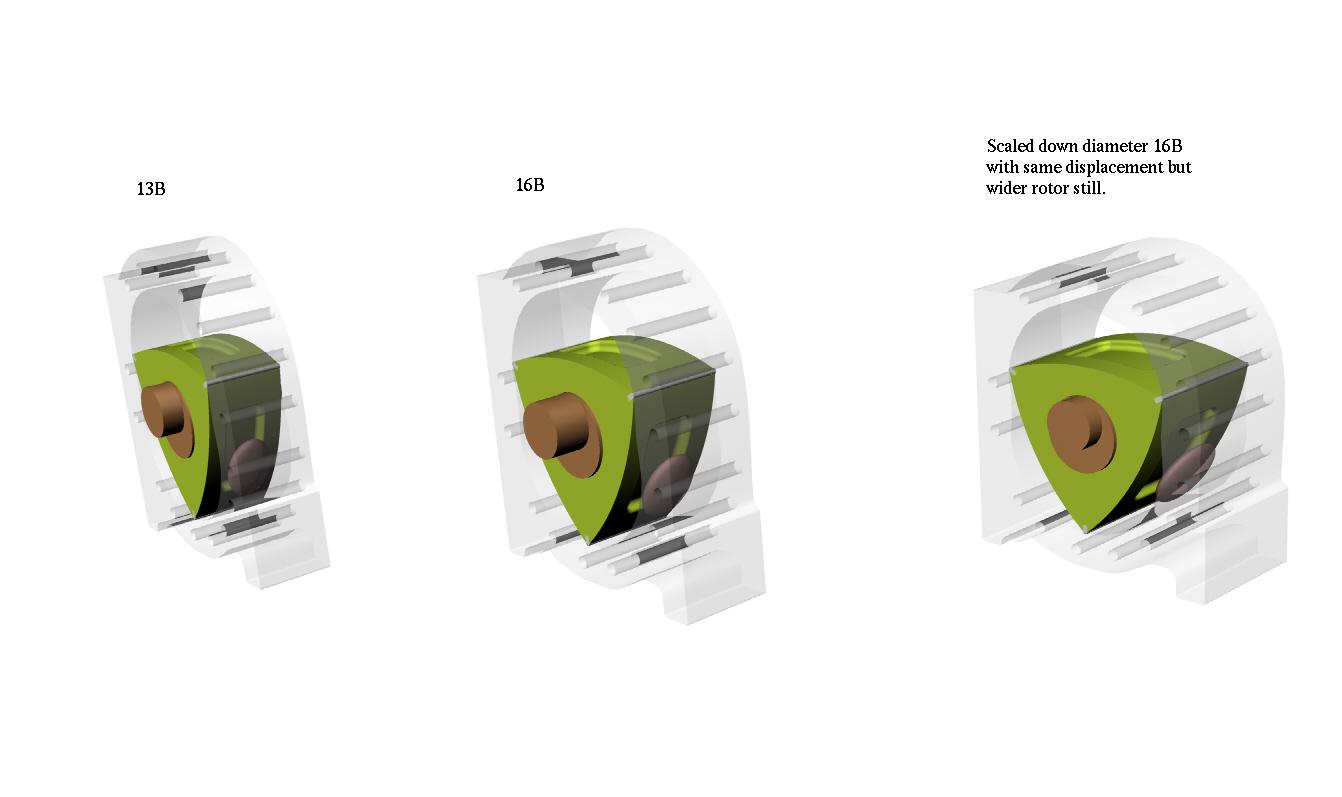
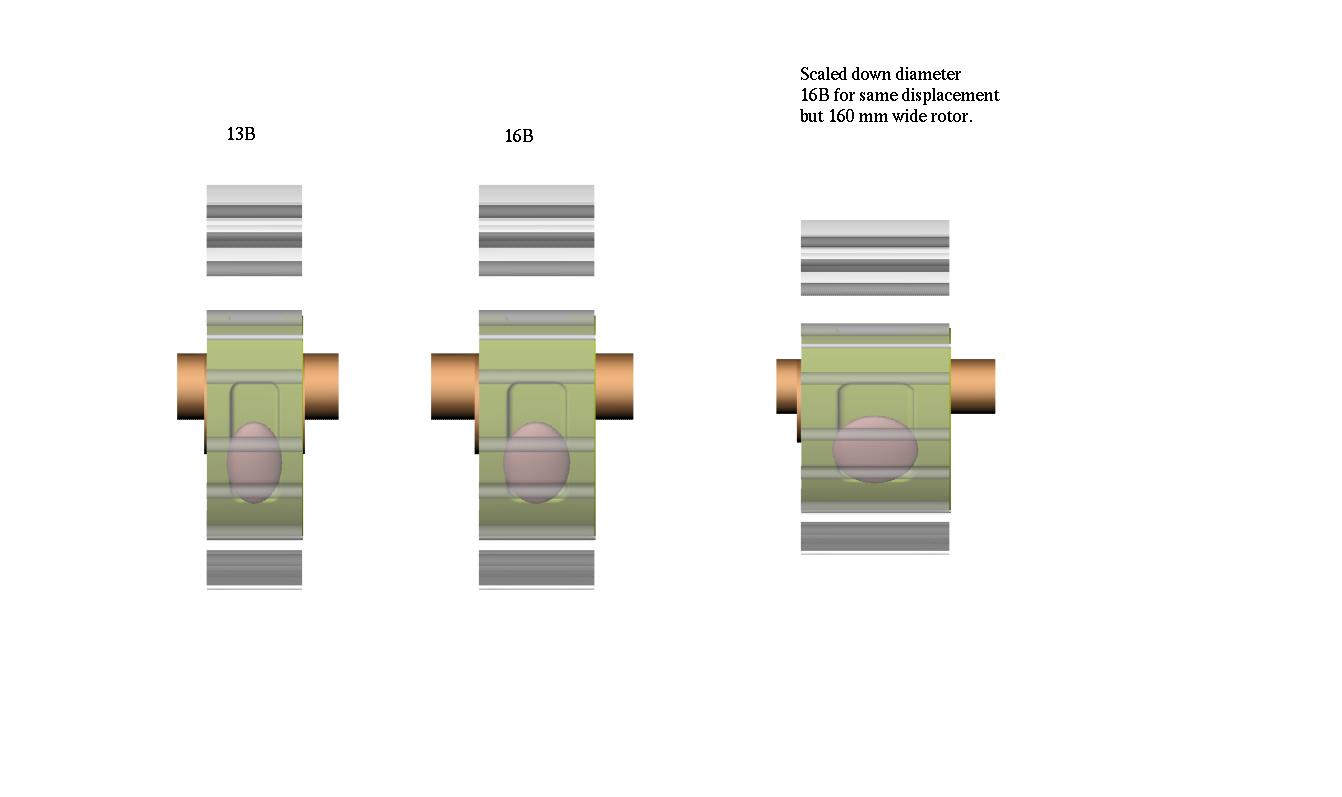
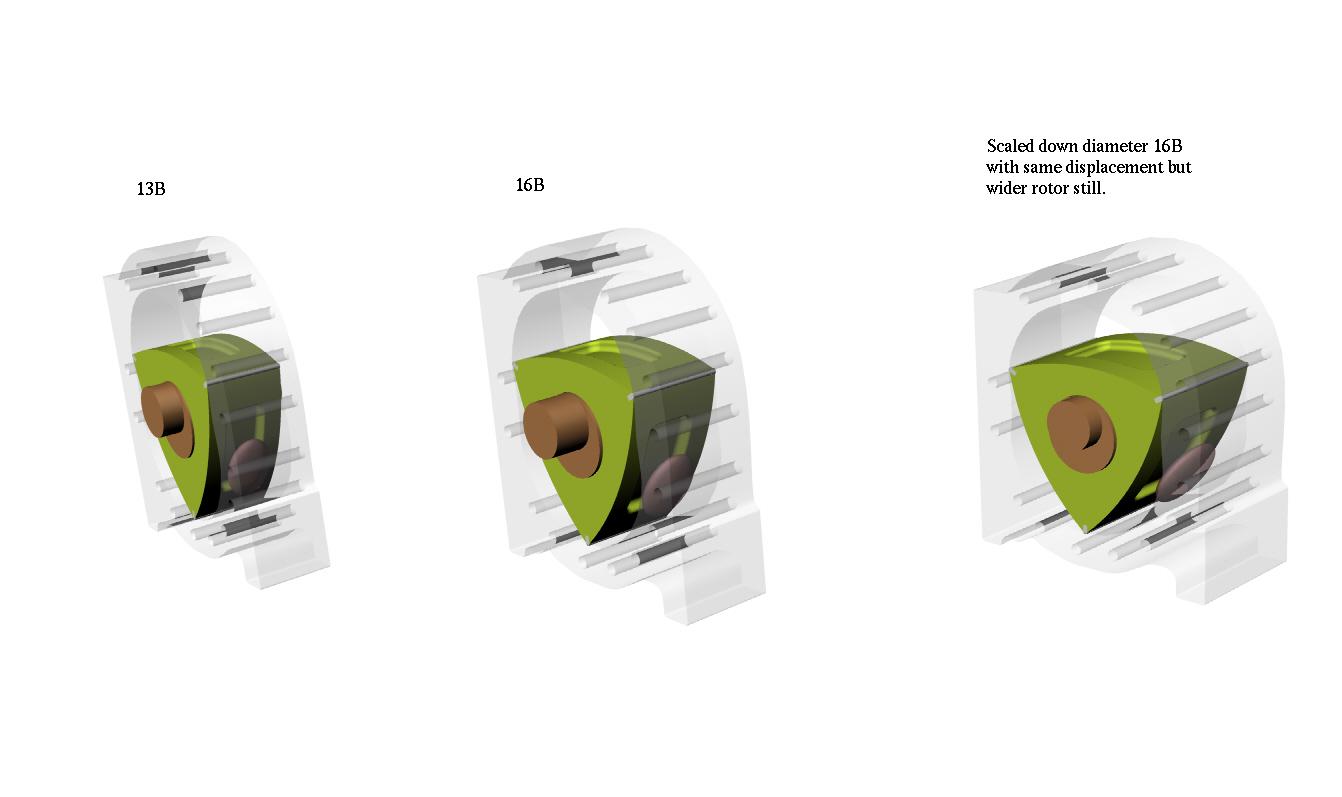
I did a few 3D's to illustrate my point about the
length to width ratio of the combustion chamber.
Up until the 16B Mazda has done few studies in this
regard as far as I am aware of. The 16B could be scaled
down in diameter keeping the displacement the same for an
even better length to width ratio.
e is the distance the rotor center is from the eccentric
shaft center. R is the distance from the rotor center to
the tip of the apex seal. The ratio R/e determines the
max compression ratio and exact shape of the trochoid of the
Wankel engine. To my knowledge very little applied research
has be done on varying this ratio. Most engines have been
built with roughly the same R/e ratios.
Paul Lamar ...No rotor no motor.
Paul... I've always accepted that there are compromises in all
aspects of changes.... I'm curious though... wouldn't the change
in aspect ratio also change the net moment arm force of the
trochoid on the eccentric shaft? (shortened moment arm = smaller
force moment = less power from your pop!)
Gary Buster,
East Texas
Yes but you will have more "pop". The "pop" is proportional to the
area of the rotor face times the pressure in the combustion
chamber. The pressure will be roughly the same but the rotor
face area will be double. What in effect you are doing is
changing the "bore" to "stroke" ratio with out changing the
displacement. You wind up with a large "bore" and a short
"stroke". A side benefit is the RPM the engine will
be capable of will be higher as the rotor bearing load
is proportional to the RPM squared divided by -- e -- or the "stroke".
Currently the rotor bearing load is what limits the RPM of the
13B engine to about 11,000 RPM.
Paul Lamar ...No rotor no motor.
The Rotary Engine NewsLetter. Powered by Linux.
ACRE NL web site.
http://www.rotaryeng.net
Copyright 1998-2005 All world wide rights reserved.