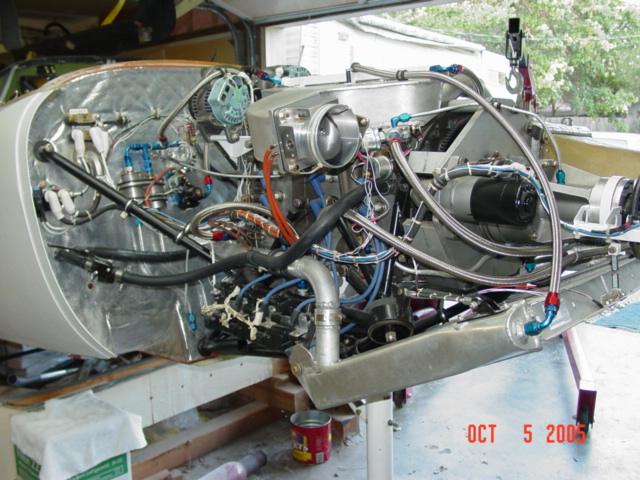
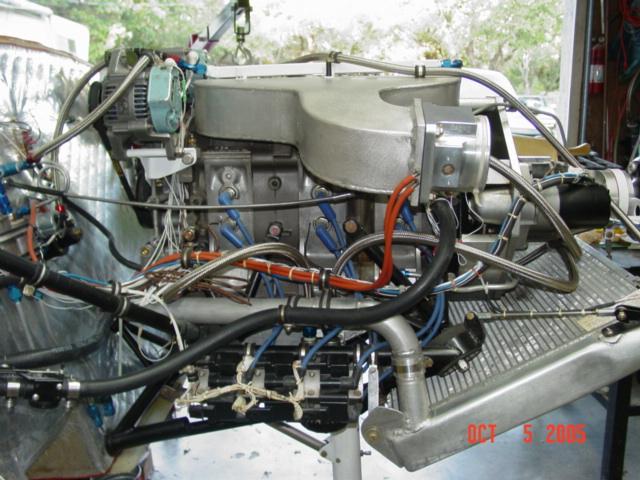
This is a preliminary motor mount and one of several
possible cooling arrangements for a Lancair ES. Since
the Lancair ES has a fixed nose gear the under the
engine location for the rad may not be practical.
This is turbo so I will do a P-port version next.
Paul Lamar ...No rotor no motor.
Paul,
From the tilt canopy, it appears that those pictures are of the
Lancair
Legacy. The mount, especially the nose gear location, looks very
similar to the ES mount though. My ES came with a bed mount which has
an extra mounting point in the lower center. I think you may need to
move the turbo as I don't think there is enough room where it is
shown.
Mark S.
Thanks Mark. I assumed it was an ES because of the nose gear.
Here are a few more pictures in addition to your first one.
Paul Lamar ...No rotor no motor.
Paul, The Legacy has an attach hard point on the firewall for the
center
point of the Continental bed mount as well. It seems to me that it
is a
little higher on the firewall than this pic of the ES.
Bill Bradburry
I am still awaiting the dimensions. These 3D's are just guesses at
this
point. Everything will have to be adjusted. Does anybody have these
dimensions? I also need the position of the thrust line and
the length of the cowl from firewall to prop flange.
Paul Lamar ...No rotor no motor.
Paul,
I'll try to get you some dimensions for you this weekend. One thing
that I noticed in your drawings is that the firewall is vertical. The
ES firewall is angled backwards about 10* from bottom to top. Look
closely at the pictures I sent and you can see it. Also, the ES uses
the same mount and strut as the IV-P, except the ES has fixed gear and
therefore uses a strut brace whereas the IV-P uses a retract
mechanism.
Another gotcha was discovering that the M/T electric prop requires a
3.5" offset due to the design. In other words, the prop flange should
not be flush with the front of the cowl. This required me to shift
the
engine aft by 3.5" from where I initially had it located. Or, I could
have extended the cowl by 3.5", but I chose the first option as the ES
is said to be a bit nose-heavy anyway. If I need to adjust the CG, I
can always move the batteries forward.
Mark S.
Thanks Mark. It is indeed a Legacy however. Is the firewall still
tilted back 10 degrees?
Paul Lamar ...No rotor no motor.
Paul,
While I'm no Legacy expert, I don't think the firewall is tilted as it
is in the ES.
Mark S.
I also found this in the Legacy manual pdf.
Makes good structural sense but pretty much rules out putting the
rad under the engine I think. I'll need the location dimensions
of this #5 point as well.
Paul Lamar ...No rotor no motor.
Paul, can the huge bay between the firewall and engine be used for
the radiator?
Perhaps. Are we talking two rotor or three rotor?
The best way to do that is bring the cold air in with a long
duct under the engine and feed it to the rad from the back
side. The wedge inlet diffuser requires less room in front of the
firewall than the outlet side (now front side) of the rad.
Here is the Continental bed mount that does not use
or require hard point #5 on the firewall.
Paul Lamar ...No rotor no motor.
Paul,
I really liked that idea, but when this design option first surfaced, I
had already located my radiator up front underneath the engine/psru.
With the radiator mounted against the ES' inclined firewall, it makes a
natural wedge-shaped plenum. Since the bottom of the radiator is out
from the firewall, it doesn't interfere with hard point #5. It does get
a little close to the main pulley though, but I think it could be made
to fit. Coolant lines would be very short too. This is my fallback
position, in case there is a major problem with the up-front design.
Did I mention that I have a spare cowl (from a IV-P)? It has 1" larger
intakes. As I recall, Tom Parkes' turbo-ES has the radiator located on
the firewall, but the cooling air is fed from the front side.
Mark S.
I think your up front rad will work fine Mark. Chuck Dunlap has his rad
there and it cools too well. Chuck had a problem with foreign
material in the rad at first. Perhaps he was using an antifreeze that
broke down at high temps. Continental had that problem with their
liquid cooled engine also. Once he put a new rad on it and sealed it
perfectly all problems with cooling went away. I am seeing that over
and over again. As soon as people seal the inlet duct perfectly cooling
problems are greatly reduced. The secret is make the inlet duct
stand alone and affix it to the rad for a perfect seal if possible.
Using part of the cowl as part of the duct is doomed to failure.
Paul Lamar ...No rotor no motor.
The Rotary Engine NewsLetter. Powered by Linux.
ACRE NL web site.
http://www.rotaryeng.net
Copyright 1998-2005 All world wide rights reserved.