Hi Paul
I am going through all of the posts on turbocompounding now and
organizing
them in an easier to read report. I am now halfway through,
complete with
graphs and websites links. I'll try to get it on CD format for you.
I came
across a note from you on 5-18-2004 advising me about the performance
limitations of the my 'heavy' amphibian prop, engine speed etc.
It troubled me for quite awhile and I didn't quite know until today so I
contacted someone who is flying a SeaWind with a Lyc. IO-540. His
engine
can rev the 3 blade AeroComposites 50lb CS prop up to 2700 for
take-off He
has an older model 290hp engine and goes 5% over to reach this rpm
only at
high lakes. A 300 hp Lyc Seawind can pull the prop to 2800 rpms.
Here is what I found out. ACI stated on their website that the 310hp
rated
props can go up to 3100 rpm but I believe that the tip speeds would be
supersonic at that rpm besides being noisy as heck and as you
pointed out
not particularly efficient.
If anyone is interested in a mental exercise here is a site to aid
you with
the calculations.
<http://hyperphysics.phy-astr.gsu.edu/hbase/sound/souspe.html>
It has some great pictures of what planes look like approaching the
speed of
sound.
According to the formula which is temperature dependent, at 66.2F
the speed
of sound will be 768.3 mph. or in metric 343 M/s. I tried to to see
if the
SeaWind sized prop disc would exceed the speed of sound at an
arbitrarily
selected 2900 rpms. Here is what I found out. A 76" dia prop works
out to
about to 6.07 meters in circumference. 2900 rpm divide by 60 secs equals
48.33 revolutions per second. The circumference of 6.07 meters is
multiplied
times the revs/sec to calculate that the prop tips are traveling 293.4
meters per sec. in an arc. Add in the forward velocity component
(100mph =
44.6 M/s) and the total tip speed which is now a following a spiral
is about
338 M/s. If I didn't just make a mistake this is below the speed of
sound at
343 M/s. Just. 2700rpm is well below.
With a ported boosted Renesis and 3.2 PSRU running at a more
normal prop
speed of 2700 the engine will be putting out close to max hp at
around 8640
rpm. But on take off climb out (best rate= drag bucket) of 99.5 mph.
and the
prop angle still flat, would the rpms drop off? I think not but its
late
now and if as example of the heavy metal saga, I obviously haven't been
thinking straight lately. Speed drops as the angle increases but I
believe
those big governed props would still be swinging at 2700 rpm? Not
so in my
C-150 fixed prop.
Time to get some C-182 air time again:) Gee its been about 15 years
since
I've flown one. Wow ..time frys.
Doug in Japan
Did you get that QB.zip I sent? That is the BASIC programming language
which you will need to run all of the prop programs I have in BASIC.
Paul Lamar ...No rotor no motor.
A useful "rule of thumb" method of doing prop calculations was told to
me by a very wise old bloke. It involves using the constant 201655. You
simply divide it by either the prop diameter in inches, or the prop
shaft RPM to get the other. I understand it takes into account the need
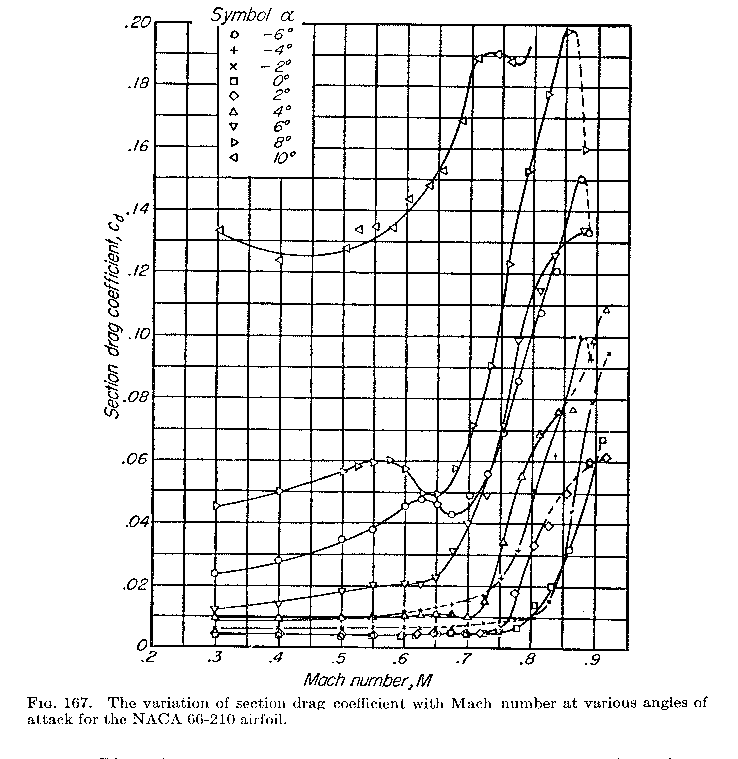
to not exceed about 0.8 Mach. This is because the air accelerating over
the camber on the back of the blade is faster than the actual tip speed.
Obviously thick props are less tolerant of high tip speeds than thin ones.
John Evans.
Think logically and do things well. Think laterally and do things better.
The Rotary Engine NewsLetter. Powered by Linux.
ACRE NL web site.
http://www.rotaryeng.net
Copyright 1998-2005 All world wide rights reserved.