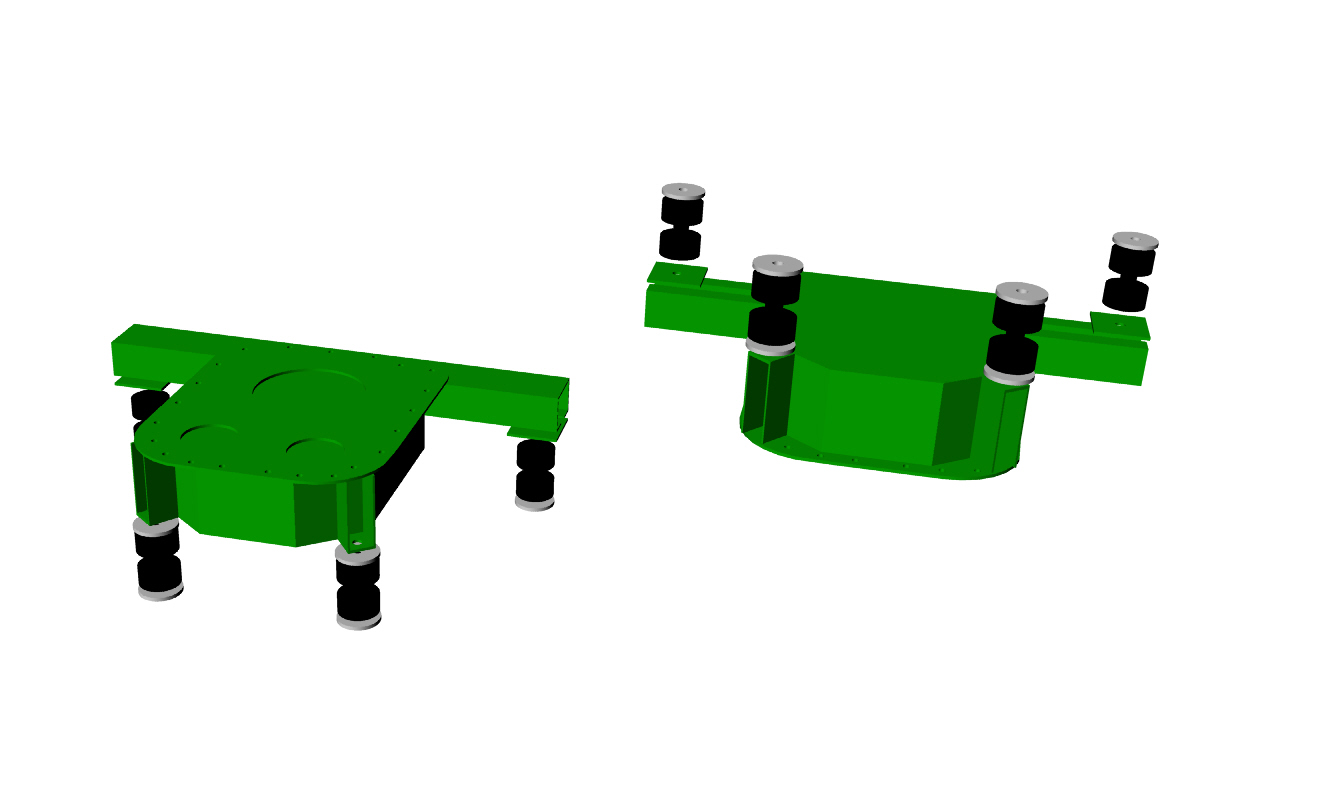
I have my Renesis engine, built by Bruce T., which looks great. I'm
working on the mounts. Your previous recommendation was to make an oil
pain with a Scherz-type beam under the front of the engine (pusher
config.), to extend out about 24" total to pick up the prop. torque.
For various reasons, I'd like to have this beam just bolt up under a
flat section of the oil pain (instead of being welded to the thin oil
pan metal).
If this beam bolts up under engine using the oil pan bolt holes, it
must
have four sides (unlike most of the current Scherz beams). I can get
2"
square tube in both SS and 4130, but the wall thickness is .065, a
little heavier than Jerry's beam (but still only 3lbs.) My
calculations
show this is way stronger than the loads you mentioned. Since this is
a
pusher with the engine right behind and above the cockpit, I'd like the
mounts to not completely fail even with much higher loads.
A smaller square (1" or 1.5") might be OK, but it would be smaller than
the 2" diameter of the rubber mounts, and there will be a problem with
the pan bolt holes (see below). I can also get 2x1" tube in .065,
which
would save some weight but lose 1" of vertical height.
I can get 6 oil pain bolts through a 2" beam, even though the outer two
are stepped back (not in line) with the others. This seems good, but
limits me from using a smaller beam that would only get the first four,
in-line bolts.
My questions are:
1. The current oil pan bolts are only 5mm, but I will have 6 of them.
Should I tap these holes out to 6 mm for extra strength? I can get 6mm
x 1.0 grade 12.9 cap bolts and the drill hole size will work.
2. The beam will need holes on both the top (5 or 6 mm for the bolt
itself) and the bottom (8-9 mm to pass the bolt and wrench through).
Would these 6 holes on the top and bottom of such a beam significantly
affect its strength?
3. Considering the bolt holes, would a smaller beam (such as 1" high,
2"
wide) be adequate for the front mount?
4. My welder says he can do the oil pan a lot easier if the rear mounts
are not an integral part of the pan, but a separate beam. This beam
would only have about a 1.5" cantilever, but a much greater load.
Would
any of the above considerations apply to a rear beam as well?
Thanks,
Scott Gettings
We never advocated welding the front Schertz beam to the oil pan
Scott. Or
at
least I did not. That is also not to say it won't work.
However don't reject thin sheet steel out of hand. It will take loads
if
properly applied. If you weld the rear MM ears to a curved peice of
.065
4130
and then weld that to the oil pan it will be way strong enough to take
the 50 pounds of load experienced at the rear mount. Way over kill in
fact.
In your case the front mount.
I don't know what idiot started the nasty rumor that sheet metal oil
pans
will
take no load. It is an out an out lie.
I don't think you are going to find 4130 rectangular tubing anywhere
near as
large as the 2" by 3" Schertz beam Jerry sells. At least I have not
been
able to
find it so far. Since strength goes up with at least the square of the
dimensions Jerry's S beam is probably four times stronger than
anything you
can
buy off the shelf with near the same wall thickness and weight.
The other factor is there is near zero torsion on a Schertz beam so a
closed
section is not required. "I" beams are not a closed section nor are
channels.
Both will take considerable bending loads to say the least. However if
you
feel this is important I am sure Jerry will weld some 4130 sheet metal
on
the
bottom to close the section and make it torsional stiff.
Tapping it out to six mm bolts won't hurt. You could also add these
clips
shown in the 3D which will make the assemble stronger for gyro pitch
loads.
----------------------------
For what it's worth, My beam mount is a piece of 2"x1" .065 rectangular
stock, with bolts through the beam to pick up 6 bolts. I also have a
set of
'ears' to pick up a bolt further back on the oil pan.
If you go this route, I recommend welding in spacer tubes between the
surfaces of the rectangular tubing so that you can properly torque the
bolts, otherwise the rectangular tubing will have a tendency to bend
inwards.
If I were doing it over, I would use one of Jerry's bent up beams.
Bill Schertz
KIS Cruiser # 4045
--------------------------------
Thanks for the new pictures.
Nice oil pan Bill.
Paul Lamar
Beautiful, work, Bill. Thanks for all your research on this issue.
And thanks, Paul for letting this thread live on to answer my dumb
questions!
Bill, did you use larger bolts than stock to attach your beam?
My previous post was in error -- the stock Renesis oil pan bolts are 6
x 1.0 mm, round socket (alan head) bolts.
Since the bottom of this beam is in tension, would it be acceptable to
have holes in the lower surface just large enough to pass the bolt's
round head through, and have the bolts just grab the upper, 'inside',
surface of the beam? Getting washers on them would be tricky, but
possible. If not, the welded spacers seem very reasonable for larger,
hex-head bolts that went all the way through. In my application, a
closed beam would be a little easier.
Scott Gettings
Sure Scott that will work fine. What the stock beam is two channels back
to back. Think of the bottom slot as a way of getting the bolts in there.
Kind of tricky no doubt. If you closed it then added spacers welded in would
work fine and the strength of the beam would go way up.
If this is the configuration you are working with the six G vertical shear load
of 1800 pounds on the two rear brackets assuming the pan is welded from .049
4130 sheet is 900 pounds per side or 450 pounds each vertical sheet ear. The
.049 4130 sheet ear is 4.5 inches high so that is .22 square inches for each
interface. Assuming the ears ARE NOT welded to the flange. Welding the ears to
the flange will make them stronger yet.
The shear stress level is then 450 divided by .22 square inches or 2,045 psi.
Nothing for 4130 as 4130 will easily accommodate 60,000 psi or 30 times
as much. One rubber bushing on one side could disappear and the oil
pan would still survive multiple hard landings.
When the beam is on the front of the engine like this the beam loads are 90%
prop torque or about 400 ft pounds or 4800 inch pounds. The bushing spacing
is roughly 22 inches center to center so one bushing will see +110 pounds
and the other will see -210 pounds.
Assuming only the outer pan bolts are taking the tensile load due to the torque
and there are no gyro clips it is seeing 4800# / 12" or a tensile load of 400
pounds. The other side is in compression so there are no loads on the bolts from
this source. Six mm is .2362 diameter so for our purposes the root of the
threads we will assume are only .2 inches. The root area would then be .031416
square inches. 400 pounds divided by 12,800 psi. Well within the capabilities of
the 6 mm bolt. An 8 mm bolt would make it some what more conservative 9,600 psi.
If the S beam is welded to the pan then the loads are shared by several bolts
and no gyro clips would be needed. It would then be necessary to do an
FEA to estimate the stress but in no case would the bolt stress be higher than
what we just calculated.
This is eliminating the anti torque contribution of the rear motor mounts. This
is a simple analysis.
If one needed a more detailed analysis one would have to take into consideration
the hardness of the rubber bushings involved. Things would be
easier to analyze if there were only one rear mount. If we have redundantly
constrained situation here with four rubber mounts. In that case the one
rear mount would take 100% of the landing load the the front s-beam would
take 100% of the torque load for calculation purposes. Nothing in here
is the least bit marginal. Way over kill no matter where you look.
You need an oil pan anyway you might as well put it to work and
save some weight.
Paul Lamar ...No rotor no motor.
The Rotary Engine NewsLetter. Powered by Linux.
ACRE NL web site.
http://www.rotaryeng.net
Copyright 1998-2005 All world wide rights reserved.