Hi Paul-
Starting on the fuel plumbing for the engine. What PSI pressure
regulator am I looking for? Any reason not to simply screw it directly
into the fuel manifold?
Mark Supinski
You need a intake manifold pressure referenced fuel pressure
regulator on the
outlet end of the fuel rail. Manifold regulators have a 1/4 inch
hose nipple to
connect the regulator to the intake manifold in addition to dash 6
or dash 8
AN inlet and outlet lines. That is sometimes called a gage port for some
strange reason. That increases fuel pressure as the throttle is
opened and
intake vacuum is reduced. The amount of fuel injected is directly
proportional
to the fuel pressure AND the width of the injector pulse from
Tracy's system.
This is what you need for Tracy's system.
Don't use a fixed value pressure regulator. Usually these are ground
adjustable
but they don't change as the throttle is opened. Required fuel
pressure is in
the range of 40 to 60 psi. You could try a $134.95 MagnaFuel
MRF-MP9925 from
Summit but I am not sure it will not leak intake manifold pressure.
If it don't have AN fittings don't use it. Too risky for an
aircraft engine application. Leaking high pressure fuel and an in flight
fire can ruin your whole day.
I tried a $200 Aeromotive AEI 3109 unit from Summit Racing and was
very unhappy
as it would it would not hold a vacuum. Called Aeromotive and they said
they all leaked and it was not a problem. Naturally I did not
believe them.
Find something else. Try TWM. Ask them if it leaks a vacuum.
My first choice was a Mallory unit but Summit was back ordered at
the time.
Get a hand vacuum pump from the auto parts store
hook it up to the gage or intake manifold 1/4 hose nipple on the
pressure
regulator and pump a vacuum. If it leaks down the unit is suspect.
I talked with Tracy C. about this, and his suggestion was the stock
Mazda unit. Any reason that would not be appropriate for the P-Ported
13b? Just wondering whether the P-Port would require more flow than the
stock can accommodate??
Mark Supinski
I don't know if the stock unit will handle the p-port engine flow
requirements. Probably worth a try. The biggest drawback to my way of thinking
is it uses hose barbs and hose clamps. Not something you want in a 50 psi
aircraft fuel system where a pin hole leak can result in an in flight fire.
I am not sure a fuel air explosion is not out of the question.
It does not pay to use cheap plumbing in any aircraft. Best to use AN fittings
in this application. In our seven years of experience so far it is always
the plumbing and other details that will get you. Mostly the plumbing.
Paul Lamar
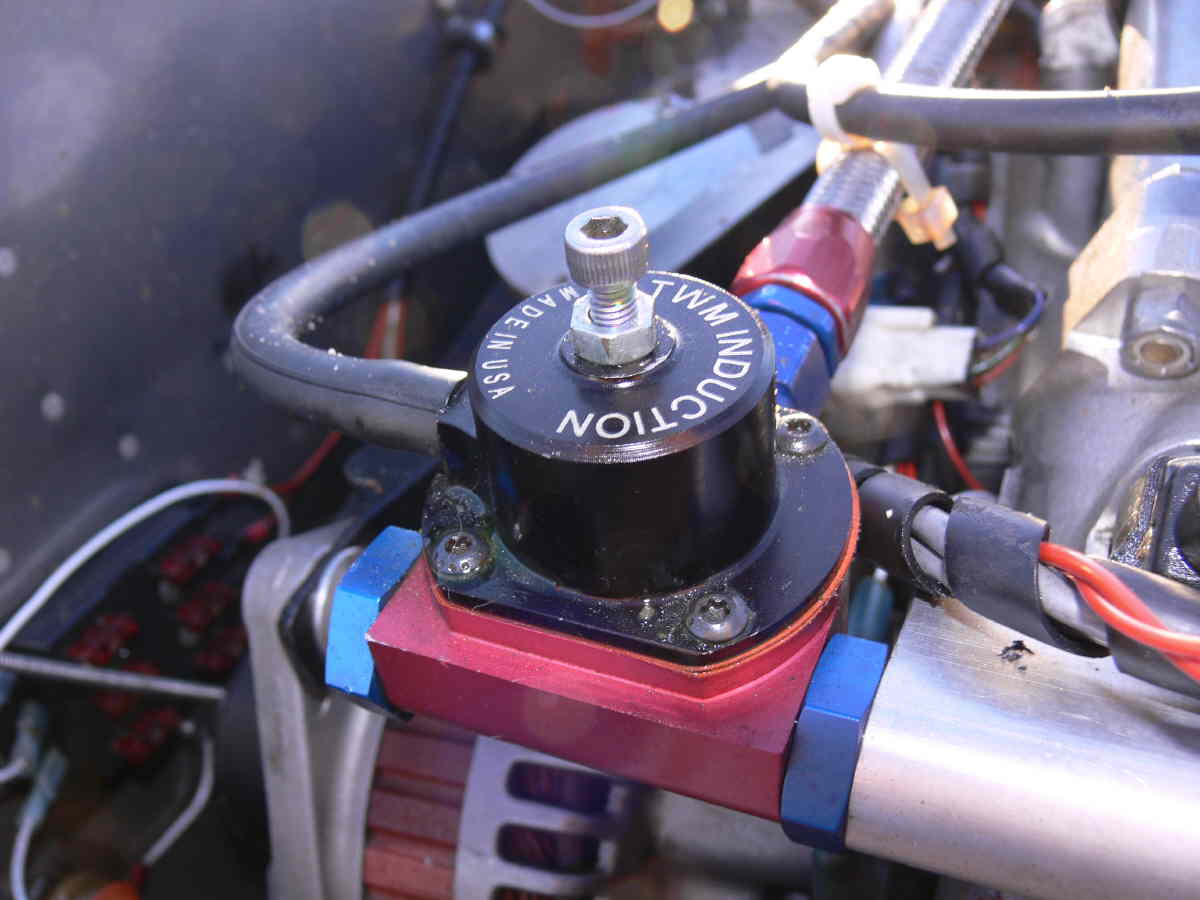
Mark Here is the TWM regulator that Dave Leonard was using. If it
is good enough for the turbo it should work for your P-port.
Paul Lamar ...No rotor no motor.
The Rotary Engine NewsLetter. Powered by Linux.
ACRE NL web site.
http://www.rotaryeng.net
Copyright 1998-2005 All world wide rights reserved.