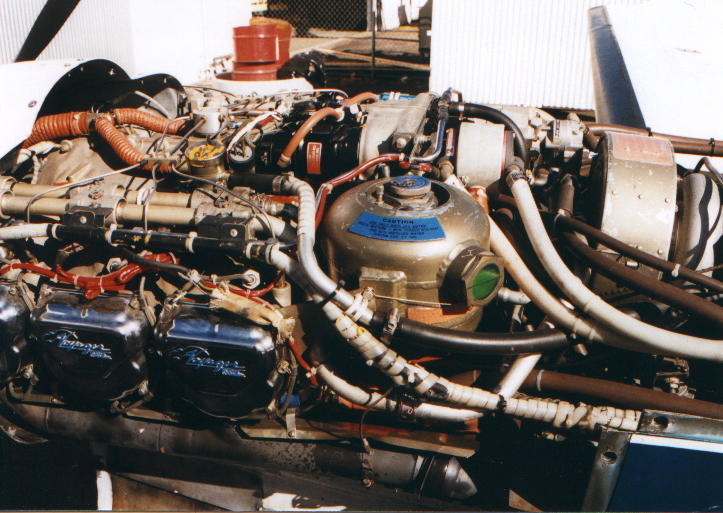
You know I have been looking at the cooling system issue. and the
lengthy discussions about it.
Here is a simple solution that covers everything that has been talked about
Will run anyway up without any loss or concern of loss of liquid.
Will allow and engine to run inverted for extended periods of time
without a problem.
I have made and used such systems on some of the racing engines I have
built in the past this just works.
You must a have pressure relief somewhere in the cooling system should a
major failure occur somewhere else in the cooling system otherwise the
radiator will be the thing the gives in.
Liquid section must be at the top when bleeding the system the floating
piston should be at least at center of the cannister when the engine is
cold.
Regards David Gaze
David, what are the dimensions of this can?
Paul Lamar
------------------------------------------------------------
How much reserve coolant do you want to have?
I would not normally expect more than say 500 to 600 ml (about a pint)
Provided the cooling system is properly sealed (No leaks) this would be
more than enough
What will be the maximum pressure the cooling system can run at ?
Do you have an area it needs to fit into ?
Also, I can create a quick design that could keep a cooling system
supplied with extra coolant for a while should a leak develop, provided
the leak was slow one.
The only draw back with that is you would be carrying extra coolant
which adds weight but would allow extra time in the air should one develop.
It also could sit almost anywhere in the craft it is not limited to the
engine area.
Could / should also have indicators that showed up in the cockpit should
the reserve system drop to say 90% due to fluid loss, a second one that
showed up when the reserve was say at 50% and a third when it was 90%
empty. This is all simple stuff but it would give a pilot time to make
intelligent decisions based on the state of the cooling system.
.
Let me know, I have done a reasonable amount of work with cooling
systems over the years.
Regards David Gaze
------------------------------------
That is a real good question. The size of the air chamber is going to control
the rate of pressure build up with coolant expansion.
At room temp Continental chose what looks like about a gallon for the air
chamber as a wild ass guess.
The engine is a 550 cubic inch six cylinder 350 HP turbocharged engine.
Here is a picture of the pressure can. This sucker has about a 1/4 wall
six to seven mm and it pops off at 50 psi. I have no idea how many
gallons of coolant are used but it looks like about 1 gallons in the pressure
can alone. At least another gallon in the engine and rad and probably two.
Wait a minute I just remembered I had a Aero Space Engineering tech paper
on the installation.
Apparently I am way over estimating the size of the pressure can. According
to the tech paper on the subject the pressure can is only 4.9 liters or 1.3 gallons.
Here is a picture I took and a diagram from the tech paper. Looks a
whole lot bigger than 4.9 L.
There appears to be two separate cooling loops.
One for each bank. Coolant comes out of the pump and goes directly to the
cylinders. It comes out of the cylinders and goes into the tank. And then
the main flow goes to the rad and then back to the inlet of the pump.
There is also a "bleed" line to the input of the pump from the coolant
tank.
BTW Kind of dumb to use a thermostat as an automatic cowl flap would
cause less drag at cruise.
120C or 248 F was experienced. The cylinders were designed for this temp.
Kind of high for a rotary but good for BSFC. This caused the EG to break
down and clog the rad until a special EG was formulated.
A pressure rise of 207 KPa or 30 psi at a flow rate of 114 L per minute
or 30 gallons per minute (about the same as a rotary) was also experienced.
Chuck Dunlap in his rotary powered RV6 had a clogged rad too. I wonder if the
same thing was going on. A special EG was formulated with out silicate
containing carboxylic acid to solve the rad clogging problem.
I'll have to revise my plumbing diagrams for a completely sealed aerobatic
system based on this info.
Paul Lamar ...No rotor no motor.
The Rotary Engine NewsLetter. Powered by Linux.
ACRE NL web site.
http://www.rotaryeng.net
Copyright 1998-2005 All world wide rights reserved.