>Do you have an area to mount this i so what is the size
>
>width x height by length please.
>
>It would be nice to know that what I draw will fit in the place it is
>going to go. :-)
>
>Regards David Gaze
>Technical Director
>Corporate Systems Pty Ltd.
>
>The firewalls are usually about 24 (600 mm) to 30 inches (760 mm) high.
>
>the Tail Wind is one of the tightest installations you will find.
>
>Paul Lamar ...No rotor no motor.
Tighter than an RV-4 ?? This I gotta see P-)
Firewall motor mount points are 23" wide X 20" tall. The cowling is
a bit taller than this but no wider.
Due to the step on the RV-4 firewall there is no room for a tall can
(and there is no room left there anyway). I would strap one to the
outboard side of the motor mount tubes between the motor mount and
the cowling. This would make it very tall and skinny. This also
makes the piston slide up and down easier and less prone to jamming.
I would ask for a Floating Piston P-tank (tube?) that is:
2" or 2-1/2" (max) OD and about 18" - 20" tall (including fittings).
This I would mount on the outside of the engine mount frame strapped
to the upper and lower tubes. It would end up between the mount and
the cowling.
I see on your Tailwind renderings the S-beam mount points peeking out
of the cowling. This size tube might fit on the inside of the motor
mount tubes for your (ahem) wide-body folks (no pun intended).
Mike McGee, RV-4 N996RV, O320-E2G, Hillsboro, OR
13B in gestation mode, RD-1C, EC-2
------------------------------------------------------------
Well that was just one rendering Mike. Either shorten the S beam
or make the cowl wider at that point :)
Paul Lamar ...No rotor no motor.
----------------------------------------------------------------------------
OK I'm going to long winded.
I will most likely repeat myself (a bad habit of mine) sorry in advance.
I'll redesign it as required once I have more information.
I do not have an RV or similar plane here. So I cannot just go measure
this.
So the simple way is to provide the HEIGHT x WIDTH x DEPTH for the place
where you are going to put it!
If you have an area that is 300mm [11.8"] x 250mm [9.8"] x 120mm [4.7"], Then a single
canister would be limited to
maximum of 280mm x 110mm x 110mm allowing for a 10mm clearance all
around, assuming it is mounted on a wall of some sort.
I really prefer the clear space available where it will go rather than
the dimensions you would like it.
How much fluid is in it, is neither here nor there unless you want to
compensate for a "leak" which you should not have.
Past units, I have made have allowed only 150- 200ml (less than 1/5 of a
pint) after all, if the cooling system is properly sealed then really
only expansion is required.
Following is a looooonnnngggggg and rambling explanation of floating a
piston canister and other things to remember about cooling systems.
In a FLOATING "Piston" system.
There is no need to have ANY fluid exit / bled from the cooling system
at all.
A regular car system does because it is cheaper to do so and they do not
ever drive inverted. Accidents not included.
A floating piston system dynamically allows for the fluid to expand and
contract.
The only reason for a catch can like in a car system is when a cooling
system exceeds the maximum pressure of a relief valve such as a radiator
cap it has somewhere to go,
since there is no dynamic expansion allowed within the cooling system in
a car it must exceed the pressure relief valve (Radiator cap)
Once the car has cooled down outside pressure will push the coolant back
into the radiator provided it has the right type of radiator cap to
allow for the return of what has been expelled because the pressure
outside the cooling system exceeds the pressure inside of the cooling
system. (In physics there is no such thing as suction!)
In a floating piston system the cooling is COMPLETELY sealed in the true
sense of the word.
The floating piston canister does not have coolant flowing through it.
It has a single connection point to the cooling system.
Only excess fluid caused by expansion will move into or out of the
canister on the fluid side of the piston.
Coolant has a given expansion by volume at a given temperature for a
given type of coolant.
It then can be calculated how much the volume will expand for a given
amount and type of coolant.
This information can normally be obtained from the manufacturer of the
coolant if they are any good.
The floating piston system can be quite small but it does depend on how
much the expansion of the coolant there is.
The volume expansion of the coolant is a NEED TO KNOW thing otherwise it
is very hard to calculate how small or big to make the expansion system.
About thermostats.
Other things to remember.
A thermostat in a cooling system is there for several reasons.
1. To bring the cooling system / engine up to temperature more quickly.
2. To control the FLOW RATE of the coolant through a cooling system to
ensure a constant temperature. (this is one most people forget)
3. To control the FLOW RATE so that the coolant can dissipate the
sufficient heat while it is flowing through the radiator/s.
(This is the one most people ignore or do not understand!)
Be aware that most engine driven water pumps will pump water through a
cooling system much faster than is actually required.
This means that the coolant does not get enough time in the radiator to
dissipate enough heat.
Having an uncontrolled flow rate can lead to more problems than one can
believe.
Air flow is something I saw elsewhere (It was either Tracey's or Paul's
website that had some good info)
Which provides an excellent description of what to do to ensure proper
air flow through radiators.
If the engine was designed to run with a thermostat it is typically
better to continue to use a thermostat.
The reason is that you will get controlled flow rate through the cooling
system and a controlled temperature.
The engine will then run at a more constant and even temperature which
is better for engine reliability and life.
It is also less likely to boil as the coolant entering the engine should
have had time to dissipate adequate heat while traveling through the
radiator.
It is really important to note too little cooling area in the radiators
and the engine will boil every time, no matter what you do.
Too little air flow and the cooling system will not be able to dump
enough heat before entering the engine again the result will be boiling
again.
A Floating Piston coolant expansion tank needs to be pressurized all the
time even when cold, how much depends on the engine it is connected to.
What happens when using such a system,
The cooling system is pressurized to a suitable pressure which depends
on the coolant expansion properties, and diameter of the floating piston.
In an engine runs at, say 20 psi in the cooling system under normal
operating conditions.
The radiator cap might have a pressure relief blow off of say 40 psi for
blow off purposes if something goes wrong, such as a cylinder to cooling
system leak for instance.
Warning indicator lights to show if the pressure in the cooling exceeds
Y psi or drops below X psi.
Either of these conditions WILL indicate a potential problem with the
cooling system.
Remember we are not letting out any coolant to the outside world.
We are allowing it to expand into the floating piston storage tank it
does not need to exit the cooling system.
We can expect a certain range of pressure that the engine will run in.
We must have a blow off should the worst happen, the blow off must only
activate if the worst happens.
The rest of time the cooling system should not leak.
Nobody ever wants this hence the reason for a warning light due to a
pressure drop below X psi.
If a cooling system is designed to operate at 110 deg C, and the cooling
fluid expands by 2% for this temperature and the total cooling system
contains 8 liters (US 2 gallons approx) then we know that the expansion
of the fluid will push approx 160ml into the floating piston canister.
Once we know that, then we also know that once this has occurred the
pressure within the cooling system should be at the correct operating
pressure.
We can now adjust the air pressure to ensure that this is what the
cooling system "sees" for normal operating temperatures.
If the temperature exceeds this then a small amount of additional fluid
will be pushed into the floating piston canister fluid side with an
appropriate increase in pressure to resist it.
If a cooling system exceeds the rated temperature of the coolant then
boiling WILL occur and the primary blow off value will "let go"
(typically the radiator cap for most people) this is a function of air
flow and or insufficient radiator area or both in most cases.
This is where the size of the floating piston, the travel, the size of
pressure can is determined for a given cooling system.
Unlike a just a can that contains a place to store excess fluid, with a
floating piston as the a mount of fluid increases so the air chamber
will push back harder this means that the boiling point also is
increased, well up to a point (thermo dynamics 101).
Once the pressure in the cooling system exceeds the blow off valve in the
cooling system (radiator cap for most) then nothing will stop it boiling
anyway.
I know I have repeated myself a few times above, Sorry.
Regards David Gaze
Technical Director
Corporate Systems Pty Ltd.
---------------------------------------------------
Sounds like it is too big for most airplanes Dave.
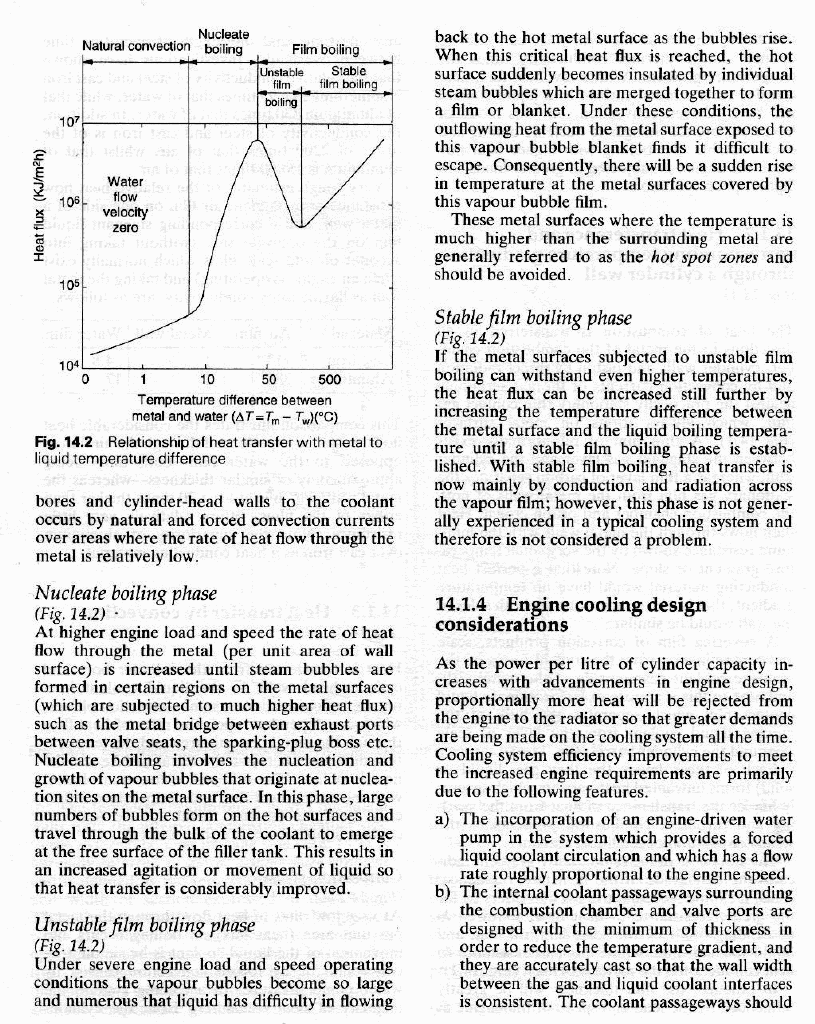
Everything you say is true but you did not mention the bubbles
problem. If you heat a pot of water small bubbles form
long before the pot boils. In fact nucleate boiling IS REQUIRED
to transfer heat at the necessary rate from the metal to the coolant.
Here is another reference to the bubbles problem. As far as I can
tell there is no way for the excess air or vapor can get past the piston.
The cowl flaps are fully capable of keeping the engine in
a warm condition by limiting the air flowing through the heat
exchanger. In an aircraft one must minimize cooling drag
and a thermostat will not do that. Cooling drag relates
directly to speed and MPG as it can be as much as 30% of total
drag... unlike a car. At 100 MPH full power climb speed
plenty of air is required to cool the engine.
At 200 MPH cruise and 65% power the air pressure available to force air
through the heat exchanger is four times as much as it is a 100 MPH.
There for the airplane will experience high cooling drag due to the
unnecessary excess air flowing through the cooling system.
Furthermore any restriction, such as a thermostat, placed in the cooling
system fluid passages will increase the HP consumed by the
water pump at any given RPM and increase fuel burn slightly.
We have built a water pump dyno and demonstrated that.
Paul Lamar ...No rotor no motor.
The Rotary Engine NewsLetter. Powered by Linux.
ACRE NL web site.
http://www.rotaryeng.net
Copyright 1998-2005 All world wide rights reserved.