Sounds like it is too big for most airplanes Dave.
Everything you say is true but you did not mention the bubbles
problem. If you heat a pot of water small bubbles form
long before the pot boils. In fact nucleate boiling IS REQUIRED
to transfer heat at the necessary rate from the metal to the coolant.
Here is another reference to the bubbles problem. As far as I can
tell there is no way for the excess air or vapor can get past the piston.
The cowl flaps are fully capable of keeping the engine in
a warm condition by limiting the air flowing through the heat
exchanger. In an aircraft one must minimize cooling drag
and a thermostat will not do that. Cooling drag relates
directly to speed and MPG as it can be as much as 30% of total
drag... unlike a car. At 100 MPH full power climb speed
plenty of air is required to cool the engine.
At 200 MPH cruise and 65% power the air pressure available to force air
through the heat exchanger is four times as much as it is a 100 MPH.
There for the airplane will experience high cooling drag due to the
unnecessary excess air flowing through the cooling system.
Furthermore any restriction, such as a thermostat, placed in the cooling
system fluid passages will increase the HP consumed by the
water pump at any given RPM and increase fuel burn slightly.
We have built a water pump dyno and demonstrated that.
Paul Lamar ...No rotor no motor.
--------------------------------------------------------------------------------------------------------------------------------------
No not at all it can be quite small. The technology of coolants has
changed somewhat.
Thermostats can be used or not but flow rate does control how well
cooling systems work.
keeping an engine at constant temp will improve engine life.
200ml + 160ml is about a can of coke and that is about the diameter I
would normally use.
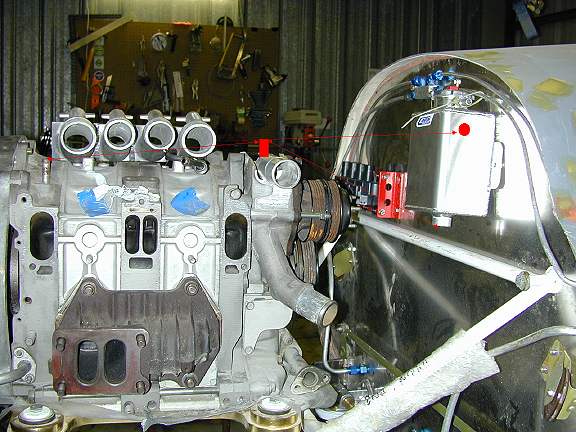
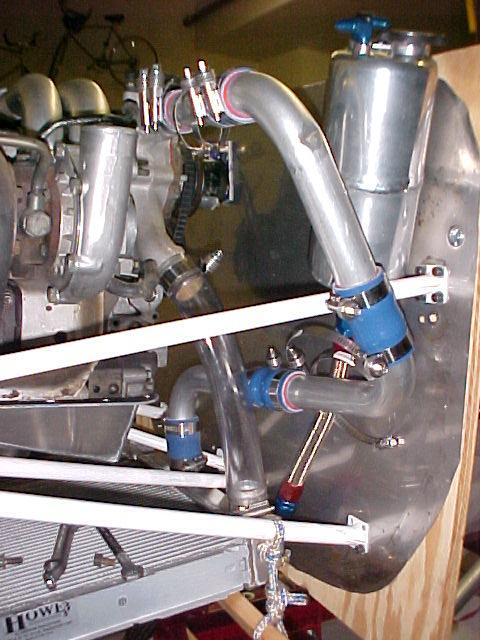
Too big how big is the catch can in you plane now ?
I assume it holds at least 1 litre / US 1 pint .
How much coolant exits the cooling system when it is running at full temp?
This will give me a pretty good idea the sizing needed.
Without some information in terms of volume expansion I can't do a design.
So I need to know how much coolant is expelled from the cooling system,
When it is running at operating temp,
When it is running at full power and temp
preferably in millilitres or litres this should be fairly easy to
come-up with.
what is the total amount of coolant in the cooling system.
The rest we can ignore it is not really required for floating piston
canister/s sizing.
It was me rambling on, I do that from time to time. :(
Regards David Gaze
Technical Director
Corporate Systems Pty Ltd.
-------------------------------------------------------------------------------------------------------------------------
In my plane it is about 2 quarts and that is quite typical for most
pressure cans. I have a rather wide firewall say compared to a
RV4 for example. I am not running the engine yet so I don't know
the answer to that. I can say the Continental six is pressure can is
about 5.9 liters with about half of that devoted to air space
with a 50 psi max at 250 F.
My guess is the rotary holds about a gallon and a half total. I am guessing.
Dave Leonard would know.
Paul Lamar ...No rotor no motor.
The Rotary Engine NewsLetter. Powered by Linux.
ACRE NL web site.
http://www.rotaryeng.net
Copyright 1998-2005 All world wide rights reserved.