Paul
The BSFC on the 420hp JetRanger is .417 according to my calculations.
[snip]
There is a fellow here in Austin that has a 1 set helicopter with
one of
these engines. I think he said it idles at 12 gph and 14 gph WOT.
Bobby Hughes
He is dreaming :) That is a BSFC of .525 no way in hell will that
happen
with a small turbine.
Paul Lamar ...No rotor no motor.
Paul
The BSFC on the 420hp JetRanger is .417 according to my calculations.
Kevin Jarvis
If that really is the case why are we screwing around with rotary and
piston
engines let alone diesel engines :)
Up load your calculations and we will see where you went wrong :)
What HP are you using. Do you know? How are you measuring it?
Do you have rotor torque and RPM numbers?
Paul Lamar ...No rotor no motor.
Paul.. these numbers below came from:
http://www.heliswiss.ch/en/home/jetranger.htm
Turbine: Allison 250-c20b
Performance: 420 HP
Fuel consumption: 100 l/h
100l = 26.41gal [my calc]
and then earlier today I stopped at the local Sheriffs hanger (Collier
County Fl.)
and asked one of the pilots about their Jet Ranger. He said 22 gal per
hr and
the same 420 hp. That works out to even lower than .417
This is not hard to believe..
Kevin Jarvis
Yes it is!
Keven, he is not running the engine at 420 HP. If the engine could do
that
there would be absolutely no need for diesel engines in tractor
trailer trucks or boats or anything else. That BSFC (.417) is in the
range of diesel engines. The entire world wide piston engine
manufacturing
would cease tomorrow. The M1 A1 Abrams tank would have twice or three
times
the range it has now.
Turbine: Allison 250-c20b
Performance: 420 HP
Fuel consumption: 100 l/h
Rotor span: 10.16 m
Overall length: 11.82 m
Width: 1.92 m
Overall height: 2.90 m
Unloaded weight (without fuel): 820 kg
I can believe .65 BSFC for a good small turbine which would
be 26 GPH at 240 HP or about 60% max power. I know nothing about
helicopters.
Will they stay in the air at 60% power? How much power does it
take fully loaded? Empty and low on fuel? As I understand it take more
power to hover out of ground effect than it does to fly forward.
Paul Lamar ...No rotor no motor.
Paul
I just talked to a MedEvac pilot that I know. Their helo has a 723hp
turbine. They plan for fuel consumption of 53gph avg.
That is BSFC of .488 They run the engine near max continuous nearly
always. He was familiar with the model turbine on eBay, said it came
from a Chinook and would probably burn 10-12gph. Not bad for 160hp,
about .5 I think.
As for routine operations, turbines are not run at 60% or 50% etc. The
engines in the Citation II run at 104% at altitude. Anything less and
the cost per mile increase, strange but true. And as he said they run
the Med helos at max cont.
There are many reasons that we are not seeing turbines replacing diesels
in trucks, boats, farm tractors etc. Two come to mind, initial cost and
the cost of operation considering the turbine runs better at max
continuous rather than up and down the power scale as would happen with
the truck, boat, tractor scenario.
Kevin Jarvis
"He was familiar with the model turbine on eBay, said it came
from a Chinook and would probably burn 10-12gph. Not bad for 160hp,
about .5 I think."
As a Chinook pilot why would he know what
power level the Chinook APU was generating? Ask him how many
watts the Chinook APU was generating at what altitude when it
was burning 10-12gph.
Dan Grey here at SZP has a Check turbo prop PT6 copy in his
Legend he tells me it burns 50 gallons an hour at high altitude
cruise were the power level is way down. A Turbo charged piston
engine can generate far more power than a turbo prop at
high altitudes.
The Citation II engine is not a turbo prop engine nor is it used
to power helicopters. Turbo fan engines are not rated in BSFC.
They are rated in pounds of thrust per pound of fuel burned.
Further more you are talking 40,000 feet while a helicopter
finds it hard to get over 18,000 feet. The pounds of fuel
burned in a Willams WJ24 is 1.2 pounds of fuel burned per
pound of thrust. Apples and Oranges.
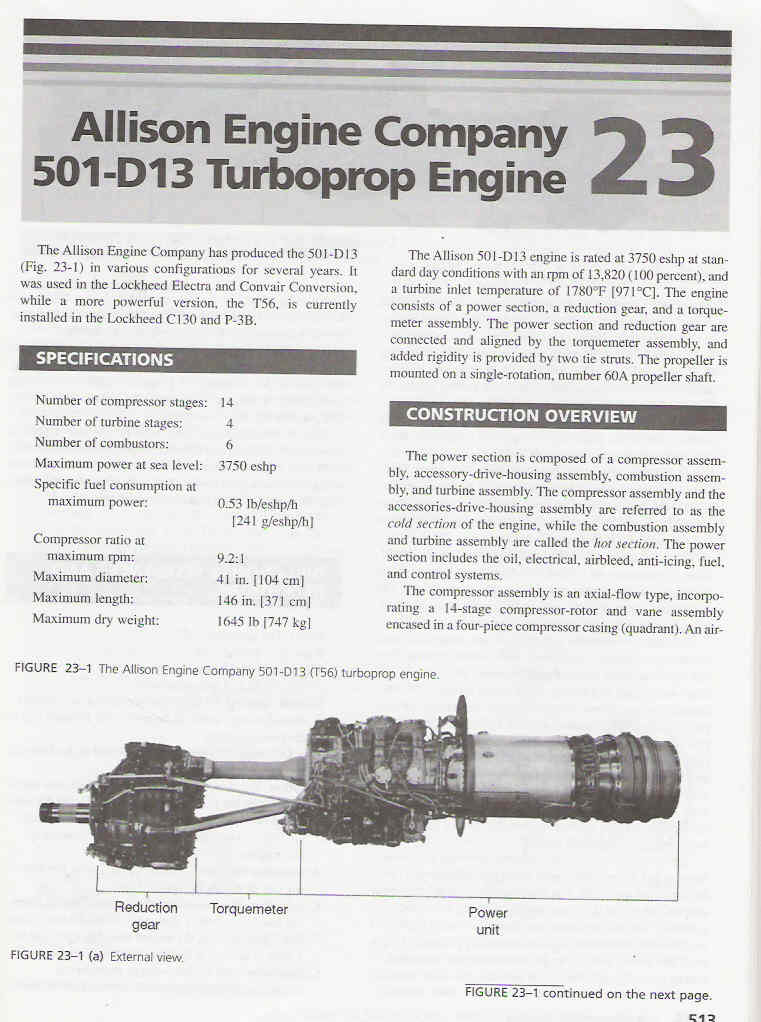
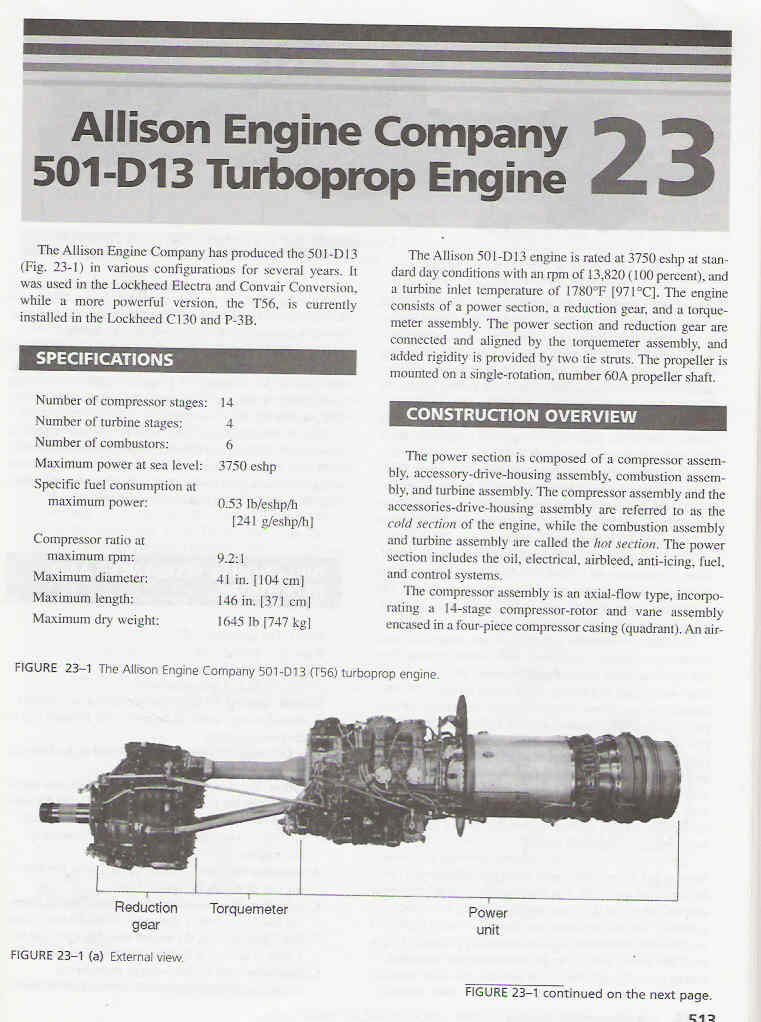
Large turbo prop engines like the Allison shown here can get down
to .53 BSFC. A far cry from .417. Unfortunately large turbo prop
engines do not scale down well. The BSFC gets much much worse as you make them
smaller. .65 BSFC is typical for small expensive turbo prop engines.
The problem is simple geometry. As you make the engine smaller tip
clearance between the compressor and turbine blades and the housings
becomes critical. Also only two or three stages are used for the compressor
and one for the turbine in small expensive engines. By contrast this Allison
Has a dozen compressor stages and two or three turbine stages.
An APU turbine is usually a glorified turbo charger with fuel
burner.
I would like to discuss this further but unfortunately my time
is limited. I would like to focus here on the rotary engine.
Far far more practical for experimental aircraft use.
Paul Lamar
"The pounds of fuel burned in a Willams WJ24 is 1.2 pounds of
fuel burned per pound of thrust."
I find it interesting that the first jet engine only comsumed .1 pound
per pound of thrust per hour more than the Williams:)
http://www.ueet.nasa.gov/engines101.php
1930 - Sir Frank Whittle in England patented a design for a gas turbine
for jet propoulsion. The first successful use of this engine was in
April, 1937. His early work on the theory of gas propulsion was
based on the contributions of most of the earlier pioneers of this field.
The specifications of the first jet engine were:
* Airflow = 25 pounds/sec
* Fuel Consumption = 200/gal/h or 1300 lb/h
* Thrust = 1000 lb
* Specific Fule consumption = 1300/1000 = 1.3 lb/lb/h
Paul Lamar ...No rotor no motor.
The Rotary Engine NewsLetter. Powered by Linux.
ACRE NL web site.
http://www.rotaryeng.net
Copyright 1998-2005 All world wide rights reserved.