From Tim Gilles junior college text "Auto Service"
Coolant Boiling and Freezing Points
The freezing point of pure water is higher than some winter temperatures,
and its boiling point is lower than the coolant temperature at which a hot
(but not overheated) engine can operate. Coolant has a higher boiling point
than water. This is especially an advantage on today's hotter running
vehicles with multiple accessories and air conditioning. One drawback to
using 100% coolant is that coolant does not absorb as much heat as water
does. Another is that the freezing point will actually be higher when the
ethylene glycol concentration is too high. Coolant is mixed with water until
it is the correct concentration. The factory radiator fill is usually about
50% water and 50% coolant, which provides protection against freezing down
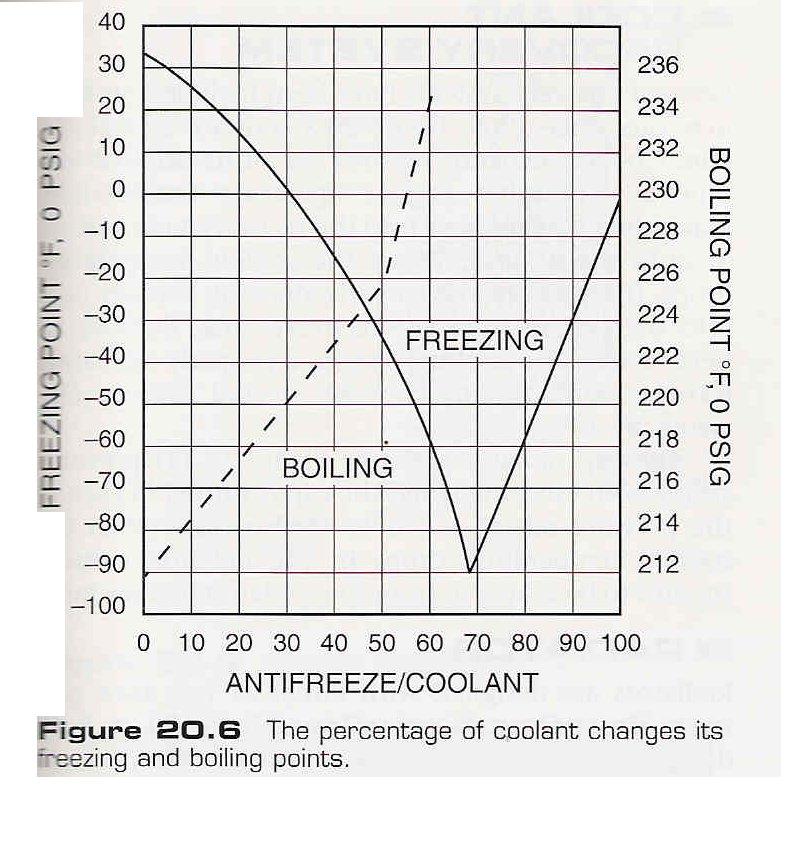
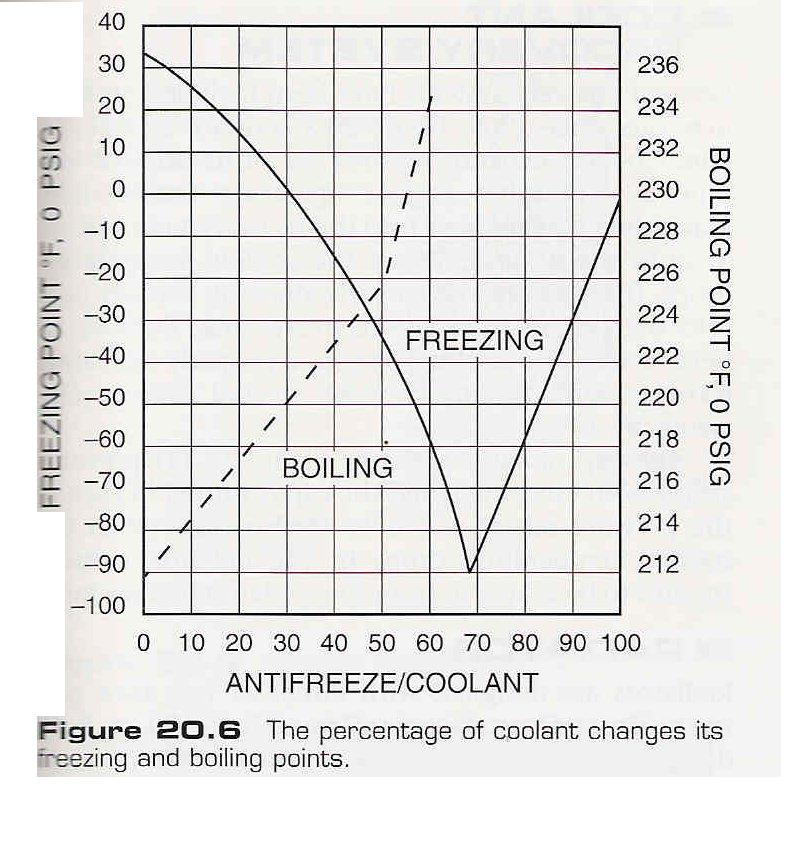
to -34 F. The freezing point of a mixture with a 70% concentration of
ethylene glycol would be -85 F. Its boiling point of 235 F is 11 F higher
than would be provided by a 50-50 mixture. A 70% concentration is the maximum
that should be used. The chart in Figure 20.6 shows the effects of various
coolant concentrations on boiling and freezing temperatures.
Also, if coolant is mixed with water, the boiling point will be higher.
RADIATOR CAP
A radiator pressure cap is used to seal the opening on top of the radiator
(see Figure 13.11). Its functions are to pressurize the coolant and keep it
from surging out as it is circulated through the radiator. Cooling systems
are pressurized for two reasons.
. The efficiency of the water pump is increased.
. Putting pressure on the coolant raises the boiling point of
the liquid in the cooling system.
When the system is not under pressure, the water pump does not always remain
full of coolant. Aeration is the result, which causes a loss of pump
efficiency of about 15%. Normal engine operating temperatures are between
180 and 212 F. The typical coolant/water mixture boils at somewhere between
220 and 230 F without pressure. When the cooling system is overworked,
temperatures can rise as high as 270 F without the coolant boiling. Pure
water boils at 212 F at sea level, but its boiling point is less than that
at higher altitudes because atmospheric pressure on the coolant is less.
NOTE: Each pound or pressure on the coolant raises its boiling point by about 3 F.
A 15-pound cap will raise the boiling point of the water by about 45 F to 257 F.
212 F (boiling point of water at sea level] + 45 F (3 x 15 pound)
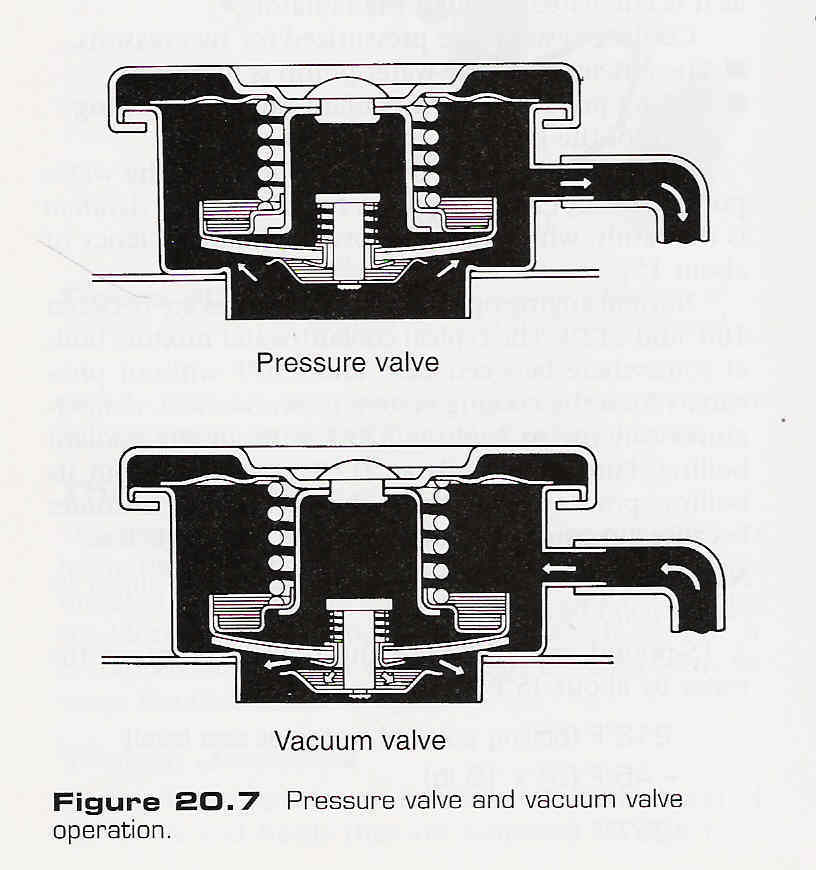
Radiator Cap Valves
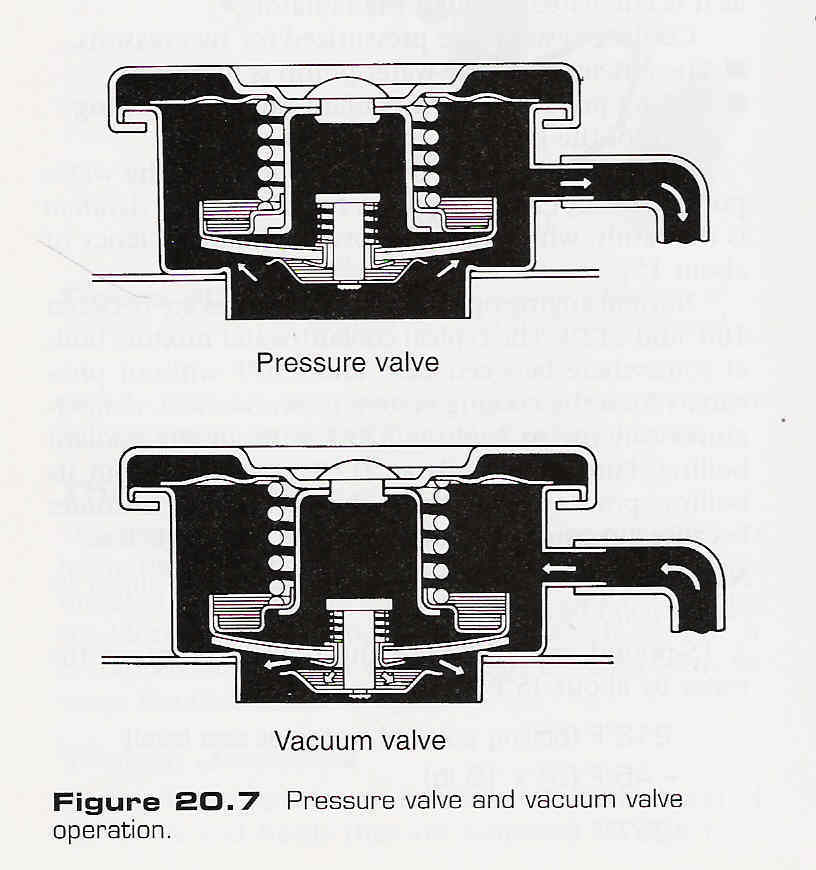
The two valves in the radiator cap are the pressure valve and the vacuum
valve (Figure 20.7)
Pressure Valve. Most pressure caps pressurize the system from 15-17 pounds.
The large spring in the cap is what maintains this pressure by forcing the
rubber pressure seal against the seat in the radiator filler neck (see
Figure 13.11). The pressure valve maintains pressure on the coolant even if
the engine is shut off.
Vacuum Valve. The vacuum valve protects the radiator as the temperature of
the coolant drops. Hot liquid shrinks to occupy less space. This could
create a vacuum on the inside of the radiator if the spring-loaded vacuum
valve did not open to prevent it. Excess coolant (that went into the
recovery tank during warm-up) is drawn back into the radiator. Some radiator
cap vacuum valves are spring-loaded and some are loose in the cap.
. A constant pressure radiator cap has a spring-loaded vacuum valve. It
. allows the system to begin building pressure as soon as the coolant starts
. to expand. An atmospheric pressure radiator cap has no spring on the
. vacuum valve. It does not build up pressure until the system gets hot.
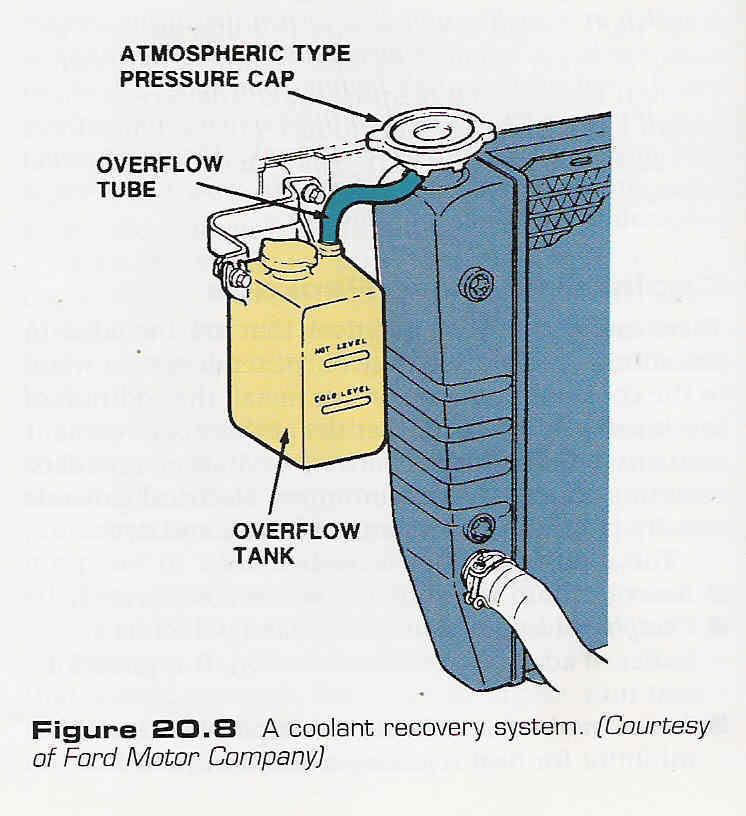
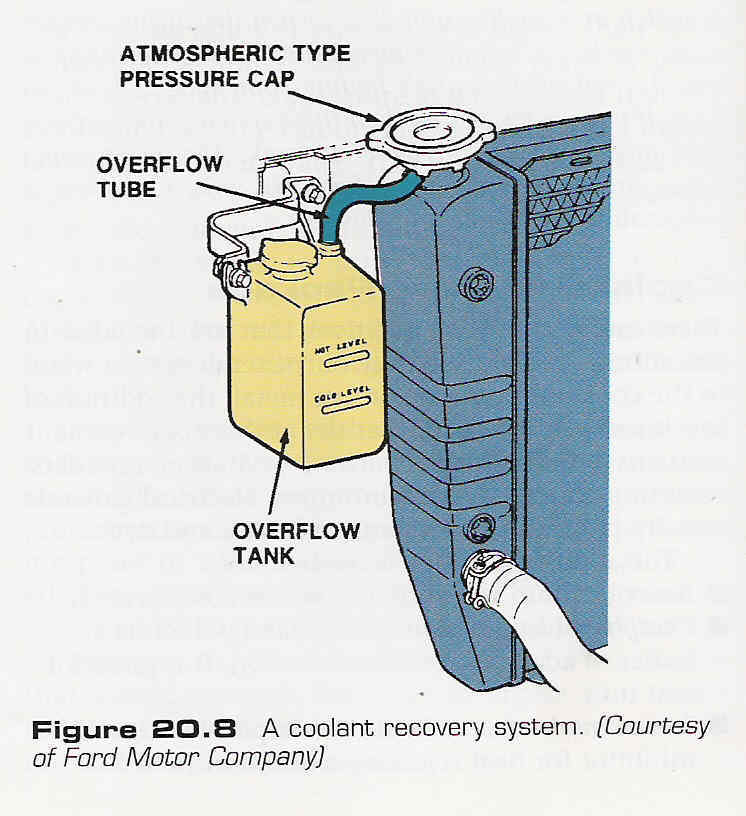
COOLANT RECOVERY SYSTEM
Coolant recovery systems have been included on most new cars since 1969.
Figure 20.8 shows a typical system. Coolant expands by over 1/10 of its
original volume as it reaches engine operating temperature. Expanding
coolant goes into the recovery tank instead of onto the ground. When the
coolant temperature drops, the vacuum valve opens, drawing coolant back into
the system from the recovery tank. Because air never enters the cooling
system, a properly operating recovery tank system increases overall cooling
efficiency by 10%. The top radiator seal (see Figure 13.11) prevents steam
from escaping when the cap is turned 1/2 turn to the pressure release
position. It also seals when the coolant temperature drops in the radiator,
causing coolant to be drawn in from the coolant recovery tank.
In the past I have assumed everybody knew this. I was wrong :)
Sorry.
Paul Lamar ...No rotor no motor.
The Rotary Engine NewsLetter. Powered by Linux.
ACRE NL web site.
http://www.rotaryeng.net
Copyright 1998-2005 All world wide rights reserved.