I generally run an 18 psi primary and a 12psi secondary for 30 psi
total. However the pressure never gets that high as the air spring
accepts all the coolant expansion without reaching 30 psi.
Dave Leonard
--
Dave Leonard
Turbo Rotary RV-6 N4VY
http://members.aol.com/_ht_a/rotaryroster/index.html
http://members.aol.com/_ht_a/vp4skydoc/index.html
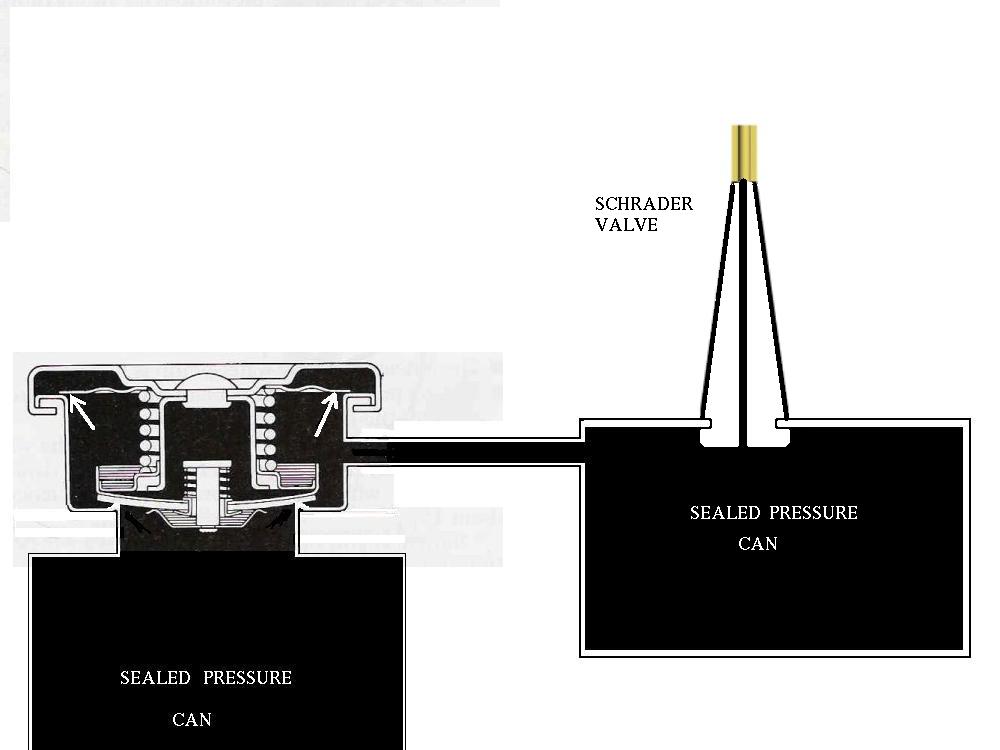
I don't see how you figure they are in series Dave.
When the first cap goes off the pressure in the second chamber
will become 33.5 psi absolute immediately which will over power
the 12 pound spring in the second cap. These caps operate
on spring pressure. Here is a diagram.
BTW do you have a 3 to 4 inch micrometer for measuring the rotor
housings?
Paul Lamar ...No rotor no motor.
------------------
Paul, I don't agree with your analysis of the radiator caps operation. Let's
take one cap, venting to atmosphere, The pressure in the system has to rise
enough to overcome the spring + the outside pressure of the atmosphere. So,
with a 10# cap, the pressure must raise to 25 psi (absolute) when you are at
sea level. As you go up in altitude, the
*absolute* pressure will drop as
the atmospheric pressure drops.
Now, lets install a chamber with another (15# ) pressure cap. When the first
cap starts to relieve, it pressurizes the other chamber, and the back
pressure on the first cap rises. So the
*absolute* pressure in the engine
is = pressure in second chamber + pressure relief of first chamber. If
sufficient pressure is transferred into the second chamber, then the
*absolute* pressure in the engine is = atmospheric + pressure relief value
of second cap + pressure relief value of first cap.
All of this assumes that the flat rubber seal on the cap (that is loaded by
a flat disk spring) can withstand the cap pressures.
Bill Schertz
KIS Cruiser # 4045
Yes that is precisely the problem. I will build a test rig in a few days
and see how much pressure it will hold. These seals are not designed
for significant pressure.
Here is what the test rig should look like.
--
Paul Lamar ...No rotor no motor.
--------------------------------------------
Took me all after noon to make this aux pressure
tank including two trips to the hardware store.. I made it
out of 1 1/2 " pipe parts and two tubeless tire schrader
valves. Holds pressure fine. One must pressure test
all the parts to make sure none leak or the test of
the cap is inconclusive.
I have two caps to test. A 16 psi by CST
and a 30 psi by C&R racing. I suspect they will all be
different as there is no specification for holding pressure
above the pressure release valve. Nor are they expected
to hold significant pressure in that area.
I'll hook everything up in a few hours and gets some
results.
--
Paul Lamar ...No rotor no motor.
The Rotary Engine NewsLetter. Powered by Linux.
ACRE NL web site.
http://www.rotaryeng.net
Copyright 1998-2005 All world wide rights reserved.