Paul Lamar wrote:
> The trouble with Wankel wear coatings is there is no way to inspect
> them for quality control. Some that look good may or may not come
> off. You can't tell unless you destructively test each article
> over every square inch of the wear surface.
>
> In other words there is no way of controlling the quality.
Russell Kent castigated Paul:
> I bet this is interesting "news" to Mazda, seeing as how they have
> been nitriding the side housings and chroming the rotor housing for
> years without apparent problem controlling quality...
>
> Paul, your emotional reaction to Mark Burns' letter (perhaps deserved)
> is interfering with your ability to make rational statements.
Paul Lamar replied:
> Passionate yes....emotional no.
>
> First you missed a very important point Russell.
>
> "Mazda has built over two million engines with excellent results."
>
> Once you make a few hundred thousand engines and they are in
> service for ten years you tend to get confidence in what you
> are doing.
OK, so you admit that it is possible to control the quality. :-) I'll
agree that method (build 100,000's) is not going to happen for Rotamax.
The subtle point I was trying to make was that if you're going to
chastise Mark Burns (or anyone else) for making unsupported claims, or
wishful thinking claims based on vaporous science, then you'd do well to
*avoid* making them yourself in the process. Unless I've completely
misunderstood, this newsletter is all about the *engineering* of these
engines in an aircraft installation. Demonstrating a reliable surface
wear coating/bonding is an engineering problem. Stating that "there is
no way of controlling the quality" is an engineering falsehood. It's
not impossible, merely difficult.
> Second; nitriding is not a coating. It is a hardening process where
> a chemical is actually ingested into the surface of the metal at
> high temps.
Hey, I work at TI, remember? I know about eutectic bonding. Every
chipmaker in the world uses it to bond 99.99% Au wires to Al, Al-Cu,
Al-Cu-Ni, Cu-Ni-Sn, ... We use a combination of heat, pressure, and
ultrasonic vibration to produce really otherworldly alloys of Au, Al,
Cu, Ni, Sn, W, Ti, Si, Ge, ... Getting Fe, Cr, N, and Al to bond is a
piece of cake by comparison. 'Course, I can only make it in 0.25mm
patches... :-)
Russell Kent
Russel,
.25 mm is ok.
How costly is it to add .25 mm Fe to the side housings? Would it stick?
Perhaps the Fe can then be chromed, hardened or nitrated?
Or perhaps the Fe is a tool steel to begin with?
However, hardening it may not work with Al attached to it.
I trust that attaching chrome directly will not stick sufficiently and
patches may come loose.
Are there any possibilities for side housings? and even the Trochoide? at
TI.
Regards
Rolf Pfeiffer
He is talking about an integrated circuit chip that is .25 mm square.
Not .25 mm thick. It is only molecules thick.
Suspect one of the things going on here is the stiffness or hardness
of the substrate has a lot to do with apex seal chatter.
Steel is three times stiffer and harder than coated aluminum.
Paul Lamar ...No rotor no motor.
It's my understanding that RotaMax has gone to a ceramic lining. I confess
to not have much background with this approach. At some point, the lining
will begin to transfer heat to the housing. I'm wondering if there is a
differential expansion between the two materials and if this falls within
the tolerences of the seals? My background with ceramic seals and liners
was back in the late 70's and early 80's when we used it for short-life
turbines. The application was expendible and you didn't require an engine
that had to live more than 150 hours (the darn things tended to be lost for
other reasons before 50 hours). They've made a lot of progress since then.
I'm told that most good turbines run with ceramic bearings these days. But
I'm unsure that the requirements for a ceramic bearing are directly
applicable for the lining of a fixed housing. I have wondered if it was
possible to build ceramic housings. I also remember an outfit in New Jersey
that was building plastic racing engines under a contract from Ford. Their
name was something like Polimotor? They used cylinder liners and had a very
light engine. You wonder if with the right material, you could mold most of
the engine versus machine it. You're definately looking at liners with this
approach and I remember that the Polimotor was basically bolted together
with long sleeved through bolts (block and head). It was liquid cooled.
George Wright
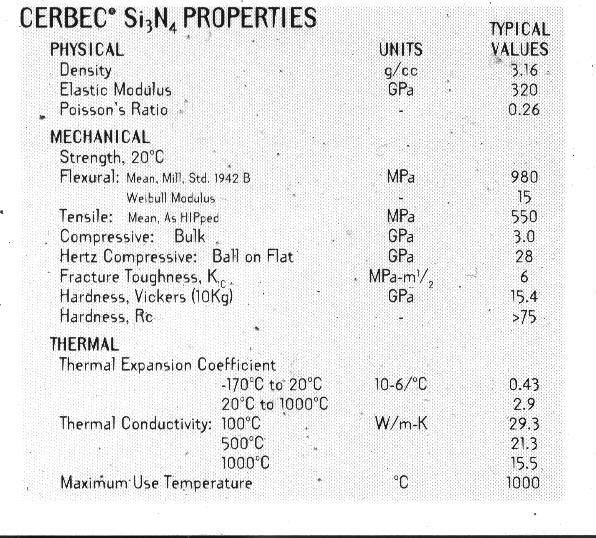
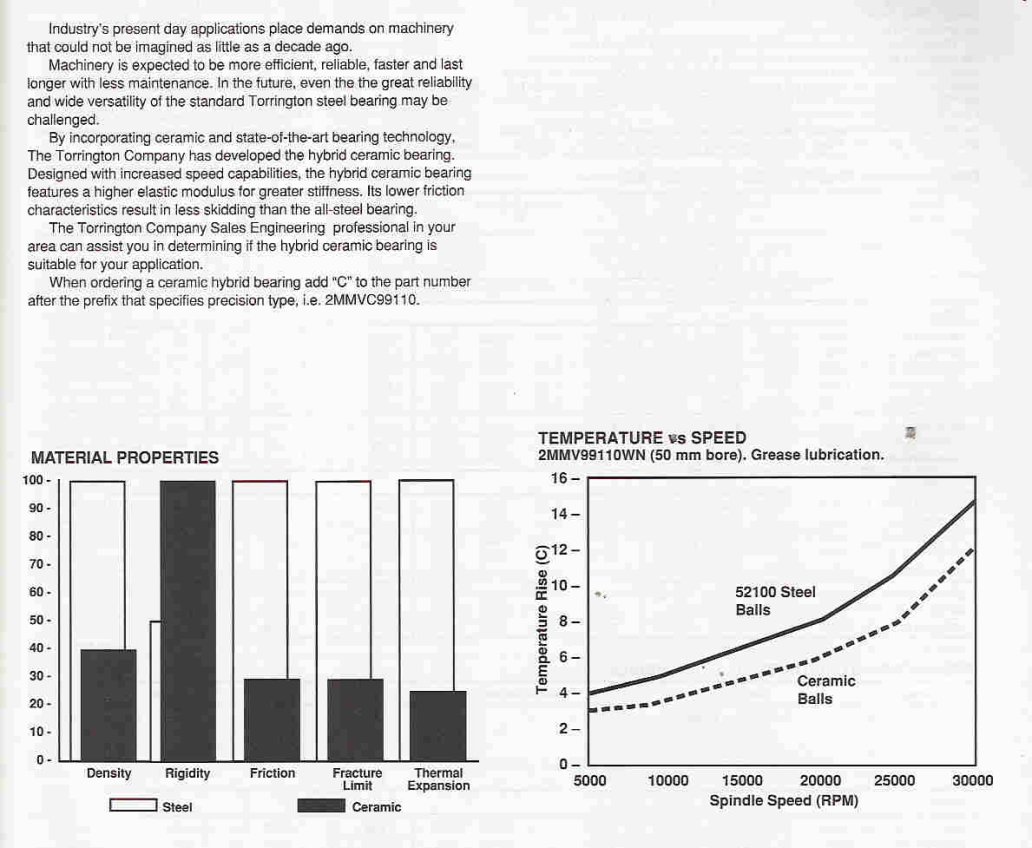
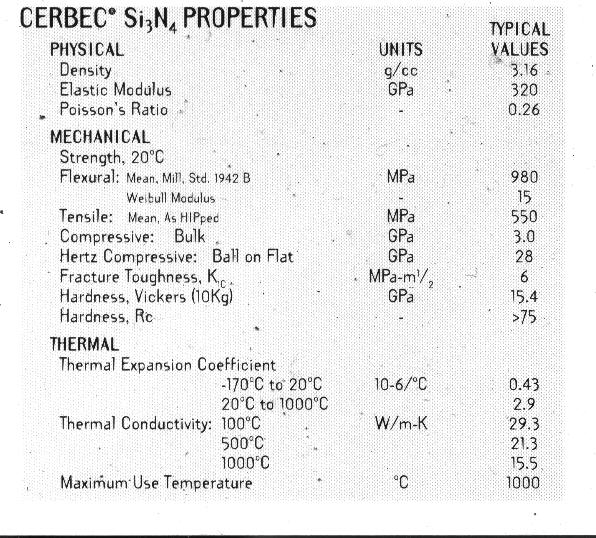
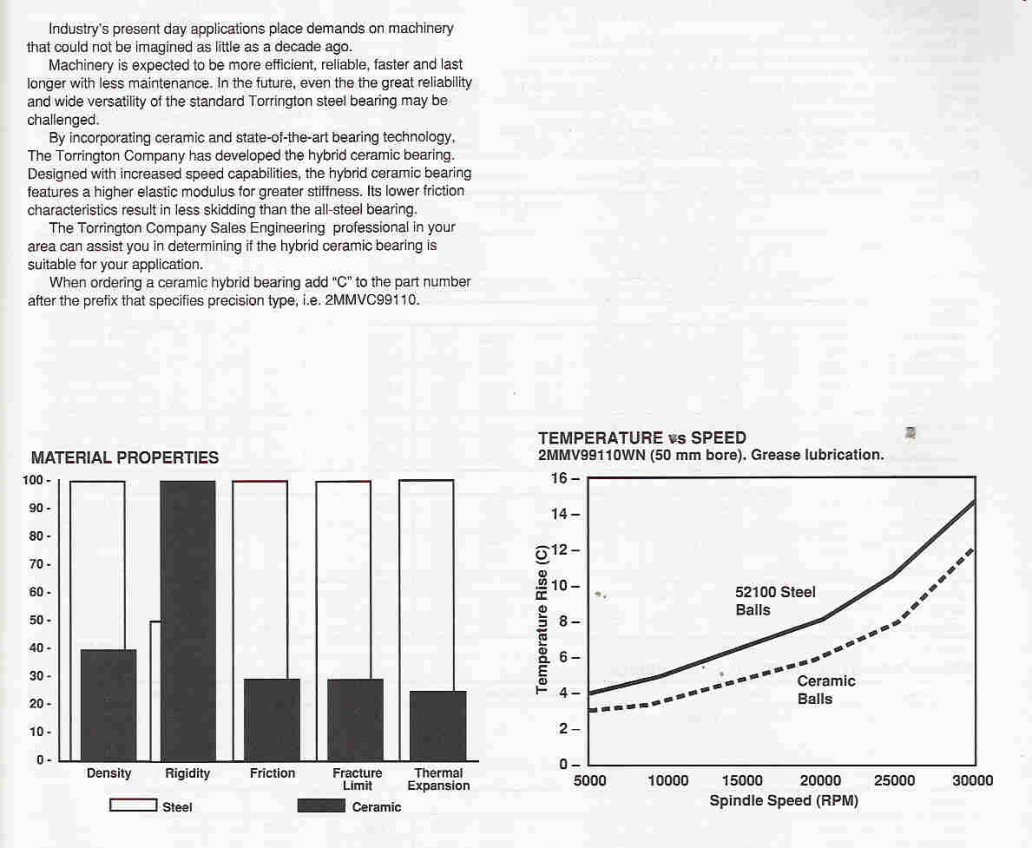
Silicon nitride ceramic ball bearings are used in high
speed machinery. Read very expensive. Same stuff
used in ceramic apex seals.
Apples and oranges.
--
Paul Lamar ...No rotor no motor.
The Rotary Engine NewsLetter. Powered by Linux.
ACRE NL web site.
http://www.rotaryeng.net
Copyright 1998-2005 All world wide rights reserved.