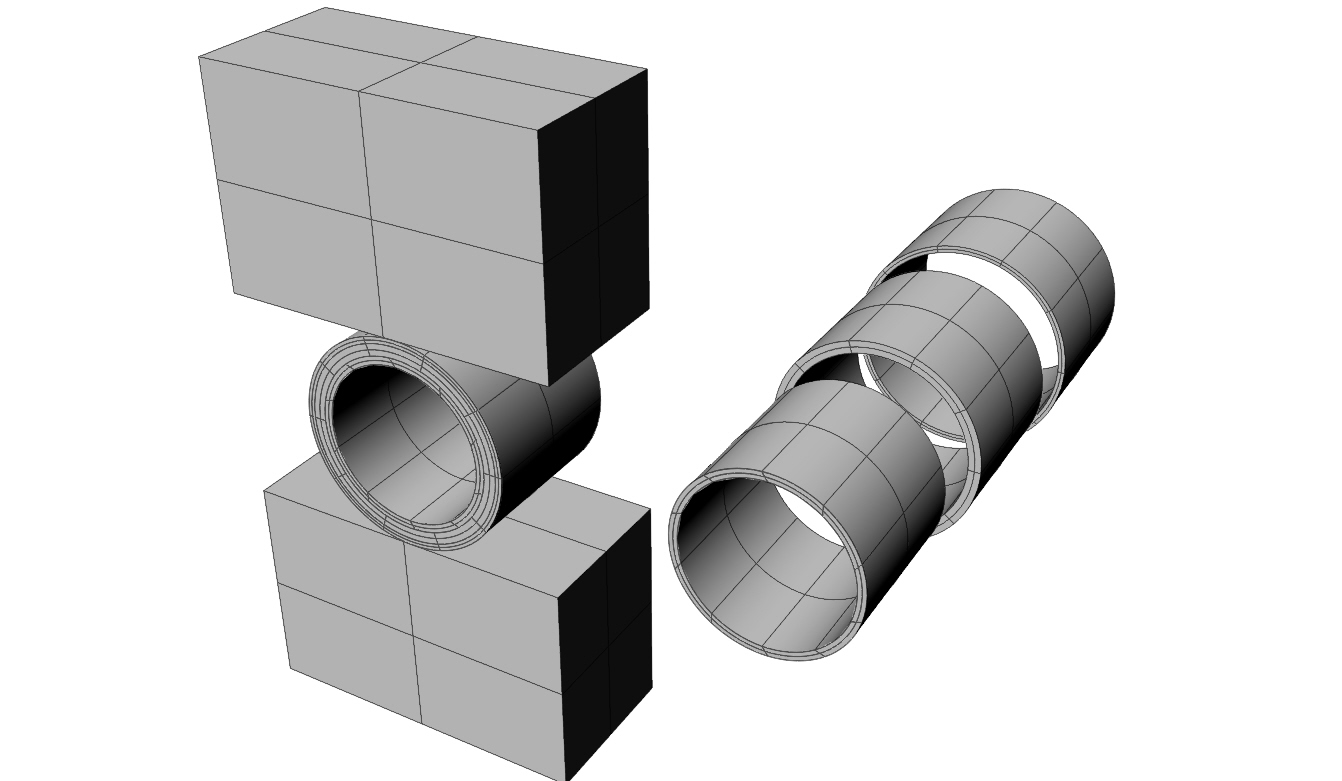
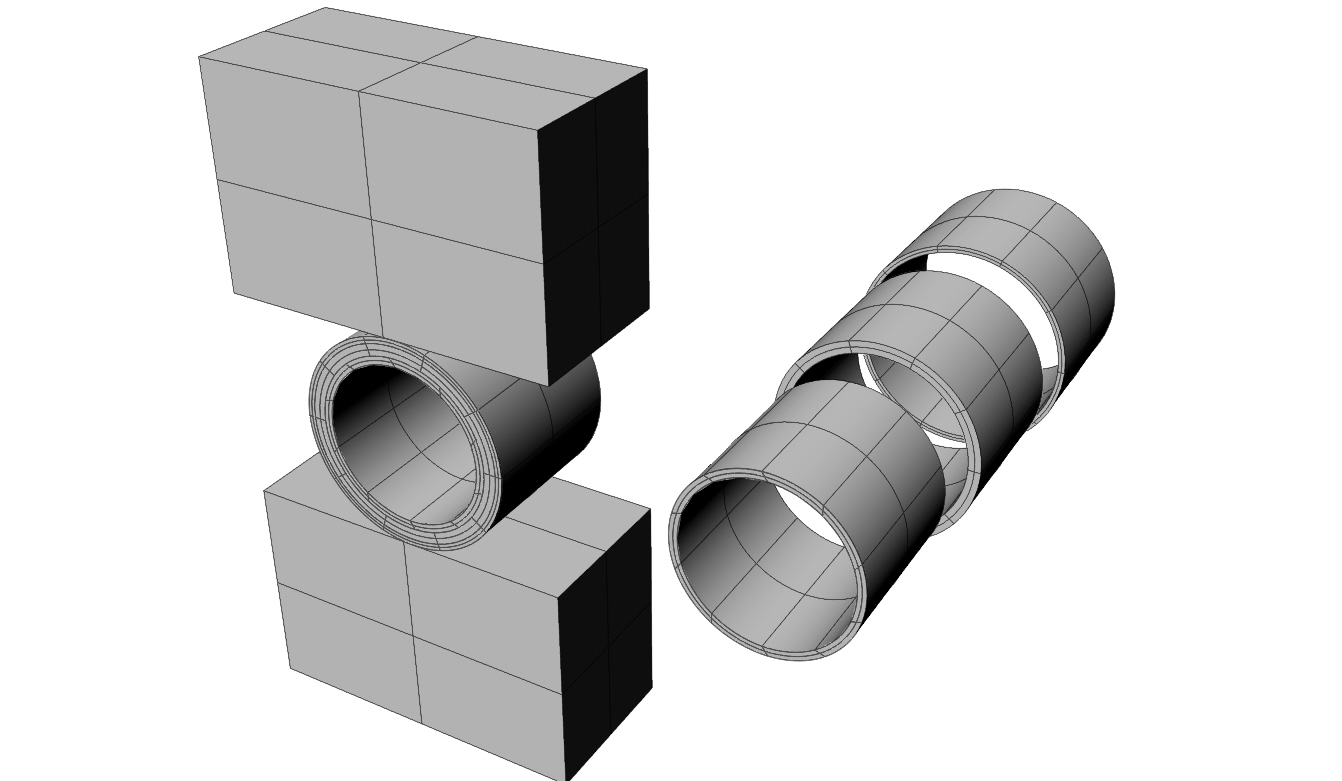
Will trade a whole CD full of cad files for an FEA on this 30 mm wide
steel ring.
The 40 mm dia. steel rollers exert a force of 2000 pounds or 900 Kg
radially outward. I also would like the contact stresses as well if
possible.
The Rockwell hardness is C64.
BTW does anybody know of any affordable FEA software?
Paul Lamar ...No rotor no motor.
Give me the modulus for each of the materials. The thickness would help as
well. There will be edge effects.
You can do this simple geometry by hand and get quite good results. Look up
"Eulerian Stress" and you will have the formulas you need.
The smart way to get cheap CAD and FEA software is to enroll in you local
community college. For about $100 tuition, you become a "student"
and qualify for the educational versions of very high-end software.
Bill Dube.
Thanks Bill See the previous message for the properties of 4340.
But here are some better data.
Density (lb / cu. in.) 0.28
Specific Gravity 7.8
Specific Heat (Btu/lb/Deg F - [32-212 Deg F]) 0.116
Melting Point (Deg F) 2600
Thermal Conductivity 21
Mean Coeff Thermal Expansion 6.6
Modulus of Elasticity Tension 33 [million]
I was perhaps a little low on the yield. More like 100,000 psi.
Yes I was thinking of taking a class on tig welding :) I have a tig and I
got a new LCD helmet for Christmas from my son. That is how I got my Rhino.
I am homing in on a cheap 120,000 RPM turbo compound gear box. Mostly off
the shelf parts.
Paul Lamar ...No rotor no motor.
Paul,
I loaded 4340 from my standard library. This is 4340 normalized and not
hardened all the way to it's max hardness.
The red areas are questionable only in that I assumed a "nip" between the
plant gears and the ring gear as 1mm. If I used an infinitely sharp nip
you'd slice right through the material no mater how strong it is and that's
not realistic.
I don't have a lot of time on this (15min) so there is no tuning.
I did discover that if you do a study without an external constraint of some
kind the part zips off into space because the software iterates through the
nodes and even the least amount of force difference 10^-13 in this case
causes the ring gear to drive out of sight. Interesting to watch!
So, I put a constraint opposite one of the contact points to keep the ring
gear from flying off.
-Ben
Thanks Ben! Wonderful!!!! We are on the verge of a major breakthrough in
fuel consumption of the turbo compound rotary amounting to 15% to 20%
better. One false start with the Rotrex gear box I am afraid.
------------------------------------------
If I am doing the conversion right N/m^2 5.979 + 008 is 86,000 psi.
Does that sound about right?
Paul Lamar ...No rotor no motor.
Hi Paul,
That's correct. Since, you're heat treating it up to 100ksi you can slide
the stress scale down proportionally. The 86Ksi comes out of the library.
I didn't bother to edit it.
86ksi is not bad for something like gears. There is a tradeoff between
toughness and strength, they are not synonymous. You alloy up but there are
all kind of issues with trying to go with stronger material at the expense
of machinability. That's why PSRU tend to grow in size with increasing
horsepower.
Let me run another study with 100ksi material.
-Ben
Don't bother. I have another one that is more important Ben.
I'll get a dwg on it to you shortly. It is very simple.
BTW what would be the spring rate on that ring. In other words pounds per
inch of deflection.
Paul Lamar ...No rotor no motor.
----------------------------------------------------------
Take the 2,000lb load and divide it by the max displacement.
In this case it was .3829mm. That's equal to .3829mm/25.4mm/in which is
0.001507480314960629921259842519685 (lol) and that equals
1326717.1585270305562810133194045 or 1.3 million pounds per inch. In other
words, this ring is no spring!
Are you getting 2,000lbs from the centrifugal force on a planet gear zipping
around inside that orbit? Is the orbit gear moving, too?
-Ben
--------------------------------------------------------------------
No. What we intend to do is heat the outer ring to about 500 F or so and
drop it down over cold soaked rollers. This will apply a constant pressure
in the line contact area.
Another part of the design is these three 5 mm thick telescopic rings
the outer one of which is 40 mm in dia and 30 mm long. Again loaded
with 2000 pounds or 900 Kg. Consider the block a 2000 pound block
or 900 Kg made from 4340 with a 100,000 psi yield. Same for the rings.
My question is does this configuration act like a leaf spring and result
in lower stresses in the individual rings than would be the case if it was one
solid ring 15 mm thick 40 mm OD? And what are they? Spring rate?
I'll show the complete design shortly.
Hopefully we will be able to do a FEA on the complete assemble.
Paul Lamar ...No rotor no motor.
The Rotary Engine NewsLetter. Powered by Linux.
ACRE NL web site.
http://www.rotaryeng.net
Copyright 1998-2005 All world wide rights reserved.