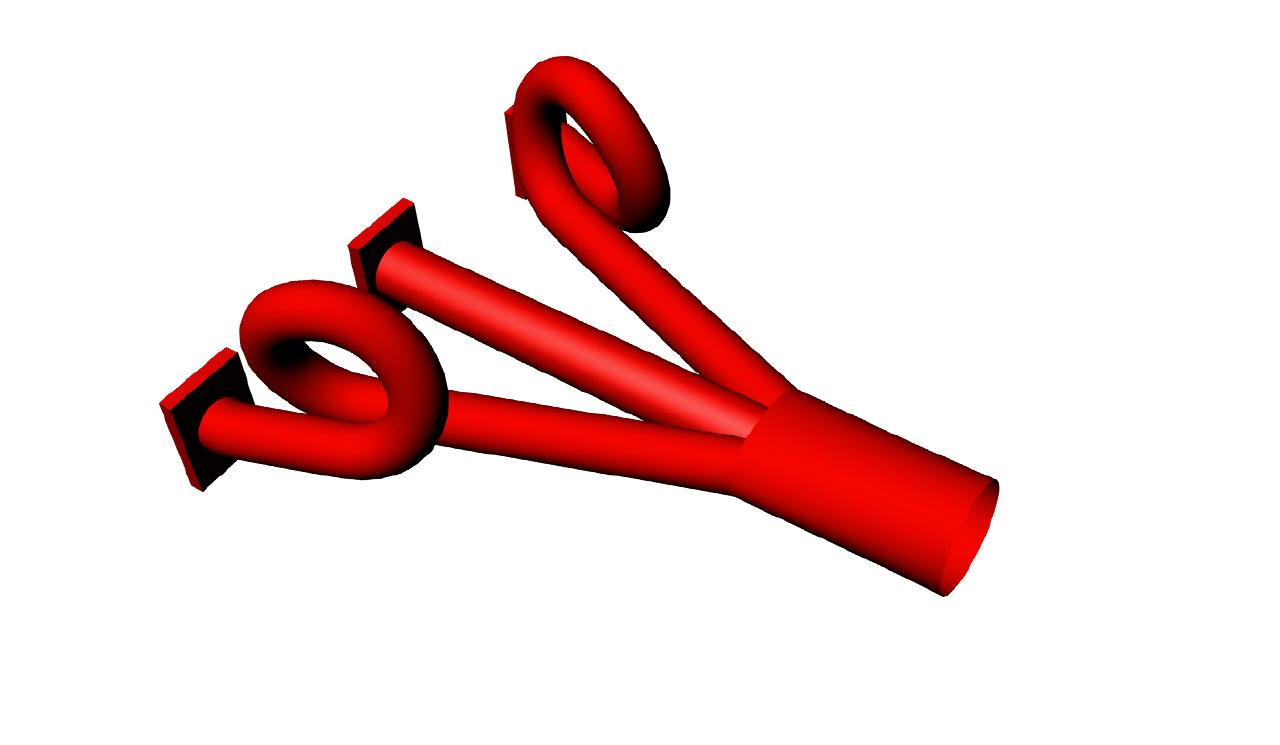
Yes it is an interesting situation. In theory the center pipe
should be around 16 inches and the two outer pipes 32 inches.
The center pipe pulses twice as often and the pulses are
180 degrees apart e-shaft rather than 360 degrees on the end ports.
--------------------------------------------------
Here is something that might be a little better.
1.75 OD tubes on the ends with a 2.5 inch radius 180 degree bends
with a 2 inch OD tube in the center. A bit closer to 2 to 1 length wise.
You did not say I had to fit it into a car did you? :)
Paul Lamar
---------------------------
Hello Paul,
Thank you for sharing your insight on this. I hope you won't be put
off if I probe your brain-trust with a few questions. I'm no exhaust
expert and probably have a lot of misconceptions on the subject, so I
hope you'll be kind enough to point out my mistakes when necessary.
Aren't the lengths you quoted based on wave pulsing that is dependent on
port timing overlap? Without timing overlap is there anything to be
gained by timing negative wave pulses to impact on a closed chamber of
minimal volume?
If you're so inclined, would you also mind commenting on a tangential
muffler design that, due to space constraints, wraps around a smaller
diameter collector chamber. Say a 3" diameter collector as opposed to
the 6" diameter shown in your design sketches. More of a tangential
header than muffler I suppose. Obviously it would require more tighter
radius wrapping of the long primaries, but if a 2:1 primary length ratio
is required it could be easily accommodated with this style design. On
the other hand, if the Renesis were to prove indifferent to primary
length tuning then wouldn't a simple tangential muffler/header be easier
to build, as well as significantly lighter and more compact.
Interesting, your 3D model came across as I was finishing up this
reply. It wasn't my intention to put you to work, but I certainly
appreciate the response.
Thanks again,
Mark Sipe
When you introduce a pressure pulse into the end of a pipe the pulse
travels down the pipe regardless of the port timing or intake/exhaust
overlap. The pulse out of the front rotor is always 180 degrees out from
the rear rotor. The idea is to connect them together at such a point so
a pressure valley is induced in one rotor's pipe as the other rotor's
pulse passes by.
Here is a pretty good book on the subject.
http://www.rotaryeng.net/books10.txt
* Scientific Design of Exhaust and Intake Systems. Philip H. Smith
and John C. Morrison Published by Robert Bentley. ISBN 0-8376-0309-9
http://www.rb.com
---------------------------
Ops I uploaded the wrong 3D
--
Paul Lamar ...No rotor no motor.
The Rotary Engine NewsLetter. Powered by Linux.
ACRE NL web site.
http://www.rotaryeng.net
Copyright 1998-2005 All world wide rights reserved.