One rule of thumb that seems to apply here is every decrease
in air temp going through the rad increases the cooling by 1%.
This is because of the temp difference between air and rad.
Assuming 100 degree air going in and a 200 degree rad temp.
Another rule of thumb is the first half of the rad (thickness) does
3/4 of the cooling.
Lets review a few cooling principles. We need x amount of airflow
given in cubic feet per minute raised to temperature x to carry
away the necessary heat.
If we had a hole in the front of the airplane with enough area
to take in the requires CFM of air at the speed of the airplane in
question and that hole was connected to the back of the airplane
with a duct and there was no heat exchanger in the duct the "cooling"
drag would be the skin friction of the air in the duct alone. This
is a lower limit on the "cooling" drag. As we install a heat
exchanger in the duct the friction or drag on the air and the airplane
increases.
The drag added depends on how easy it is for the air to flow
through the heat exchanger. A highly porous heat exchanger
is very little drag. The thicker the heat exchanger the harder it is
for the air to flow through it. In other words it becomes less
porous.
Now a few years back it was discovered that the drag in the heat
exchanger was proportional to the square of the speed of the air
flowing through the heat exchanger. If we increase the frontal area
of the heat exchanger somehow keeping the air volume flow the same and slow
the air going through it we can decrease the drag on the heat exchanger
and the airplane. That was done by a diverging area duct called a diffuser.
What we also need to do however is speed the air back up before we let
it exit the duct.
If we slow the air we must also increase the frontal area of the heat
exchanger to keep the CFM the same. If we want to keep the volume flow the
same we must make it thinner. It just so happens that that makes the heat
exchanger more efficient in the bargain. Now here is a quote from Kays &
London on the subject.
"highly compact surface geometries [read optimum heat transfer for a given
HE core volume] is that the resulting core shapes are characterized by large
flow frontal area and short flow lengths for the gas-flow path."
Now if we do nothing other than make the heat exchanger thicker with
out greatly adding to the transfer of heat from the heat exchanger to the
air stream all we have really done is greatly increase the drag along with
a slight increase in the cooling.
All this is assuming of course one has a converging duct on the out let
side of the heat exchanger. That is where the cowl flaps come in. They ARE the
converging duct.
Dave is attempting to increase the cooling keeping the drag the same
without making the hole in the front of the airplane larger in area and
without using cowl flaps and at the same time increasing the temp of
the air flowing through the water rad.
Good luck Dave :)
For the new guys read http://www.rotaryeng.net/how-to-cool12.html
Paul Lamar ...No rotor no motor.
So, the deficiency in Dave's current system is the non-existent
duct after the first set of radiators. If the air path was
sufficiently sealed and ducted, then the air would be put to use (not
escaping without being used) and upon exit could be accelerated with a
narrowing duct and/or louvers(pressure recovery) to reduce drag.
I can't see a way to increase cooling or reduce drag, without
ducting the air. I also can't see a way to duct the air without adding
a third air inlet.
Am I using the term "pressure recovery" correctly?
Blake C. Lewis
Yes you are Blake.
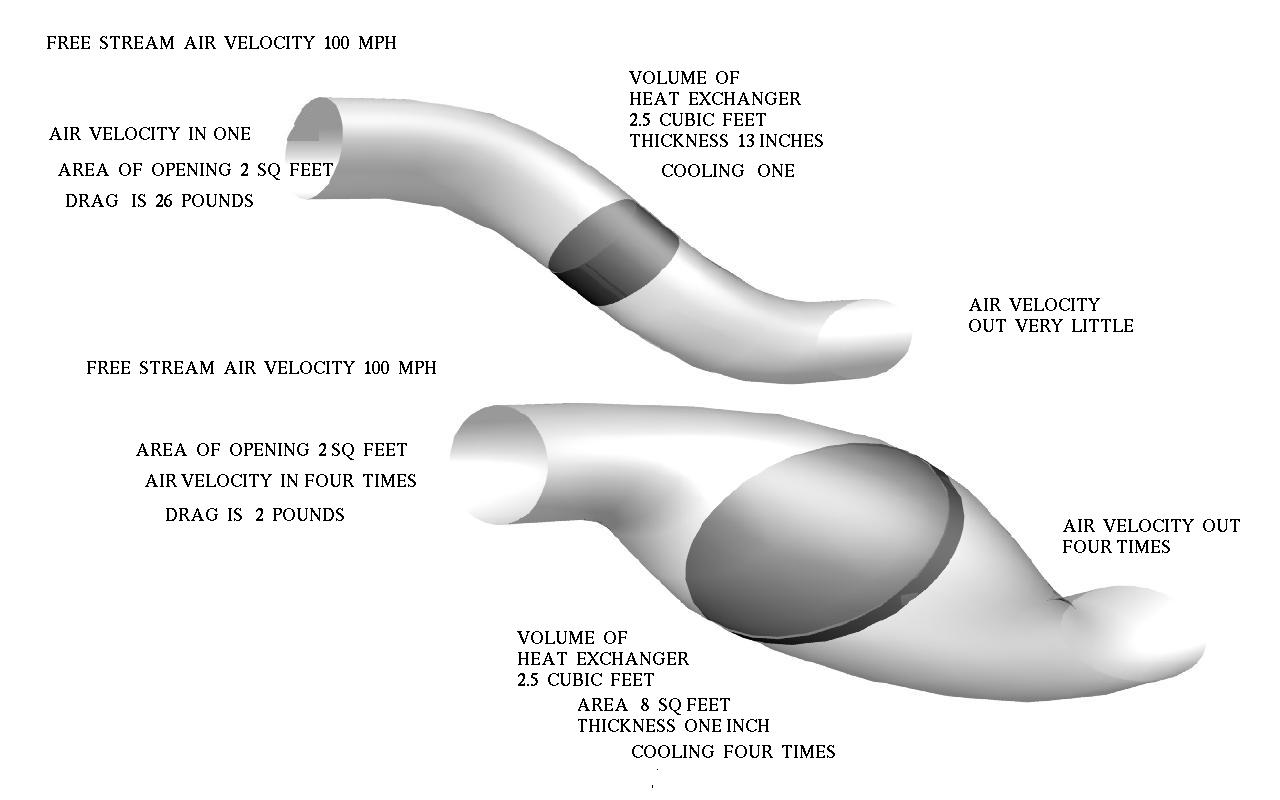
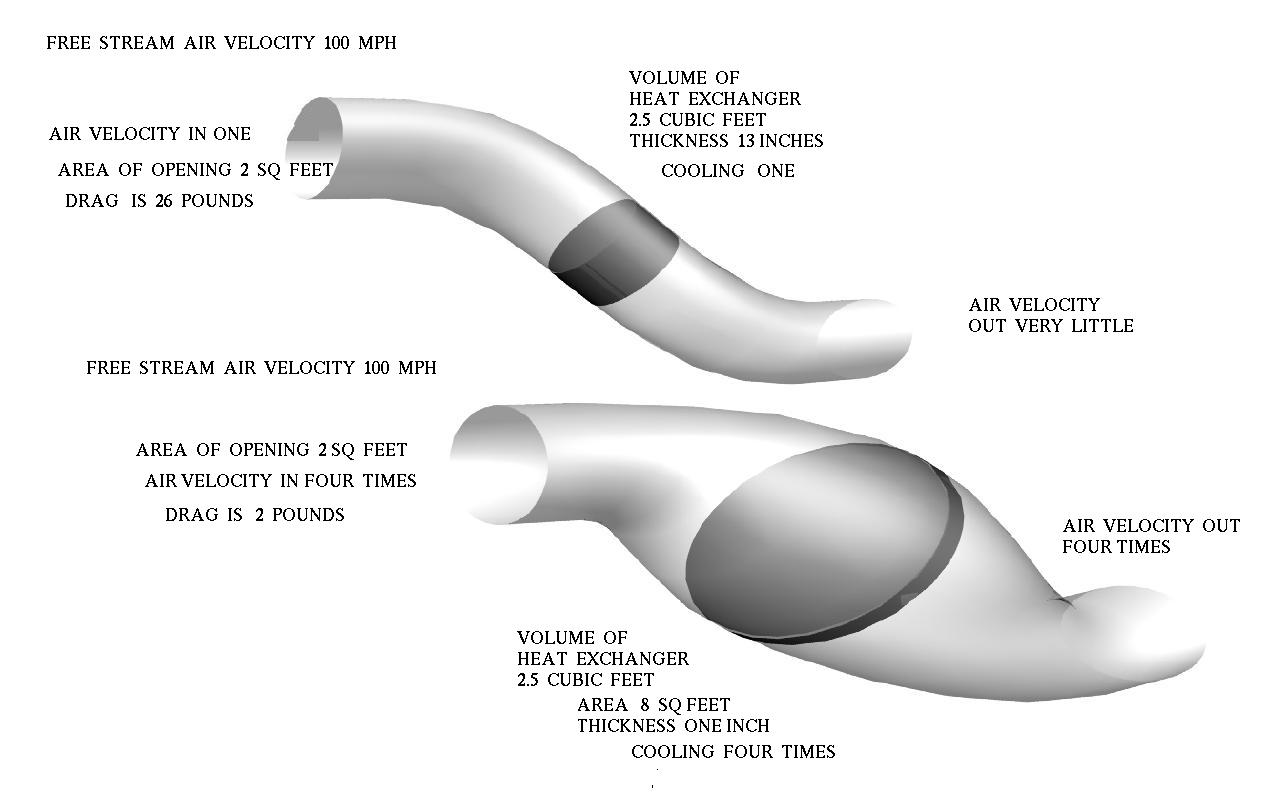
Here is a diagram. The drag of the constant area duct/thick HE is not really
26 pounds because of a phenomena called external diffusion that tends
to streamline these things to a certain extent. Takes a wind tunnel
to know for sure. Probably sloping the opening back reduces the
drag when the cowl flaps are closed as was done on the P51.
Paul Lamar ...No rotor no motor.
The Rotary Engine NewsLetter. Powered by Linux.
ACRE NL web site.
http://www.rotaryeng.net
Copyright 1998-2006 All world wide rights reserved.