> Don't know if anybody else noticed but the final FAA report on
Paul's
> [Conner] crash has been out since beginning of the month.
According to thej
> report the likely cause of engine failure is the fuel valve
selector
> position which was partially sucking air from the empty right
tank. It
> brings a memory flash of John Denver's death in his EZ with the
fuel
> selector problem.
>
> So now I am glad to have a 2.3 gal sump tank where the fuel feeds
from
> either tank with the selector valve. In fact I took off once with
the
> selector valve off and the sump tank low level warning light came
on.
> richardt2005
Nothing about it being aft of the CG limit? Amazing.
Paul, if the final report is out, can you now "talk"?
Perry Mick.
Sure! What do you want to know?
No way for me to know if the airplane was aft of the CG limit
or not. I am sure he pulled too many G's (90 degree bank) and stalled
the canard trying to make it back to the runway. (There was a plowed
field
more or less straight ahead.)
When that happens the canard airplane turns towards the ground.
That is what the pilot witness described. We had another fatal crash
similar situation at SZP when an air show pilot pulled too many G's
in a canard at low level and crashed in the river bed.
Paul got it rolled out 90 degrees and mostly pulled out but the
vertical velocity was still high when he struck the ground almost
level. Hard enough to bury the inflated tire below ground level.
It was not muddy ground either.
I felt it was the fuel selector valve but there is no real proof
as it could have moved during the crash. I will say the detentes
on that Andair fuel selector valve were no where near strong enough.
Some body else checked the only two fuel injectors well after the crash
and found one of them intermittent or some such. Not a good idea to use
only two injectors.
First mistake was taking off with an improperly designed fuel
system using a left, right and both fuel selector valve along with a
myriad of other errors in the fuel system design. Fuel in only one
tank. Sump tank was like a 2 x 4 across the entire width of the
fuse. Sump tank was improperly vented to one strake tank. All
this is AFTER the crash.
Paul was not too good on sharing the details of his airplane with us.
For example we went around and around on the cooling.
When I got there and saw the airplane there were two large
holes one in each side of the plenum that was supposed to be
feeding air to the rad.
Paul Lamar
------------------------------------------------------------
Did you take notes when you visit Paul Conners crash site? At the time you
implied a lot of mistakes were made. I already have an aircraft fuel
system
article up. Could you please review it in light of the crash and recommend
alterations.
http://www.wankel.org/28_Fuel/28-10%20fuel_system.htm
Mark Wrathall
Wankel.org
Yes I wrote a report and submitted it to the FAA.
Paul Lamar
----------------------------------------------------
Here is the final report. Substantially what I suggested
to the FAA as the most likely scenario.
On further hind site and after someone obtained the wreckage
from the heirs the injectors were tested and one was found
to have some sort of problem. Don't use only two injectors.
Paul Lamar
--------------------------------------------------
ATL05LA081
HISTORY OF FLIGHT
On May 16, 2005. at 1545 central daylight time, a Homebuilt Experimental
Built
airplane, N2992, registered to and operated by the commercial pilot,
collided
with trees shortly after takeoff from runway 24, at the St. Elmo Airport,
in St. Elmo, Alabama. The flight was operated under the provisions of
Title 14 CFR Part 91, and visual flight rules. Visual meteorological
conditions prevailed and no flight plan was filed for the local flight.
The pilot received fatal injuries and the airplane sustained substantial
damaged. The flight originated from the St. Elmo, Airport in St. Elmo,
Alabama
on May 16, 2005, at 1540.
According to witnesses, during takeoff the engine did not seem to
be developing full power. At about 250 feet above the ground the
airplane banked left and the engine quite. The airplane's bank angle
increased and exceeded 90-degrees. The airplane's nose dropped suddenly,
the wings leveled and the nose came back to nearly level prior to the
airplane colliding with trees in a wooded area. Witness, telephoned
the 911 operator reported the accident, and proceeded to the scene to
provide assistance.
PERSONNEL INFORMATION
A review of records on file with the Airmen Certification Branch,
Federal Aviation Administration, Oklahoma City, revealed that the
pilot was issued a commercial pilots certificate with ratings for airplane
single engine land, airplane multiengine land, and instrument rating on
May 27, 1986. In addition, the pilot was issued a repairman certificate
with ratings for experimental aircraft builder on July 14, 1999. The pilot
held a third class medical certificate issued on June 03, 2005 with no
limitations.
AIRCRAFT INFORMATION
Review of aircraft records on file with the e Federal Aviation
Administration, Oklahoma City, revealed the amateur built experimental
airplane was registered on November 17, 2004.
METEORLOGICAL INFORMATION
At 1656, the Mobile Regional Alabama weather reporting facility,
located 13 statue miles north of the accident site, reported winds
variable at 3 knots, visibility of 10 statute miles, scattered clouds
at 7000 feet, temperature 28 Celsius, dew-point 12 degrees Celsius,
and an altimeter setting of 29.90 inches of mercury.
WRECKAGE AND IMPACT INFORMATION
Post-accident examination of the wreckage site revealed that the
airplane rested approximately 1500 feet west of the St. Elmo Airport,
in a wooded area. The direction of travel at impact was 040 degrees.
Examination of the airframe revealed damage to the fuselage and empennage.
The landing gear and the right and left wing also exhibited damage.
Examination of the engine reveled that the engine was separated from
the engine mounts.
Post accident examination of the fuel tanks revealed that both fuel
caps were secured and the tanks were not breached. No fuel was found
in the right wing tank and the left wing tank contained approximately
6 to 8 gallons of automobile fuel. The fuel selector was observe
selected between the both and left position.
MEDICAL AND TOXICOLOGICAL INFORMATION
The toxicology examinations for the pilot were negative for carbon
monoxide,
cyanide, and ethanol.
ADDITIONAL INFORMATION
The fuel selector has three inlet ports (left, right, and both) and
four positions (left, right, both, and off). The right fuel tank line
was attached to the both port. According to Antare, the manufacturer
of the fuel selector, if the selector handle is allowed to rotate to
the position between both and left, the fuel output line from the selector
valve is connected to both the right and left fuel tank. With only fuel
in the left tank the high pressure electric fuel pumps could draw air
only from the right tank and no fuel.
When the fuel selector lever was rotated by hand, the detents in
the selector valve were very weak and almost unnoticeable.
------------------------------------------------------------
Paul,
Am I reading this right, " The right fuel tank line
was attached to the both port. ", the valve was incorrectly installed ?
John
Not exactly. It is rather impossible to install it incorrectly.
The Andair valves are in the category of barrel valves.
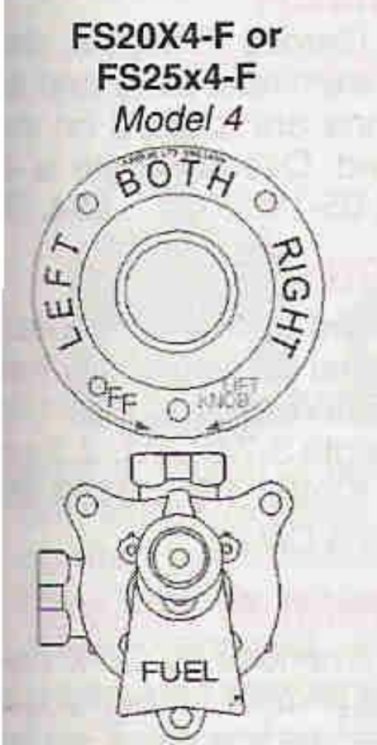
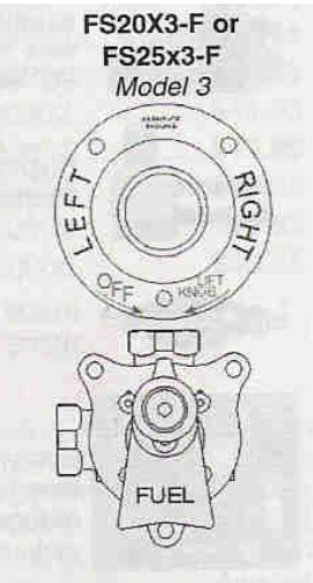
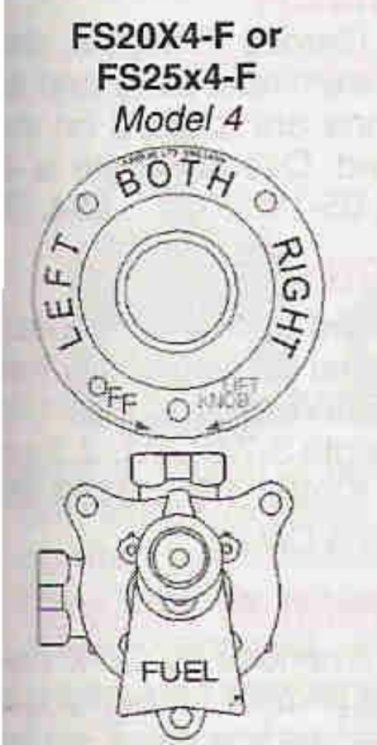
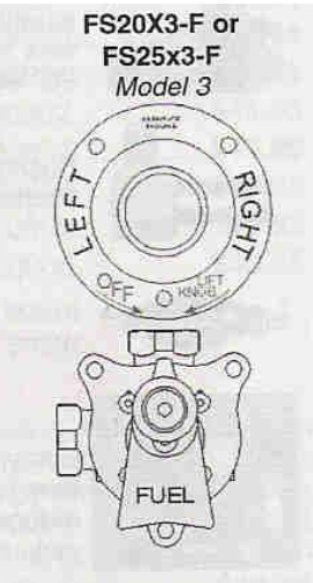
The first illustration is out of the Andair catalog.
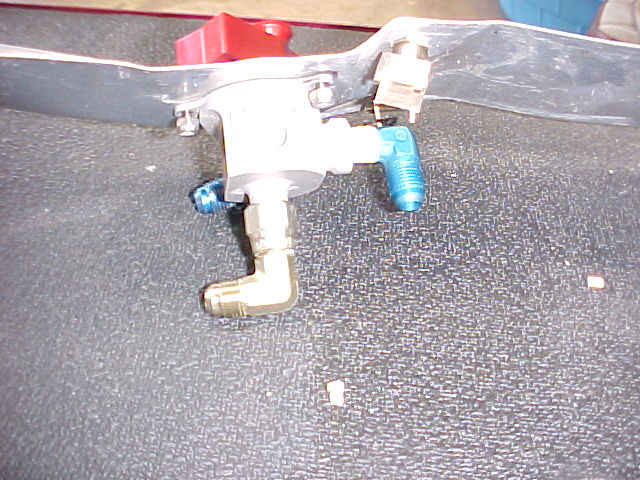
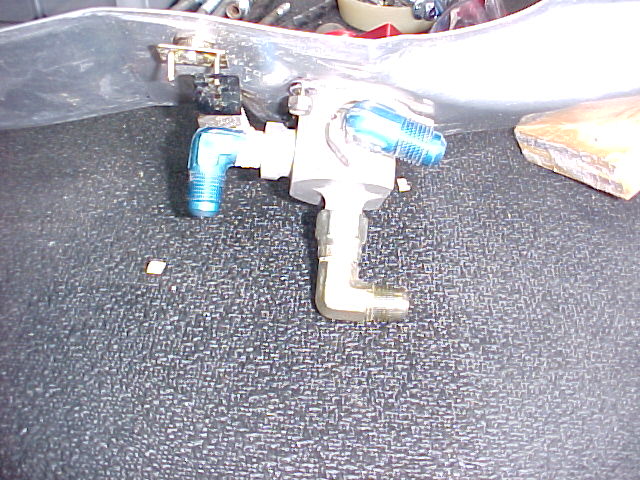
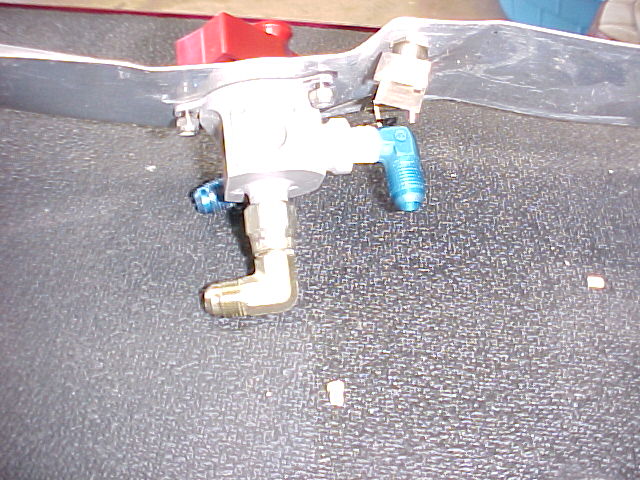
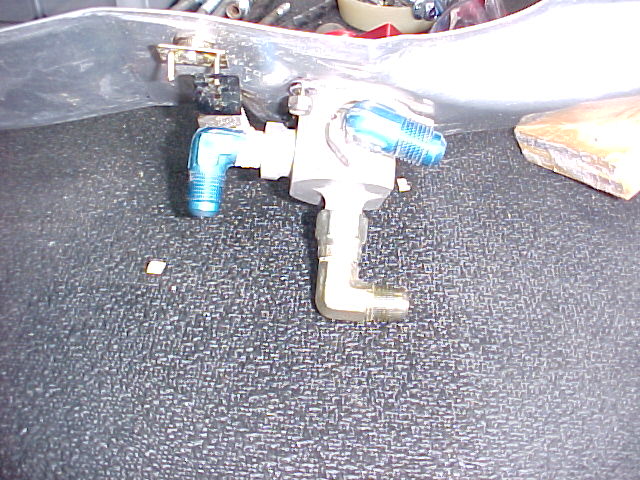
Note that the placard says left, both, right and off but
there are only two ports on the valve. One on the left and one
on the top. The pictures show the actual valve Paul
used.
The handle and rotor on the other hand can
rotate to the left, both, right and off position.
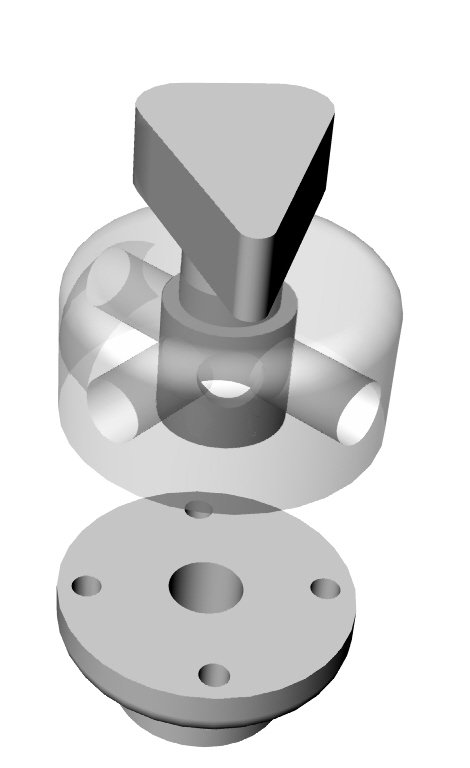
Obviously there is something tricky going on inside
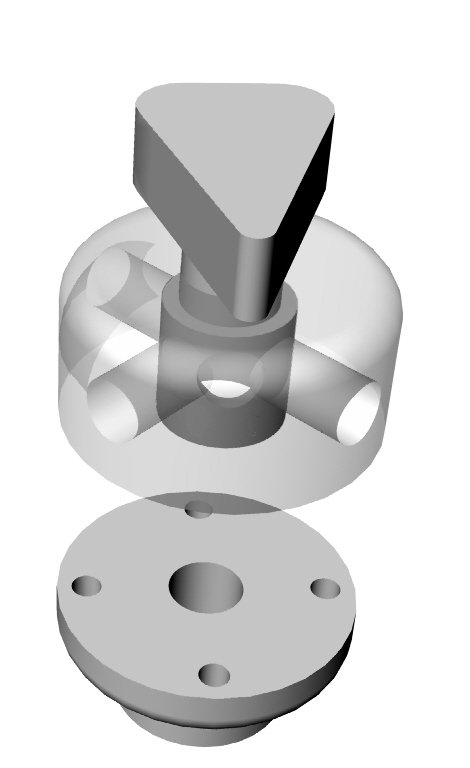
the valve. Since I was not allowed to take the valve
apart I did some 3D's on the possible arrangements
inside the valve.
The 3D shows that when the handle is 45
degrees between left and both the valve is connected
to both. 45 degrees is not a detented position.
In this case the detentes are very weak.
Now this 3D is obviously does not show the actual barrel
used in the left both right and off valve. BTW The port on the
right shown in this 3D was blocked in this valve.
The slot in the barrel must be wider in the valve to uncover
both ports fully when the handle is up or north yet not wide enough
to uncover the top port when the handle says left or east.
In other words the only thing Andair changed between the
left-both-right-off valve and the left-right-off valve
is the barrel itself. The slot in the latter barrel
is obviously narrower.
The last attachment is the Andair left-right-off valve.
Is this clear?
This is probably not clear enough so I may have to do some
more 3D's
The bottom line is don't use a left-both-right-off valve
in a mid wing or low wing airplane. Use the left-right-off
valve only.
I have sent a bunch of stuff to Mark on this subject
and hopefully he will update his web site.
Paul Lamar ...No rotor no motor.
The Rotary Engine NewsLetter. Powered by Linux.
ACRE NL web site.
http://www.rotaryeng.net
Copyright 1998-2006 All world wide rights reserved.