NACA REPORT No. 822
CALCULATIONS OF ECONOMY OF 18-CYLINDER RADIAL AIRCRAFT ENGINE
WITH EXHAUST-GAS TURBINE GEARED TO THE CRANKSHAFT
By RICHARD W. HANNUM and RICARD H. ZIMMERMAN
SUMMARY
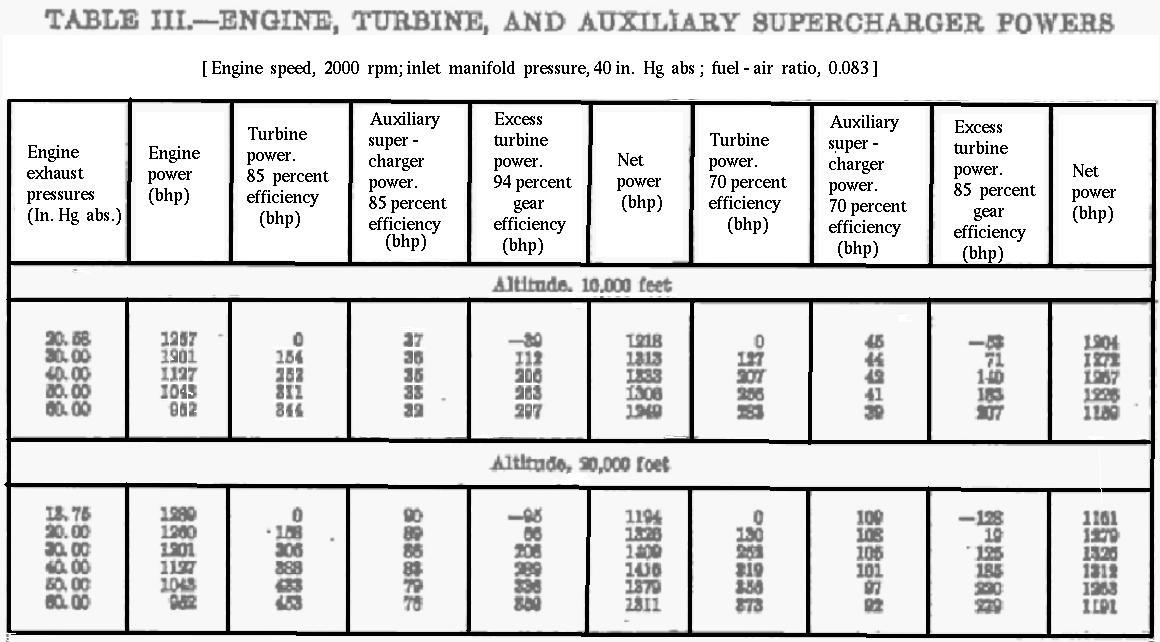
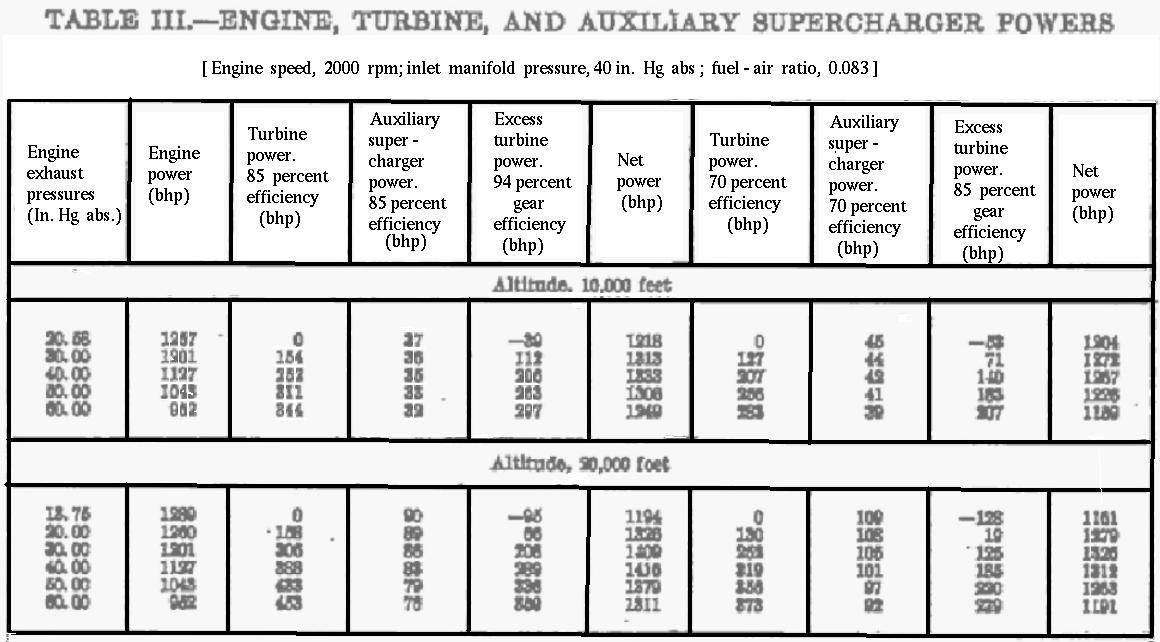
Calculations based on dynamometer test-stand data obtained on an 18-cylinder radial
engine were made to determine the improvement in fuel consumption that can be
obtained at various altitudes by gearing an exhaust gas turbine to the engine
crankshaft in order to increase the engine-shaft work. The calculations indicted
that, for turbine and auxiliary supercharger efficiencies of 85 percent minimum
net brake specific fuel consumption improvements of 0.357 pound per brake horse
hour at an altitude of 10,000 feet and of 0.323 pound per brake horsepower hour
at 30,000 feet can be obtained by gearing the exhaust-gas turbine to the engine
crankshaft and operating that engine at a speed of 2,000 rpm, an inlet-manifold
pressure of 40 inches [5 psi boost] of mercury absolute, and a fuel-air ratio
of 0.063 [12:1].
The reduction in net brake specific fuel consumption that can be obtained if
the exhaust-gas turbine supplies all the auxiliary supercharger power and if
its residual power is transmitted through gears to the engine crankshaft as
compared with auxiliary turbo supercharging, is approximately 14 percent at
an altitude of 10,000 feet and 21 percent at 30,000 feet.
The net brake specific fuel consumption is a minimum is for engine exhaust
gas pressure approximately 25 percent above inlet-manifold pressure and varies
only slightly from that minimum for a range of exhaust gas pressure
from 6 to 45 percent above inlet-manifold pressure.
INTRODUCTION
The use of an exhaust-gas turbine to drive a supercharger at high altitudes
is an effective method of maintaining sea level engine power at altitude.
Analysis has shown, however, that the waste energy of exhaust gases is
recovered more effectively by maintaining an engine exhaust pressure higher
than the minimum required for turbo supercharging and thus increasing the
work output of the exhaust-gas turbine. The extra turbine power beyond that
required for supercharging Can be supplied to the engine crankshaft through
suitable gearing (compound operation).
The purpose of the analysis reported is to determine the improvement in net
brake specific fuel consumption that can be obtained if an engine is equipped
with a geared turbine and supercharger as compared with the engine using a
standard turbo supercharger. The calculated values specific fuel consumption
presented for an engine-turbine combination were based on NACA test data
obtained on an 18-cylinder radial engine. Operating conditions for which the
brake specific fuel consumption of the combination is a minimum are given.
The required turbine-nozzle area is also calculated to indicate the size of
turbine suitable for geared operation.
Because the engine, the turbine, and the supercharger have different
characteristics, elements designed to give maximum efficiency at some
operating conditions are incorrectly matched at other conditions. Provision
must therefore be made to obtain satisfactory performance over the entire
operating range. The problem of obtaining a wide operating range is briefly
discussed.
The investigation reported was conducted at the NACA Cleveland Laboratory
in the fall of 1944.
-------------------------------------------------------
First the rotary is a very mechanically robust engine that tolerates high boost
pressures. The Achilles heel of this technique proved over time to be the
failure of the piston engine exhaust valves when the exhaust gas pressure was 25%
higher than the intake pressure.
Guess what? The rotary has no exhaust valve.
The full 9 page report is obtainable from:
http://naca.larc.nasa.gov/
In pdf form.
Paul Lamar ...No rotor no motor.
The Rotary Engine NewsLetter. Powered by Linux.
ACRE NL web site.
http://www.rotaryeng.net
Copyright 1998-2006 All world wide rights reserved.