>
> >>Paul
> >>
> >>I see a lot of manifolds online that will fit the 13b that are for
> >>carburetor use.
> >> Is it a good or bad idea to use say an ellison TB or (Marvell
> >>Shebler?) carb?
> >>My thinking is less fuel preassure less plumbing everything seems
> easier from
> >>what I understand the fuel burn difference is only .5 in favor of
> >>F/I. I really
> >>think I could've had my motor running months ago if I didn't have
> >>to fight with
> >>the F/I manifold and fuel rails and injectors. Lets say I where to
> >>go that rout
> >>would I not simply need a good ignition system and a redrive? what
> >>about boiling
> >>the fuel in the bowl or do aircraft style carbs not work that way?
> >>
> >>Tony
> >>
> >>There is a lot to be said for using an aircraft carb that can be
> leaned
> >>at altitude on a rotary. You have mentioned several of those
> factors.
> >>We were having lunch up in Bishop with the bunch that showed up
> >>to help Dave get the wings off. One person asked me what was the
> >>most reliable rotary system one could install. I said an aircraft
> carb
> >>and a couple of magnetos :)
> >>
> >
> >
> >Ken Welter has been flying Weber carbs for years.
> >
> >Hans
> >
> Yes I have been flying for over 1300 hrs on Weber and I fly
> regularly at high altitude as I live in the Northwest where there are
> lot on mountain.
> The reason I like a carb is that it is simple, just hook up a
> fuel line and a throttle cable and go fly.
> There are a couple of ways to lean the mixture on a carb. What you
> need to do is create a pressure differential between the float bowl
> and the Venturi. There is a way that is used on snowmobiles that uses
> bleed air from intake vacuum to do this. The way I did it is with
> a controllable air ram. When the air ram is closed all the air is
> drawn through the air cleaner shown in this photo. When the air ram
> is opened it creates a higher pressure on the Venturi then on the
> float
> bowl as the float bowl vents are on the side of the velocity stacks
> and the air ram shoves the air strait into them as the ram tubes are
> positioned about an inch from the velocity stacks.
> Also note that I flew for about 400 hrs without any
> mixture control on the Weber. With a high tech carb such as a Weber
> with multiple air correction circuits compared to a crude antique
> carb such as an aircraft carb the Weber can sense the thinner air and
> deliver less fuel so less manual adjustment is needed.
> Also I don't think there is any way an aircraft carb will deliver
> the airflow needed with a smooth power band. I have used a 51mm Weber
> for about 100 hrs but am now running a 48mm. For all out power the 51
> is best but the 48 has a smother power band and is less altitude
> sensitive so I would probably suggest it for most applications.
> Ken Welter
>
>
> ----------------------------------
>
> OK, All this time I've been heading toward EFI, Now I'm hearing EFI is
> perhaps not a good choice. So here is my question to all. What are the
> major problems with the plumbing? Should a certain material be used for
> the plumbing? Paul why is it you stated the homebuilder probably can't
> make a reliable plumbing system for the high pressure EFI system? T.W.
>
>
> ----------------------------------------------------------
> He can make it all right. It is designing it seems to be
> a problem. In other words making decision on where to put what
> seems to be the problem. Fuel pumps, selector valves, vents, etc.. If you
> are installing a Lycoming those decisions are made for you. Each type
> of airplane is different so therein lies the problem. High pressure
> EFI fuel systems are not as easy as they look. People make big mistakes.
> The other thing is high pressure pumps suck a lot of amps.
> Too bad they are not as good on sucking fuel :)
> So now the electrical system becomes slightly more important.
>
> On the other hand low pressure none return carburetor fuel
> systems are pretty straight forward. The low pressure electric
> pumps are not finicky and have been around for decades. It
> is also possible to get a mechanical fuel pump without too much
> trouble. The old diaphragm mechanical pumps were positive
> displacement and would suck the chrome off a bumper.
>
> In effect the carb float bowl acts like a small fuel sump and
> covers a few sins.
>
> Now what kind of airplane are you building?
>
> BTW one of the reasons the crash rate is higher for low wing
> airplanes is fuel management by the pilot is more complicated
> in low wing airplanes.
>
>Paul Lamar
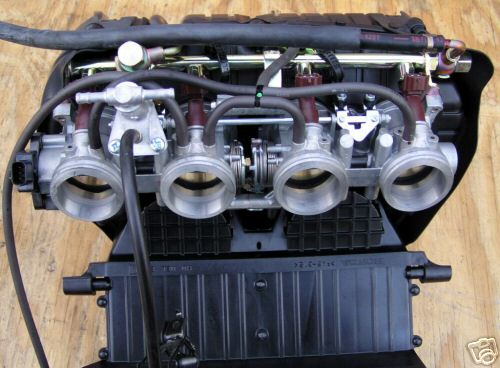
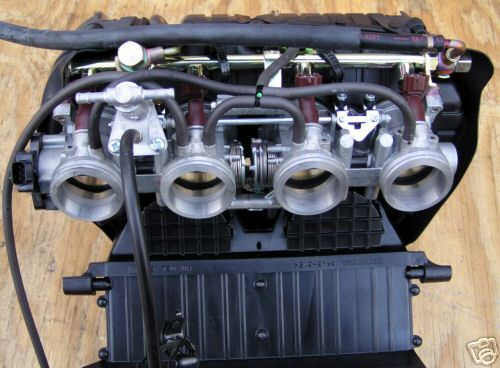
In my last e-mail to you I asked about motorcycle fuel injection systems
these are very compact and are being used on bikes with as much as 180hp.
would these be any better or worse than the current injection system we
have now? I think we can simply use our injectors for the Mazda. But why
would you? these already handle N/A 13b horsepower does it use the same
type pumps and the same psi? I know your not a motorcycle mechanic so
I'm only asking if all injection is created equal.
Tony
I think it is. That plumbing is an accident waiting to happen
on an aircraft engine.
Paul Lamar ...No rotor no motor.
I never said anything about the plumbing. I'm only asking about the
injection itself if you where to use "aircraft grade plumbing" would
this work and if not. why why why???
Tony
If it will handle 180 HP why not? :) What type injectors are they?
Peak and hold or saturation? What is the fuel pressure they are designed
for? What is the resistance of the injector coils?
Why use them instead of Mazda injectors?
Paul Lamar ...No rotor no motor.
The Rotary Engine NewsLetter. Powered by Linux.
ACRE NL web site.
http://www.rotaryeng.net
Copyright 1998-2006 All world wide rights reserved.