>>> > Don't know if anybody else noticed but the final FAA report on
Paul's
>>> > [Conner] crash has been out since beginning of the month. According
>>> to thej
>>> > report the likely cause of engine failure is the fuel valve selector
>>> > position which was partially sucking air from the empty right
tank. It
>>> > brings a memory flash of John Denver's death in his EZ with the fuel
>>> > selector problem.
>>> > > So now I am glad to have a 2.3 gal sump tank where the fuel feeds
>>> from
>>> > either tank with the selector valve. In fact I took off once with
the
>>> > selector valve off and the sump tank low level warning light came
on.
>>> > richardt2005
>>>
>>> Nothing about it being aft of the CG limit? Amazing.
>>> Paul, if the final report is out, can you now "talk"?
>>>
>>> Perry Mick.
>>>
>>> Sure! What do you want to know?
>>>
>>> No way for me to know if the airplane was aft of the CG limit
>>> or not. I am sure he pulled too many G's (90 degree bank) and stalled
>>> the canard trying to make it back to the runway. (There was a plowed
>>> field
>>> more or less straight ahead.)
>>>
>>> When that happens the canard airplane turns towards the ground.
>>> That is what the pilot witness described. We had another fatal crash
>>> similar situation at SZP when an air show pilot pulled too many G's
>>> in a canard at low level and crashed in the river bed.
>>>
>>> Paul got it rolled out 90 degrees and mostly pulled out but the
>>> vertical velocity was still high when he struck the ground almost
>>> level. Hard enough to bury the inflated tire below ground level.
>>> It was not muddy ground either.
>>>
>>> I felt it was the fuel selector valve but there is no real proof
>>> as it could have moved during the crash. I will say the detentes
>>> on that Andair fuel selector valve were no where near strong enough.
>>>
>>> Some body else checked the only two fuel injectors well after the
crash
>>> and found one of them intermittent or some such. Not a good idea to
use
>>> only two injectors.
>>>
>>> First mistake was taking off with an improperly designed fuel
>>> system using a left, right and both fuel selector valve along with a
>>> myriad of other errors in the fuel system design. Fuel in only one
>>> tank. Sump tank was like a 2 x 4 across the entire width of the
>>> fuse. Sump tank was improperly vented to one strake tank. All
>>> this is AFTER the crash.
>>>
>>> Paul was not too good on sharing the details of his airplane with us.
>>> For example we went around and around on the cooling.
>>> When I got there and saw the airplane there were two large
>>> holes one in each side of the plenum that was supposed to be
>>> feeding air to the rad.
>>> Paul Lamar
>>
>>
>> ------------------------------------------------------------
>> Did you take notes when you visit Paul Conners crash site? At the time
>> you
>> implied a lot of mistakes were made. I already have an aircraft fuel
>> system
>> article up. Could you please review it in light of the crash and
>> recommend
>> alterations.
>>
http://www.wankel.org/28_Fuel/28-10%20fuel_system.htm
>>
>> Mark Wrathall
>> Wankel.org
>>
>> Yes I wrote a report and submitted it to the FAA.
>>
>> Paul Lamar
>> ----------------------------------------------------
>> Here is the final report. Substantially what I suggested
>> to the FAA as the most likely scenario.
>>
>> On further hind site and after someone obtained the wreckage
>> from the heirs the injectors were tested and one was found
>> to have some sort of problem. Don't use only two injectors.
>>
>> Paul Lamar
>> --------------------------------------------------
>> ATL05LA081
>>
>> HISTORY OF FLIGHT
>>
>> On May 16, 2005. at 1545 central daylight time, a Homebuilt
>> Experimental Built
>> airplane, N2992, registered to and operated by the commercial pilot,
>> collided
>> with trees shortly after takeoff from runway 24, at the St. Elmo
Airport,
>> in St. Elmo, Alabama. The flight was operated under the provisions of
>> Title 14 CFR Part 91, and visual flight rules. Visual meteorological
>> conditions prevailed and no flight plan was filed for the local flight.
>> The pilot received fatal injuries and the airplane sustained
substantial
>> damaged. The flight originated from the St. Elmo, Airport in St. Elmo,
>> Alabama
>> on May 16, 2005, at 1540.
>>
>> According to witnesses, during takeoff the engine did not seem to
>> be developing full power. At about 250 feet above the ground the
>> airplane banked left and the engine quite. The airplane's bank angle
>> increased and exceeded 90-degrees. The airplane's nose dropped
suddenly,
>> the wings leveled and the nose came back to nearly level prior to the
>> airplane colliding with trees in a wooded area. Witness, telephoned
>> the 911 operator reported the accident, and proceeded to the scene to
>> provide assistance.
>>
>> PERSONNEL INFORMATION
>>
>> A review of records on file with the Airmen Certification Branch,
>> Federal Aviation Administration, Oklahoma City, revealed that the
>> pilot was issued a commercial pilots certificate with ratings for
>> airplane
>> single engine land, airplane multiengine land, and instrument rating on
>> May 27, 1986. In addition, the pilot was issued a repairman certificate
>> with ratings for experimental aircraft builder on July 14, 1999. The
>> pilot
>> held a third class medical certificate issued on June 03, 2005 with no
>> limitations.
>>
>> AIRCRAFT INFORMATION
>>
>> Review of aircraft records on file with the e Federal Aviation
>> Administration, Oklahoma City, revealed the amateur built experimental
>> airplane was registered on November 17, 2004.
>>
>> METEORLOGICAL INFORMATION
>>
>> At 1656, the Mobile Regional Alabama weather reporting facility,
>> located 13 statue miles north of the accident site, reported winds
>> variable at 3 knots, visibility of 10 statute miles, scattered clouds
>> at 7000 feet, temperature 28 Celsius, dew-point 12 degrees Celsius,
>> and an altimeter setting of 29.90 inches of mercury.
>>
>> WRECKAGE AND IMPACT INFORMATION
>>
>> Post-accident examination of the wreckage site revealed that the
>> airplane rested approximately 1500 feet west of the St. Elmo Airport,
>> in a wooded area. The direction of travel at impact was 040 degrees.
>> Examination of the airframe revealed damage to the fuselage and
>> empennage.
>> The landing gear and the right and left wing also exhibited damage.
>> Examination of the engine reveled that the engine was separated from
>> the engine mounts.
>>
>> Post accident examination of the fuel tanks revealed that both fuel
>> caps were secured and the tanks were not breached. No fuel was found
>> in the right wing tank and the left wing tank contained approximately
>> 6 to 8 gallons of automobile fuel. The fuel selector was observe
>> selected between the both and left position.
>>
>> MEDICAL AND TOXICOLOGICAL INFORMATION
>>
>> The toxicology examinations for the pilot were negative for carbon
>> monoxide,
>> cyanide, and ethanol.
>>
>> ADDITIONAL INFORMATION
>>
>> The fuel selector has three inlet ports (left, right, and both) and
>> four positions (left, right, both, and off). The right fuel tank line
>> was attached to the both port. According to Antare, the manufacturer
>> of the fuel selector, if the selector handle is allowed to rotate to
>> the position between both and left, the fuel output line from the
>> selector
>> valve is connected to both the right and left fuel tank. With only fuel
>> in the left tank the high pressure electric fuel pumps could draw air
>> only from the right tank and no fuel.
>>
>> When the fuel selector lever was rotated by hand, the detents in
>> the selector valve were very weak and almost unnoticeable.
>> ------------------------------------------------------------
>
>
> After reading the various posts on this unfortunate accident, I am still
> not clear on why a left, right, both, off fuel selector is a bad idea.
> Can you dumb it down for me? I have one and was planning on using it.
>
> jeremy solomon
>
> What brand is it?
>
> Is this a high wing airplane, mid wing airplane
> or low wing airplane?
>
> The main problem with a low wing airplane
> is if you put it on "both" and one tank is empty or one of the tank
> pick up tubes becomes momentarily uncovered or dry the engine
> will quit as the high pressure pump will suck air from the
> line with the least resistance. The pump is attempting to suck all of
> the time. With the Andair valve this can happen when the valve
> is in between settings or passing from one setting to another.
> There could be a situation where the plane is in a slip or
> an uncoordinated turn. One of the inlets will become uncovered
> and the pump will suck air. High pressure pumps don't suck well
> and are hard to re prime.
>
> On a high wing airplane there is always a head of fuel on
> the valve (a slight pressure) and on the pump. The pump does
> not really need to suck.
>
> On a high wing airplane when the valve is set on "both" some
> fuel can actually flow out of one tank into the other. Not
> necessarily so with a low wing airplane depending on the height
> of the valve.
>
> There are three things you always need to keep in mind.
> The height of the fuel above or below the valve and the pump inlet
> under all flight conditions or attitudes. The fuel level should
> be as high as possible.
>
> On Paul Conner's airplane the valve was not as low as it could be and
was
> quite far forward. There were other mistakes as well.
>
> Also the air pressure in the fuel tank due to venting differences.
> At 150 MPH or more fuel can be transfered from one tank to the other
> and hence overboard just due to improper venting. Venting configuration
> is extremely important.
>
> The third thing is where is the return flow going? It is possible
> to pump a tank dry in less than half or 1/4 of the time if the return
> flow is going to other than the tank fuel is being drawn from.
>
> The red line in these 3Ds is the return flow.
> The green is the supply line. Here are are few plumbing scenarios.
>
>
> Paul Lamar ...No rotor no motor.
Paul,
On your four pump system you need to run your feed lines through the
selector valve too don't you ?
John
Yes but it is only single level valve and not a two level valve.
That gives one a much wider choice of valves. Not only that
the height of the valve mounting now becomes irrelevant.
The down side of that system also requires the pilot to do
two things and not one when switching tanks
making it slightly more pilot error prone. He must switch the
return fuel and select the correct pump electrical switch.
The fuel quantity gages are more important
in a low wing airplane as now one must get the vast majority of
the fuel out of one tank before switching to the tank with the most
fuel for landing.
As a back up system it would be nice if you
had a timer combined with a flow meter on each tank so you knew
how many gallons of fuel you burned out of each tank. You would
have to remember to reset them when the tanks were filled.
BTW there are a few more systems that will work also.
Paul Lamar ...No rotor no motor.
Paul, This system is so much simpler, with respect to plumbing that I am
really considering it for the RV-10. Has anyone sourced the in-tank fuel
pumps? With just a few wiring connections instead of in cockpit plumbing
it has advantages. In tank pumps would also eliminate vapor lock
problems. A slip ring switch connected to the return valve to change the
fuel pump (primary) would be a good way to connect everything.
Bill Jepson
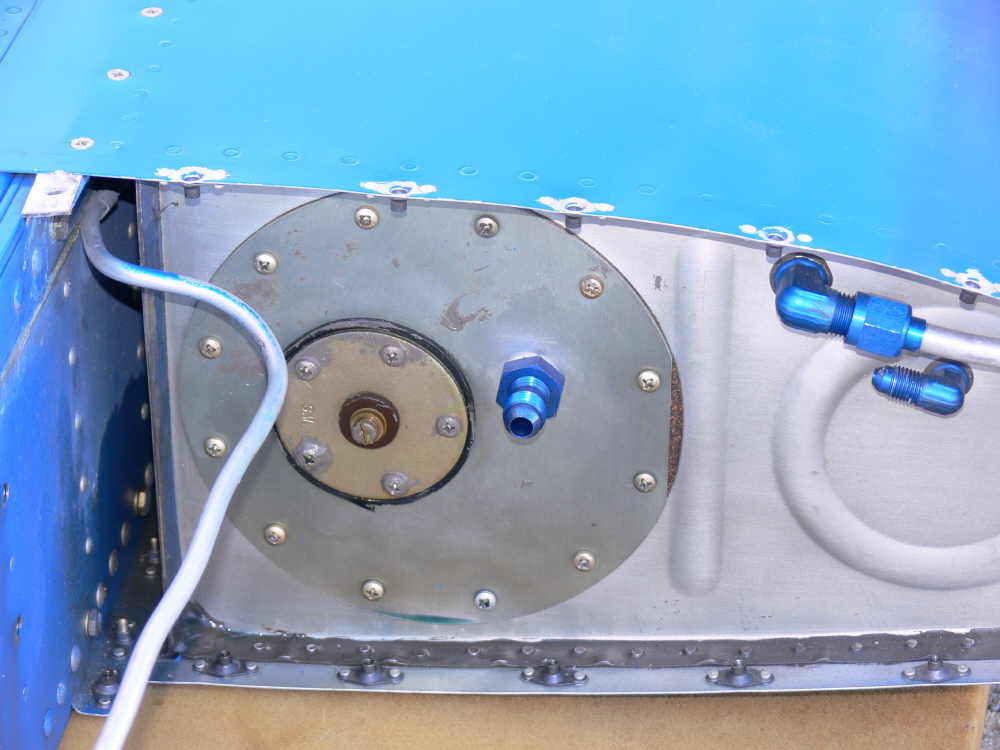
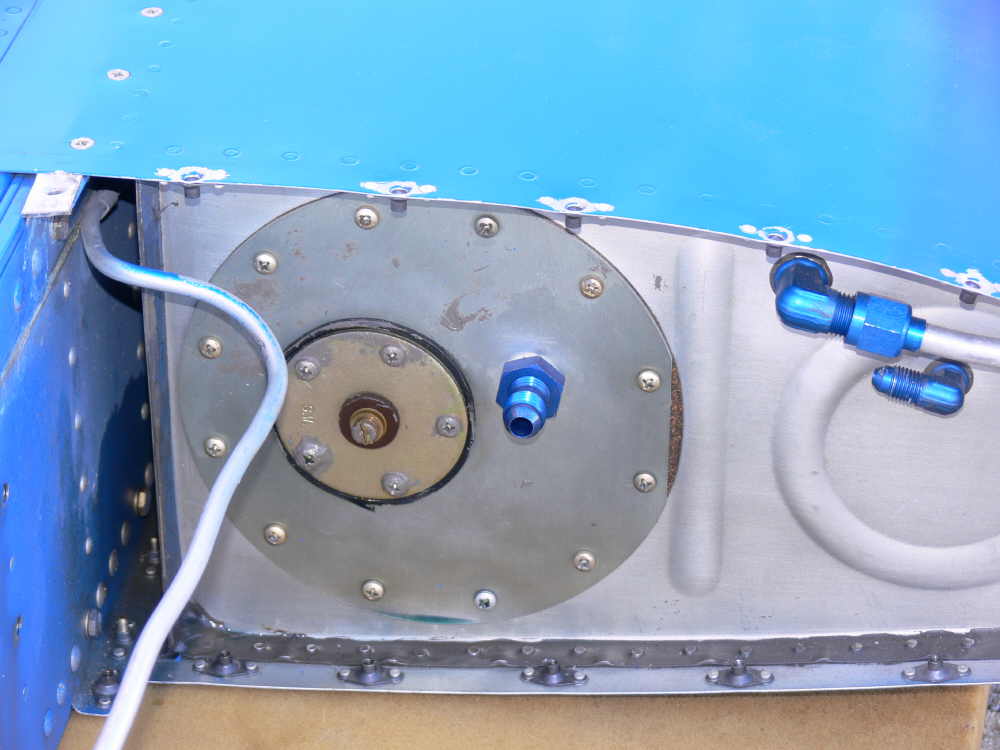
There are a zillion high pressure in-the-tank fuel pumps around
as every car in the world has one. When we were taking the wings
off Dave's airplane I was checking things out on how hard it would
be to access and maintain the in-the-tank pumps once the airplane was finished.
It does look feasible if you plan ahead.
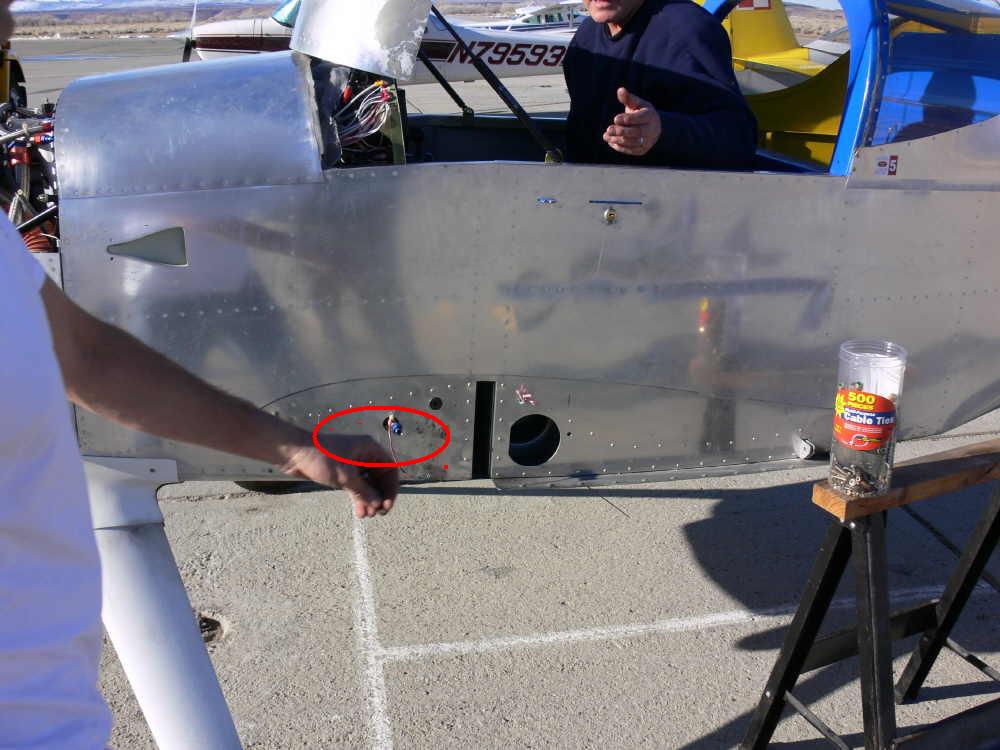
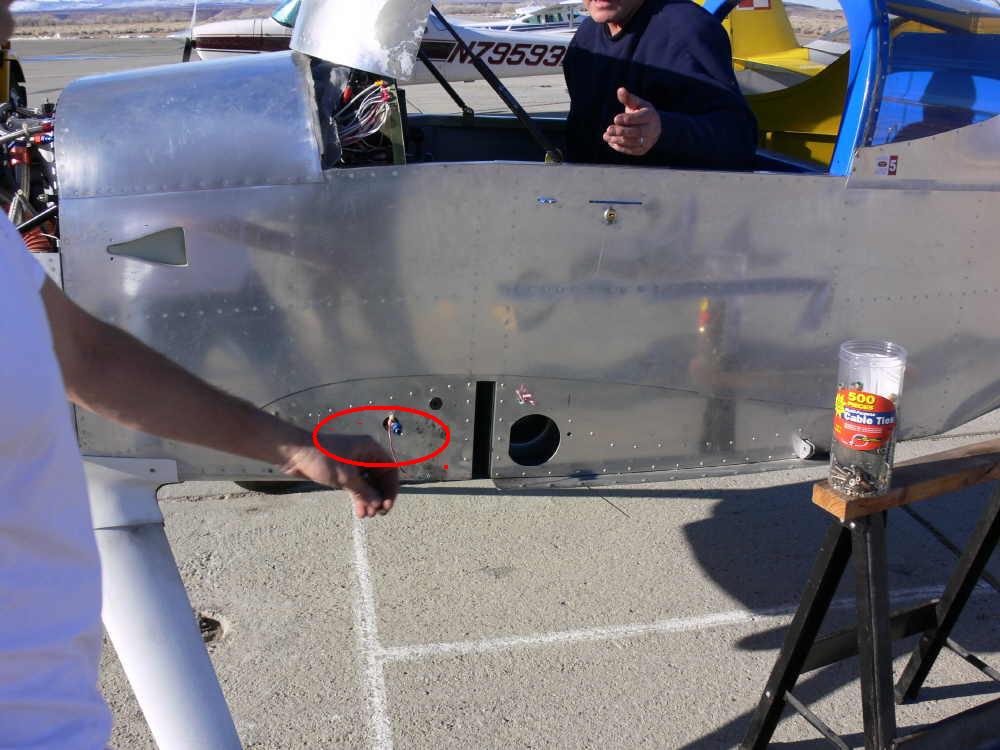
It looks like a large hole can be cut in both sides of the fuselage skin
opposite the large access panel in the root ribs. It would be wise
to rivet a doubler all around the out side of the hole.
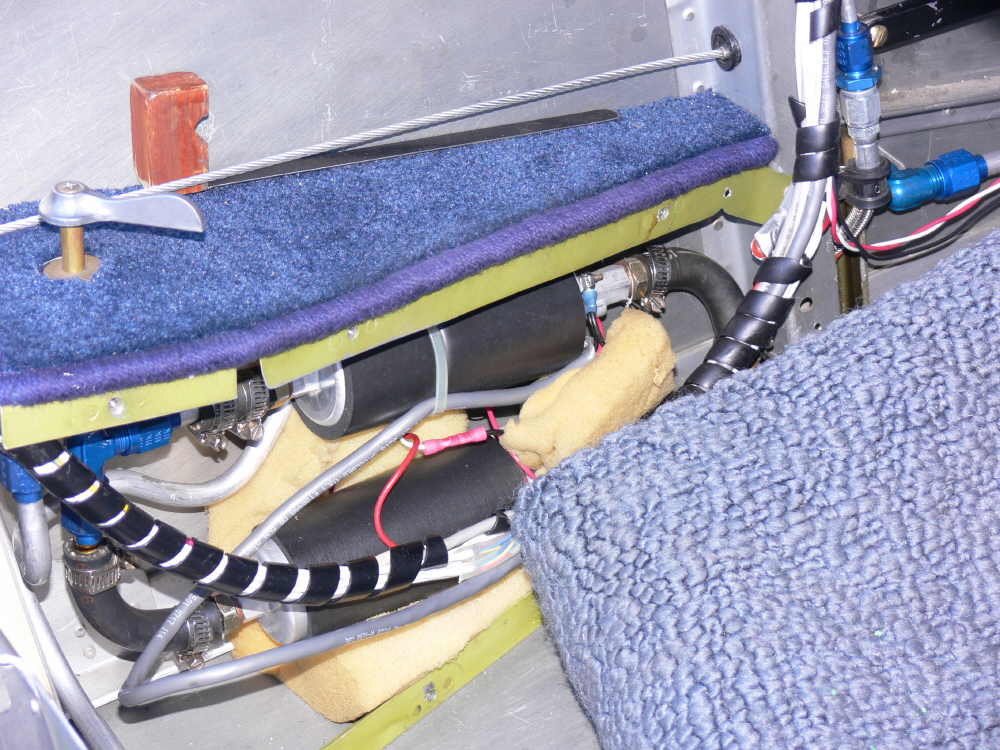
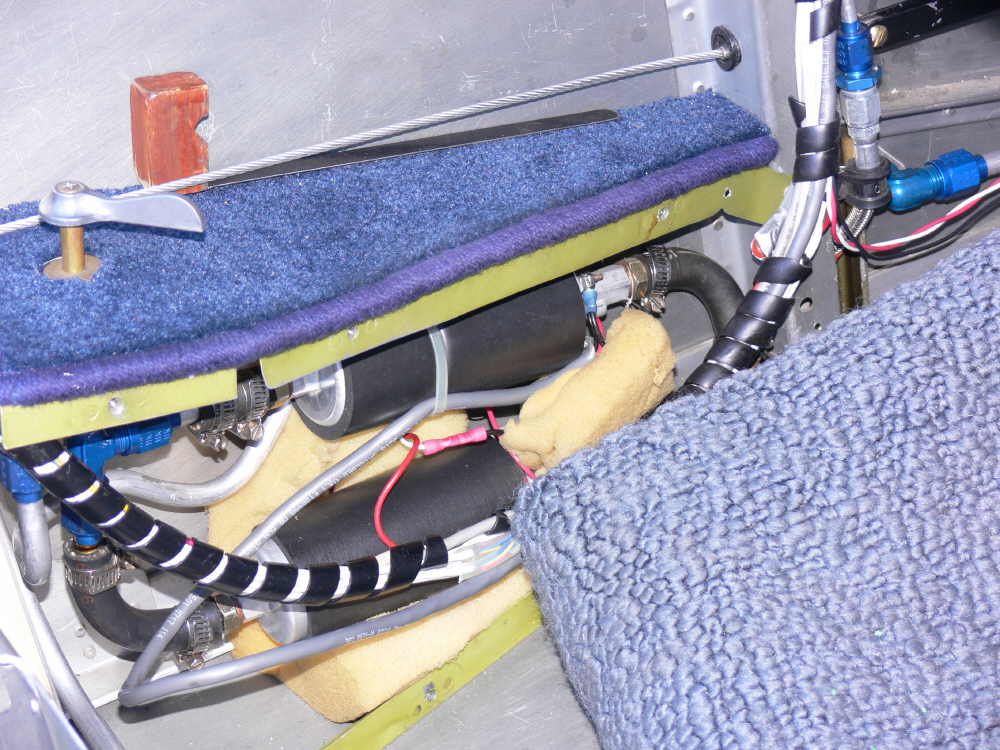
Right now Dave has the pumps tucked down below the pilots
left elbow.
Paul Lamar ...No rotor no motor.
The Rotary Engine NewsLetter. Powered by Linux.
ACRE NL web site.
http://www.rotaryeng.net
Copyright 1998-2006 All world wide rights reserved.