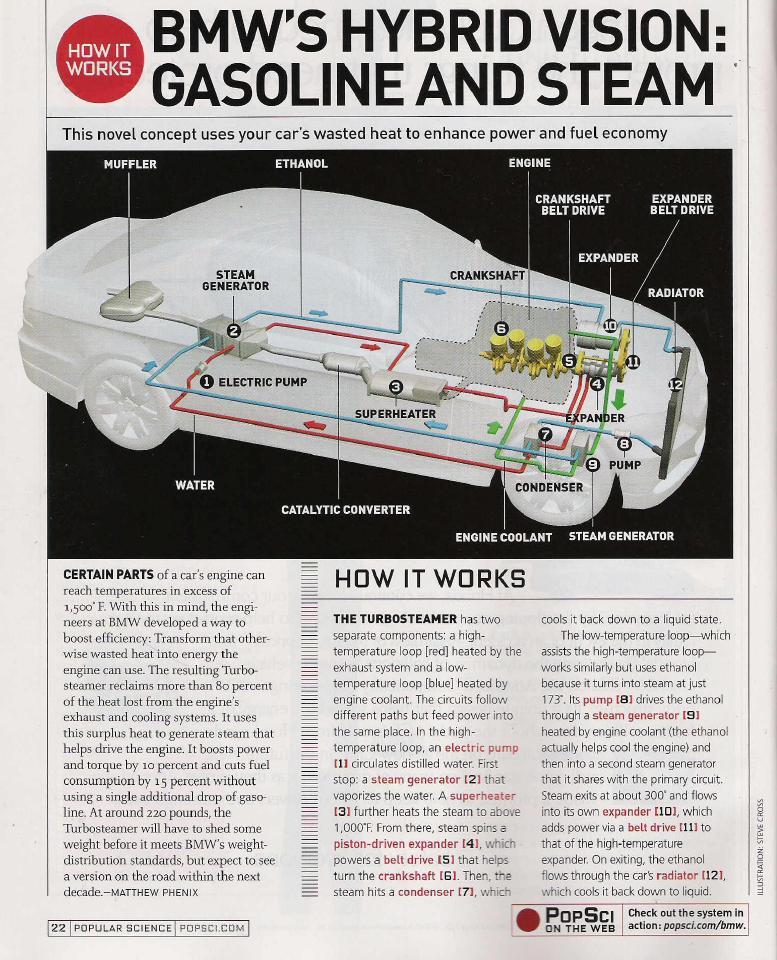
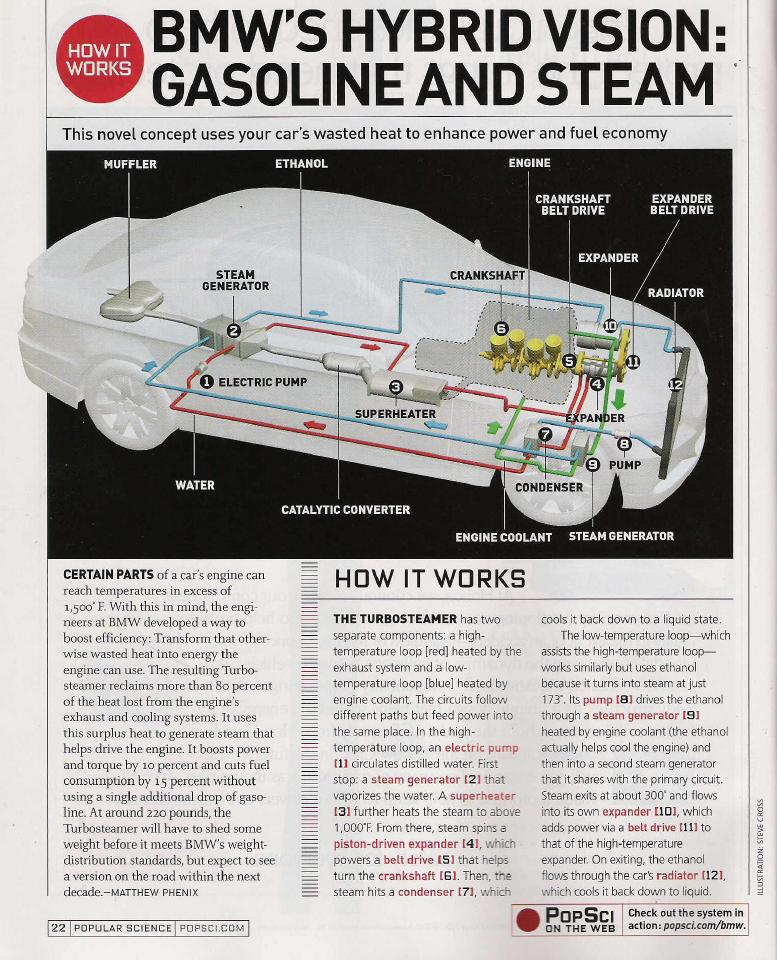
There is some engineer lurking on here working for BMW
stealing my ideas :)
This idea was proposed on here in March of 2005.
That is when I first did the 3D.
http://www.rotaryeng.net/combined-cycle-turbo-compound.jpg
Paul Lamar ...No rotor no motor.
Sorry Paul, but that Idea (steam bottoming cycles) has been around for
*decades*. Extensive research was done on it funded by DOE and some by NSF
in the 70's and 80's. Thermo-electron made a bottoming cycle over-the-road
truck as part of the program.
Problem was always
*co$t* and complexity.
Bill Schertz
KIS Cruiser # 4045
http://arjournals.annualreviews.org/doi/abs/10.1146/annurev.eg.07.110182.001453;jsessionid=nzqJfRkUmYY63ZdZCM?cookieSet=1&journalCode=energy
Oh darn :) Maybe when the price of gas hits $10 a gallon.
BTW while I got you on the line what do you think of BMW's idea
to use alcohol to cool the engine and let it vaporize at 173 degrees
Fahrenheit. Doesn't the heat of vaporization require and therefore remove
large amounts of heat? I would imagine the cooling system would have to be
high pressure capable.
-----------------------------------
Oh man, where do I start.
That is one of the most complicated bottoming cycles I have seen,
Steam-Rankine, coupled with Organic Rankine Cycle, one primary mover (the
engine), and
*two* secondary engines (steam expansion and alcohol
expansion). The control of this with varying power loads is likely to be a
nightmare, coupling all the fluid flows with the heat loads and power
requirements.
I think someone has not thought this out very well, did some brainstorming
and it is all paper study.
Bill Schertz
---------------------------------
Actally BMW have claimed to have built an engine and tested it.
http://www.greencarcongress.com/2005/12/bmw_developing_.html
"In tests with a 1.8-liter, four-cylinder engine, the new auxiliary power
unit reduced fuel consumption by up to 15% while generating nearly 14
additional horsepower and 20 additional Nm of torque.
The Turbosteamer is based on the same principle as the steam engine:
heated fluid forms steam in two circuits which is used to power the engine.
The primary energy supplier is the high-temperature circuit which uses
exhaust heat from the internal combustion engine as an energy source via
heat exchangers. More than 80% of the heat energy contained in the exhaust
gases is recycled using this technology, according to BMW.
The steam is then conducted directly into an expansion unit linked to
the crankshaft of the internal combustion engine. Most of the remaining
residual heat is absorbed by the cooling circuit of the engine, which
acts as the second energy supply for the Turbosteamer."
-------------------------------------------
Just proves that with a computer controlling things you can
do almost anything :)
What about just using the alcohol to cool our rotary engines?
--
Paul Lamar ...No rotor no motor.
The Rotary Engine NewsLetter. Powered by Linux.
ACRE NL web site.
http://www.rotaryeng.net
Copyright 1998-2006 All world wide rights reserved.