>
> Remind me to get back to you on this spark plug issue next
week. I
will be
> speaking with an ex Mazda rotary guy who helped design the
intake
system for
> the LeMans engine. The spark plug question as well as the
profile
shape of
> the P-port are several answers I seek. I happen to agree with
about the
> future of stricter EPA regs. in the future.
>
> Doug in Japan
>
Doug, If you get the chance, ask him if the LeMans engine
intake was
ever operated at maximum length
at 9000 rpm. I'm trying to develop a program for manifold
design and it
indicated that the manifold would be in primary resonance at
max length
at 9000 rpm. Looked like second harmonic was used at all
other engine
rpms. Would help a lot if you could confirm this.
Tracy Crook
What are you using for intake air velocity of sound Tracy? I would
be very
surprised if it was second harmonic. In the intake air the
velocity (V)
of sound is roughly 1,100 feet per second depending on
temperature.
From Scientific Design of Exhaust and Intake Systems Page 82.
L = V x 180 / RPM therefore L = in inches is 31.9 inches
with V = 1100 and RPM = 6200.
At 8000 RPM it is 24.74"
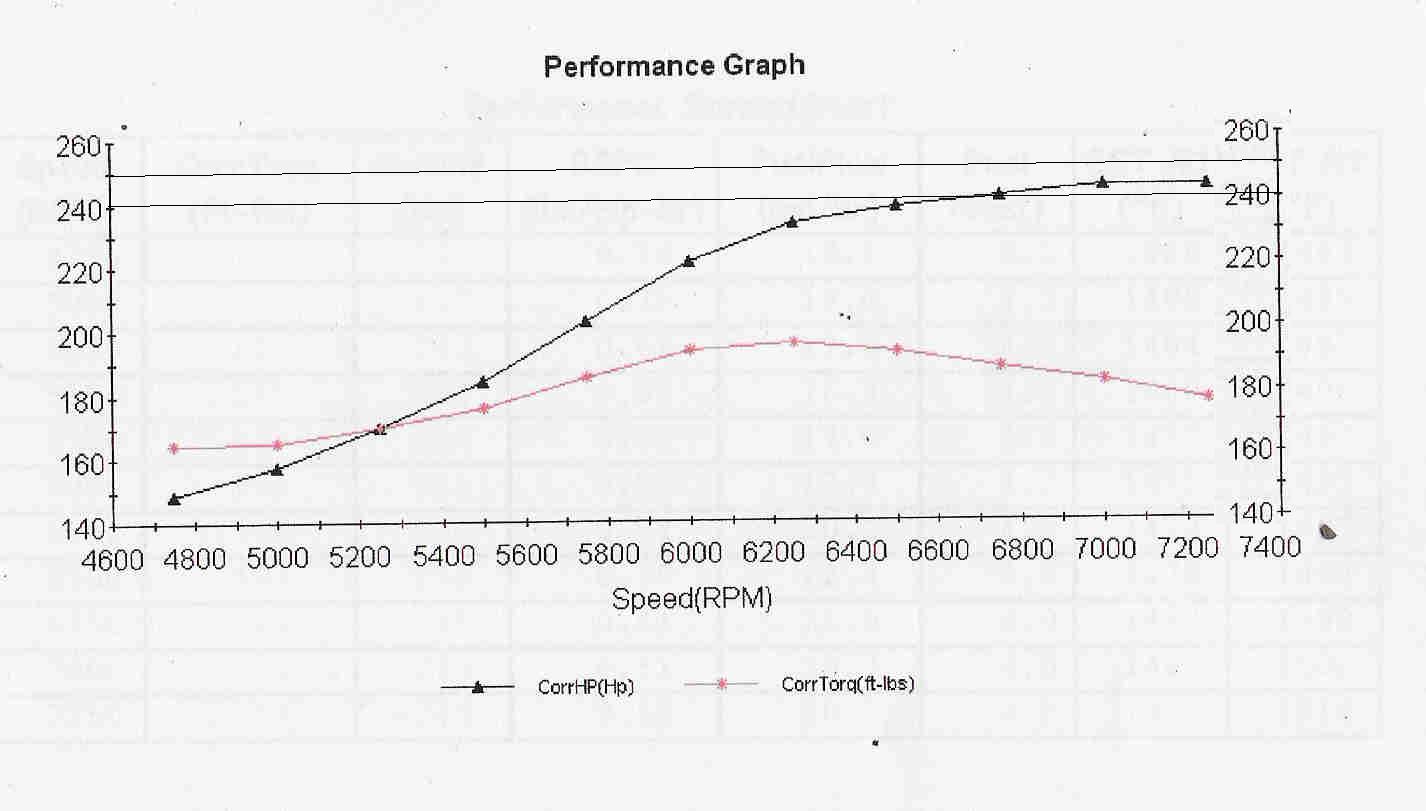
Here is a an actual dyno run of a copy of the actual Lemans
P-port with
a 25 inch length runner including carb that seems to be resonant
around 6200 RPM. (Max torque.) This seems to indicate that it
is the
first harmonic.
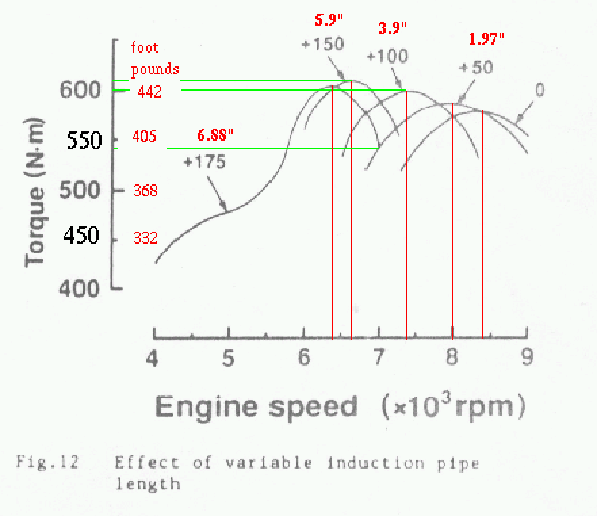
To the numbers in this torque chart from Mazda you must add the
fixed
length of 16 inches. That would make the 6500 RPM length number 23
inches.
Paul Lamar
-------------------------------------------------------------------
I was not basing my guess solely on speed of sound
calculations. As
your examples show, the various formulas, guidelines, rules of
thumb, etc, frequently do not correlate with real world results.
I'm hoping to develop something that does.
As for that Mazda LeMans engine dyno chart, my question relates to
what the curve would have looked like if the plot for the +150
setting (max length) had been carried all the way out to 9000 rpm.
If there were a monster torque peak there, do you think Mazda would
want the other racers to know about it? : )
Tracy Crook
---------------------------------------------------------
I thought my example correlated pretty well with the formula.
It also correlated well with the Mazda data.
I did not measure the temperature of the air going into the runners
but if you put your fingers on the runners when the engine is running
they are quite cold due to evaporation of the fuel.
The speed of sound
in a hot exhaust system is 1,700 feet per second. The speed of sound
under
standard conditions is 1100 feet per second. If we assume for the moment
the speed of sound in the colder intake manifolds is 1000 fps then the
optimum length of the runner comes out to:
1000 x 180 / 6200 RPM = 29 inches which is pretty darn close to
the 25 inches we were using.
It is also pretty darn close to what Mazda claims at 22.88 inches at
6400 RPM. I would say
We also correlated the torque well, despite the use of a 58 mm downdraft
carb, with the torque Mazda got per rotor at 6000 or 220 foot pounds
for a two rotor using EFI. We got 200 foot pounds. I am completely
satisfied
as we nearly matched the results Mazda got with their Lemans engine.
I think it is rather amazing given the resource we had and what
Mazda had. The dyno test were also done 15 years apart on two entirely
different dyno s. I also think there is more to be had with your EFI
when
we get it tuned properly.
These length numbers for the runners are far cry from that which
it would be if we were operating on the second harmonic.
Note that we are using about the same diameter pipe Mazda was using
on their Lemans engines. There is some recent evidence that the diameter
of the pipe also enters into the equation.
BTW I mentioned no rules of thumb. The formulas are based on organ pipe
theory which works for the design of organs for the past few hundred
years.
If you build it by the formula that is the tone you hear.
Do you have the book "Scientific Design of Exhaust and Intake Systems"
Philip H. Smith and John C. Morrison Published by Robert Bentley.
ISBN 0-8376-0309-9 ?
Your last question has me rolling on the floor laughing.
The Lemans paper SAE 920309 was written after Mazda won Lemans
outright.
All scientific and engineering papers are written to be as accurate
as possible as it is rather embarrassing for a dozen people to
exactly repeat
your experiments and get results entirely different. Sooner or later
you are found out to be a lier. Your credibility at that point
goes down the tubes. Cold fusion is a classic example.
Beside that the friction of the engine is rapidly rising, the
air velocity in the intake pipes is increasing and so too the
friction drag of the air on the inner walls of the intake pipes. The
flow coefficient of the exhaust port is also deteriorating and the
restriction of the exhaust system in general is also increasing.
The chance of a sudden torque or HP jump at 9000 RPM is rather
unlikely to say the least. All that is why you are seeing a gradual
decrease in the peak torques as the RPM is building up in the Lemans
engine torque curves chart.
It is also why you are seeing a gradual decrease in the torque in
the high power
RX8 engine from 6000 RPM on up and the low power engine from 5000
RPM on up. Note the little bump in torque curve in the low power engine
at 7200 RPM which may have led you to your conclusion since
you are running the low power engine. The stock intake system in
the lower power RX8 engine is much less sophisticated than the
high power engine so there will be more discontinuities in the torque
curve. Also the lower torques are a reflection of the smaller
port area in the low power four port engine as compared to
the high power six port engine.
Paul Lamar ...No rotor no motor.
I didn't say the SAE paper was not correct, I merely suggested that
it might not be complete.
As far as correlation, you give the following examples of tuned
manifold lengths based on experimental and calculated results.
8000 @ 24.74"
6400 @ 22.88"
6200 @ 29.00"
6200 @ 25.00"
6200 @ 31.9"
If there is a pattern here then it escapes me : )
Tracy Crook
-----------------------------------------------
Well you very deviously mixed then up :)
Some were calculated and some where actual test data.
Calculations were made at ambient temperature and below
ambient temperature.
Calculated
RPM Len Speed sound
6200 @ 31.9 1100 ambient temp
6400 @ 30.9 1100
8000 @ 24.7 1100
6200 @ 29 1000 below ambient temp
6400 @ 28 1000
8000 @ 22.5 1000
Actual test data
RPM Len don't know
6200 @ 25 ????? Mazdatrix dyno p-port carb
6400 @ 22.9 ????? Mazda dyno p-port EFI
These are almost at the limits of the precise interpretation
of the low rez torque curve chart from Mazda.
In the case of the Mazdatrix dyno curve it is hard to
say exactly where peak torque is because the curve is
so flat. In other words 6200 RPM could just as easily have
been 6400 RPM.
If you can come up with a unified field theory of intake
manifold design that takes into consideration the runner
diameter, number of runners per rotor AND the length
of the runners AND you can prove it with dyno charts
I am all ears :)
Paul Lamar ...No rotor no motor.
The Rotary Engine NewsLetter. Powered by Linux.
ACRE NL web site.
http://www.rotaryeng.net
Copyright 1998-2006 All world wide rights reserved.