Paul
I want to know about measuring the exhaust pressure, in the exhaust. Temp
is easy. For flow I would think with the MAP, and known data about burn
efficiency we can roughly calculate it. What type of pressure sensors can.
survive those temps?
Doug in Japan
A water manometer with a five foot length of steel brake line
tubing to isolate the exhaust heat from the rubber tubing going to
the water manometer. Should cost all of two hundred yen :)
12 inches of water is .45 psi so you may need a ten
foot high water manometer. Pressure will be above or below
or signed addition to atmospheric.
A mercury Hg manometer would be more compact.
Now the real problem is getting a high speed, high temp electronic
sensor that will measure exhaust pulse shapes at 6000 to 8000
pulses per minute.
The manometer will measure average exhaust pressure.
The British used an ingenious rotary valve connected to the crankshaft
and 18 Hg manometers. One for each 20 degrees of crankshaft rotation.
for measuring exhaust pulse shapes. Rube Goldberg but effective.
Let me know if you want to build one and I'll send you the scanned sketches
and construction notes.
Paul Lamar ...No rotor no motor.
Paul,
Sorry, mousototis again. For all of you wondering about this affliction,
it is the uncoordinated movements that select the send button before the
typing begins. I think it precludes other more serious brain problems:)
Yes a mercury manometer sounds more realistic than a step ladder and only a
wee bit more expensive.
For measuring pressure pulse sequence within the combustion event, I thought
we already discussed this about one year ago. Was it Volvo that was using
the a spark plug as a sensor and monitoring the electrical noise caused by
the combustion event.
Doug Fir
I think it was Saab and they measured the electrical resistance
across the spark plug gap just before the engine fired. Air resistance
increases with pressure and heat I think. Air is an insulator so that
is why you have to pressurize your magnetos if you fly real high.
Come to think of it that may be the key to a cheap high speed high heat
sensor for the exhaust pulses. Use a spark plug a current source and
an oscilloscope. :)
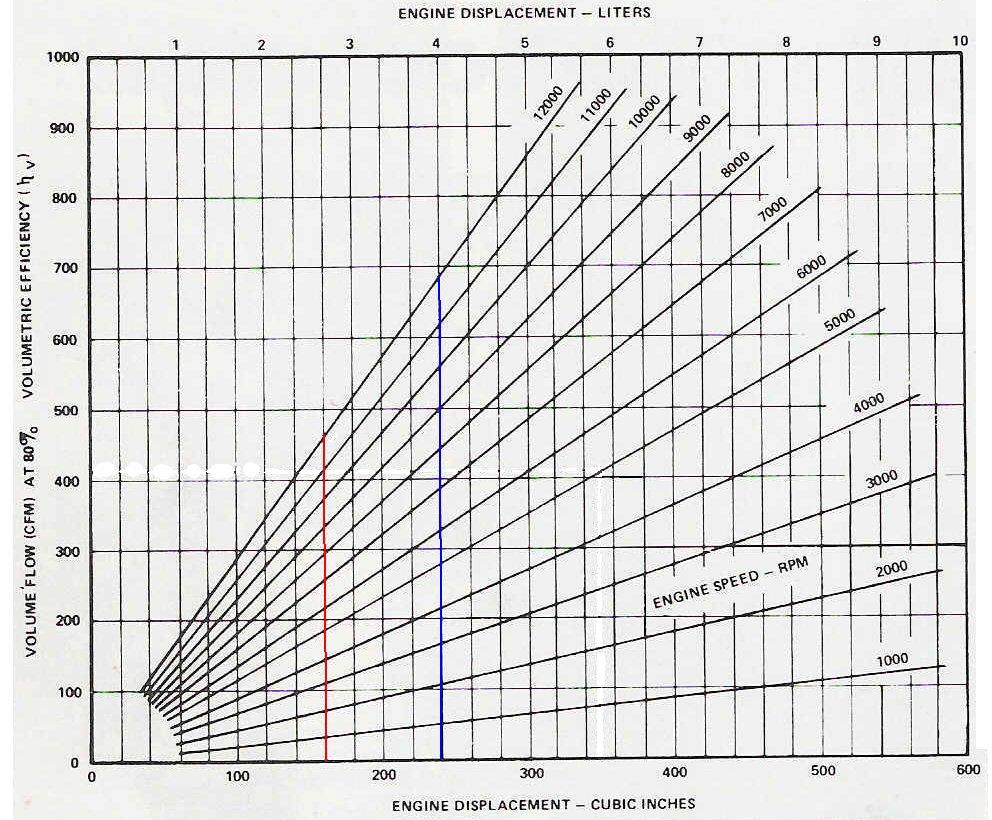
BTW if you need airflow requirements for the rotary I scanned and modified this
handy chart from MacInnes. VE is 80 percent in the chart so you have to
Multiply air flow by 1.2 for a side port and 1.35 for a p-port.
The red line is the two rotor and the blue line is the 3 rotor.
If you are doing P1 / T1 = P2 / T2 "T" is in Kelvin. Just in case you forgot :)
"The Kelvin temperature scale (K) was developed by Lord Kelvin in the mid 1800s.
The zero point of this scale is equivalent to -273.16 °C on the Celsius scale.
This zero point is considered the lowest possible temperature of anything in
the universe. Therefore, the Kelvin scale is also known as the "absolute
temperature scale". At the freezing point of water, the temperature of the
Kelvin scale reads 273 K. At the boiling point of water, it reads 373 K."
http://www.windows.ucar.edu/earth/Atmosphere/temperature/kelvin.html
Paul Lamar ...No rotor no motor.
The Rotary Engine NewsLetter. Powered by Linux.
ACRE NL web site.
http://www.rotaryeng.net
Copyright 1998-2006 All world wide rights reserved.