I believe I said some of this before
The three R3350 exhaust turbines produced 150HP each at takeoff power. I
don't know what the ratio was after that. The engine driven supercharger
was single stage two speed. The compound turbines supposedly had enough
exhaust area that they did not produce any back pressure. I assume that
to mean they operated on the exit velocity of the exhaust. H. Karibian
----------------------------------------
Yes you did.
Don't tell me it was working at sea level. How could that be? :)
Just kidding my friend Doug Hurant.
A little background on Hurant. Hurant was a flight engineer on
Lockheed Constellations powered by R3350TC engines as I recall.
He should know.
Paul Lamar ...No rotor no motor.
Durant
No problem with the kidding. With a name like mine you get used to it:)
But what is your point? I think you are saying the blow down turbines were
working at sea level, OK yes we heard that many times and I believe you.
I haven't heard how much of the blowdown turbines' total 450 Hp power was
canceled out by the supercharger needs at sea level. We all know they worked
a heck of lot more efficiently at 30,000 feet. Since everything was always
connected I can imagine the designers would have made sure their was some
excess power developed from the blown down turbines even at worst operating
conditions. And if this is so wouldn't you say the turbo compounding idea has
a wide range?
Perhaps we are discussing semantics. Wide range of operating altitudes
verses wide range of power settings. I was thinking about the prior.
Doug Fir
--------------------------------------------------------------------------
Hurant is talking NET blow down HP Doug. How would he or anyone else know with
out looking at a heat balance chart what amount of HP the supercharger was using?
R3350TC and other engines of the era had torque meters. He knew the torque and the
RPM and he knew the net HP into the prop over and above the basic engine.
A "heck of a lot more" was not all that much.
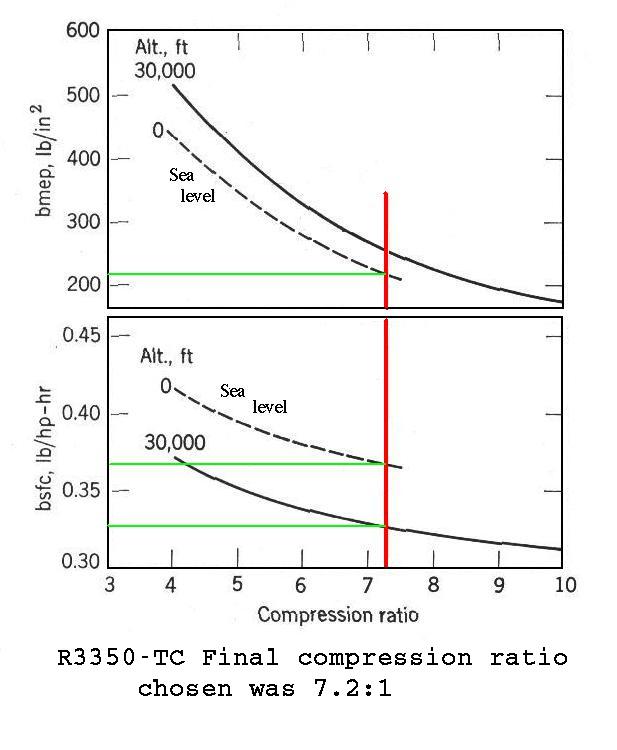
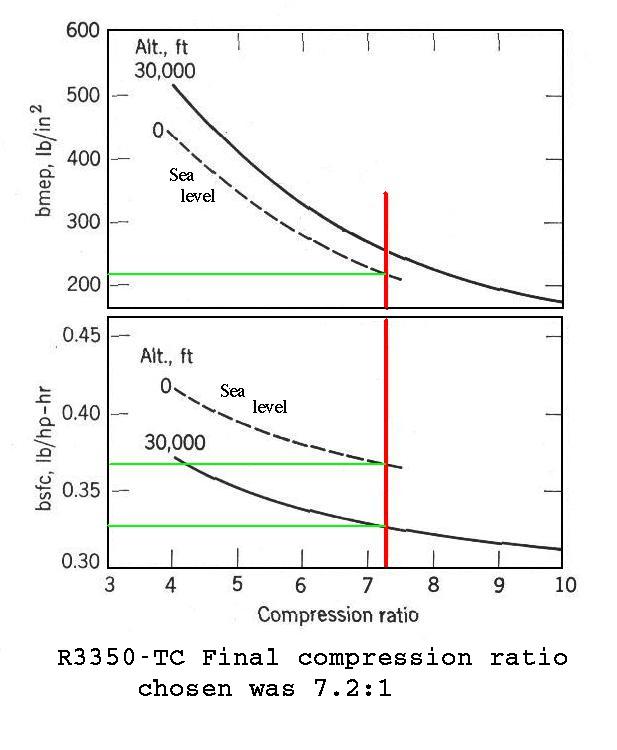
Here is the actual data. First chart. The SAE paper said what actual compression
ratio CW finally choose for the engine. Namely 7.2:1. At sea level the BSFC
was .37 and at 30,000 feet it was .32 or .33. The difference is only .05.
In other words for every 10,000 increase in altitude the BSFC got .017 better.
Hardly earth shaking. On a TC 200 HP .4 BSFC engine the fuel burn
would go from 13.3 GPH at sea level to 12.76 GPH at 10,000 feet.
Hardly a heck of a lot less.
I have updated the web site with this chart.
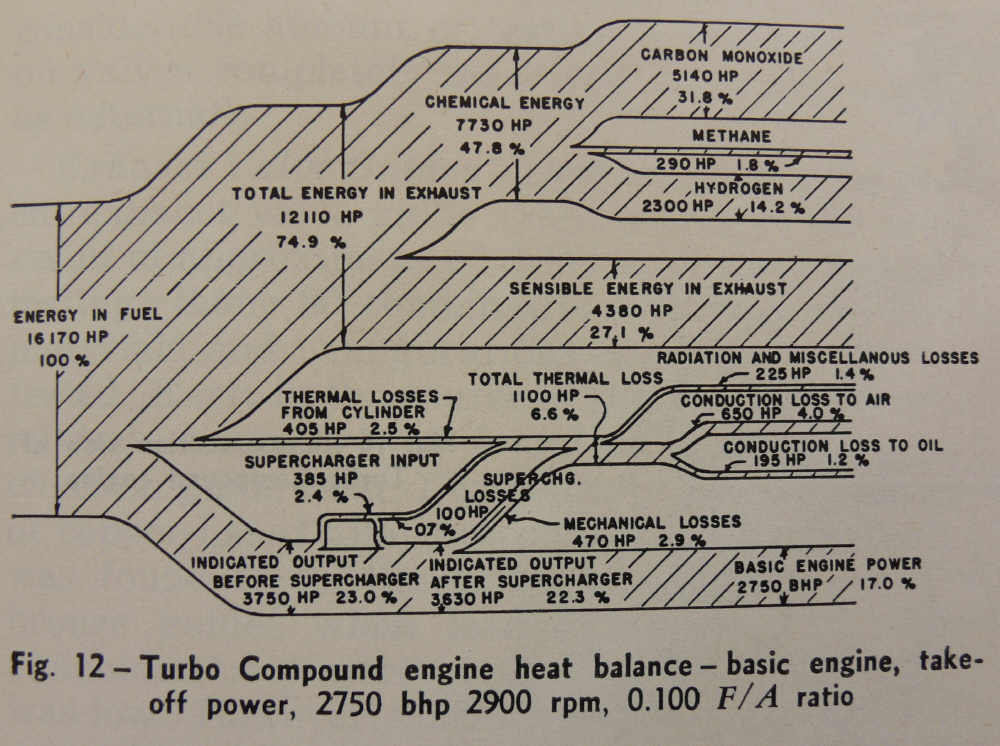
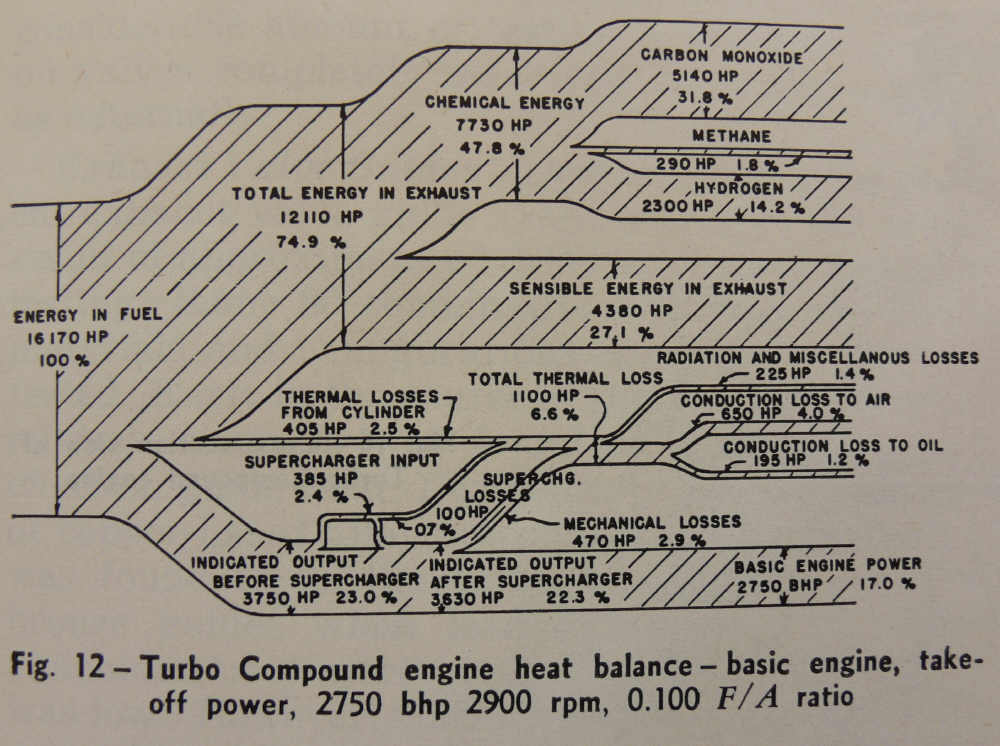
Chart two. "R3350TC-take-heat-balance". Out of a gross total of 3750 HP
the supercharger was consuming 385 HP. Subtracting 470 HP mechanical losses
from the gross total gave us 3630 net HP to the prop. Now look over on the lower
right side on the chart. The basic engine was 2750 HP sans turbines. Same as the
B29 engine. All three turbines generated the takeoff HP increase or 880 HP. Divide
by three to get individual turbine HP's and you get 293 HP per turbine for this
engine version.
Overall efficiency with a 10:1 air fuel ratio for take off was 17% without
turbo compounds and 22.3% with the turbines. Or an overall engine efficiency
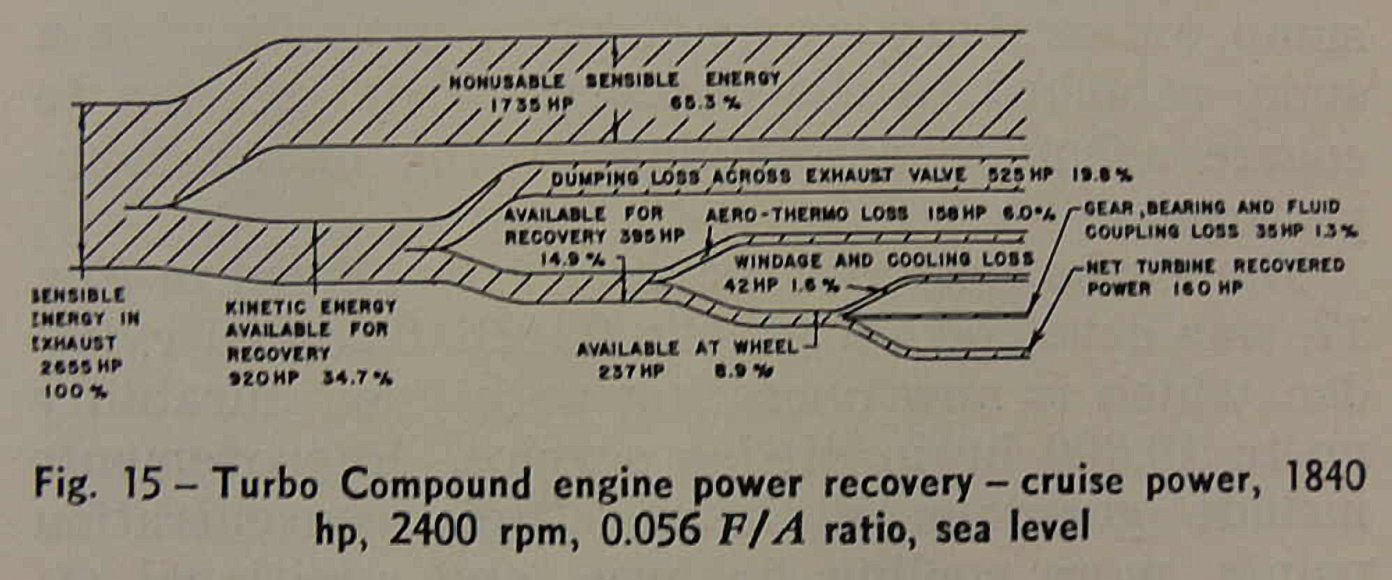
gain of 5.3 percent at high power. Now the sensible power going to the turbines
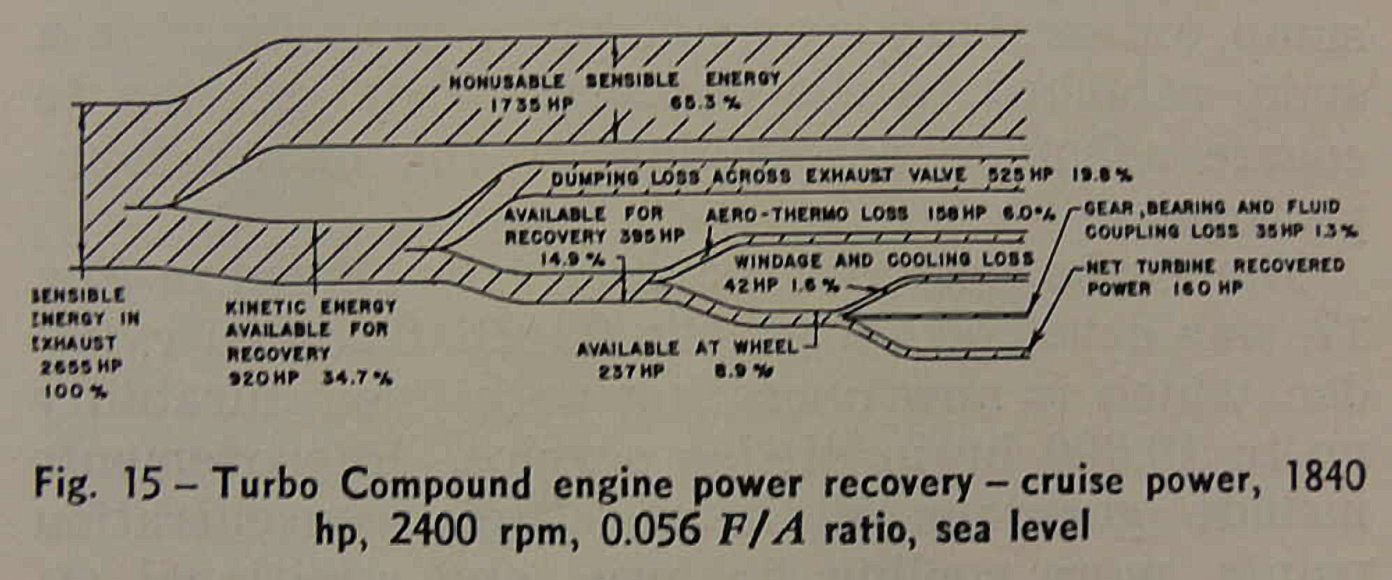
is with the huge losses to the exhaust valves. About THREE TIMES AS MUCH will
be going to the turbines WITHOUT the exhaust valves. Chart three. "R3350TC Power
recovery heat balance."
All these charts are now on the web site. In case you did not get them when
I first uploaded them to the news letter message stream. I cannot understand how
you missed all this unless you did not get the charts. On the other hand if you
did get the charts perhaps there is something to the saw dust joke after all ROFL
When you come over we can go up to Caltech and spend the day in the library.
Paul Lamar ...No rotor no motor.
The Rotary Engine NewsLetter. Powered by Linux.
ACRE NL web site.
http://www.rotaryeng.net
Copyright 1998-2006 All world wide rights reserved.