>
>> Come to think of it, I have to wonder why Mazda has not explored
>> turbo compounding for the rotary. Like you said, this engine is a
>> perfect
>> gas generator for spinning a turbine.
>>
>> I would think though that in auto applications at the low power
that
>> is
>> typical of highway cruise, there is not that much exhaust energy. It
>> would have to be a pretty small turbine, but then you would run the
>> risk
>> of over speeding it in full-throttle acceleration.
> > Gordon
>
>
> You can't over speed a turbine that is connected to your engine output
> shaft with a belt.
>
> Hans
>
> Depends on the ratio Hans. At 20:1 over all we will have to limit
> engine
> RPM to 6000. At 6000 engine RPM the turbo will be going 120,000 RPM.
> That is fine for testing but I suspect the final drive ratio
> will be more like 1.7:1 rather than 2:1 so given a 10:1 traction
> drive 7000 engine RPM will give 119,000 turbo RPM.
>
> With a three inch pulley on the traction drive that will allow use to
> use a five inch pulley on the e-shaft. 1.666:1 One point six to one.
> Paul Lamar
> You can't over speed a turbine that is connected to your engine output
> shaft with a belt. (at an appropriate ratio)
Hans
------------------------------------------------------------
Hans,
If using a variable-ratio pulley system (CVT) it could be possible to
over speed a small turbine. As the speed and torque of the turbine build,
the ratio gets steeper, freeing the turbine to increase speed.
I would be especially careful about this at altitude, because if you
have undersized your turbine a bit, it could try to make up with speed
what it is lacking in size -- if it is attached to the engine shaft with
a CVT.
Regards,
Gordon.
----------------------------------------------------------
Gordan and Hans,
I want to thank you guys for bringing this subject up. I thought about it a lot
in the last 12 hours. A fixed ratio has some other bad effects. It is possible
to overload the traction drive HP wise by zinging the engine up with little or
no load such as a fine pitch or fixed pitch prop or on a dyno with
no load what so ever. This is because of the rotational inertia of the
turbine is added to the rotational inertia of the compressor and both are spinning
at 20 times engine RPM.
Another bad effect it has is it limits the range of ratios possible between
box and engine. One must always think of not exceeding the turbine red
line of about 120,000 RPM at max engine RPM so that severely limits the
choice of ratios used.
So I have decided to put in a one way clutch. This now means you could use
a ratio of as little as 1:1 and get power out of the turbine at 60,000 RPM
(if it were available) while the engine is running at 6000 RPM. In fact the
coupling will not lock up until the traction box output RPM exceeds the engine RPM.
I now understand and believe this feature is essential.
I will upload a drawing shortly.
Paul Lamar ...No rotor no motor.
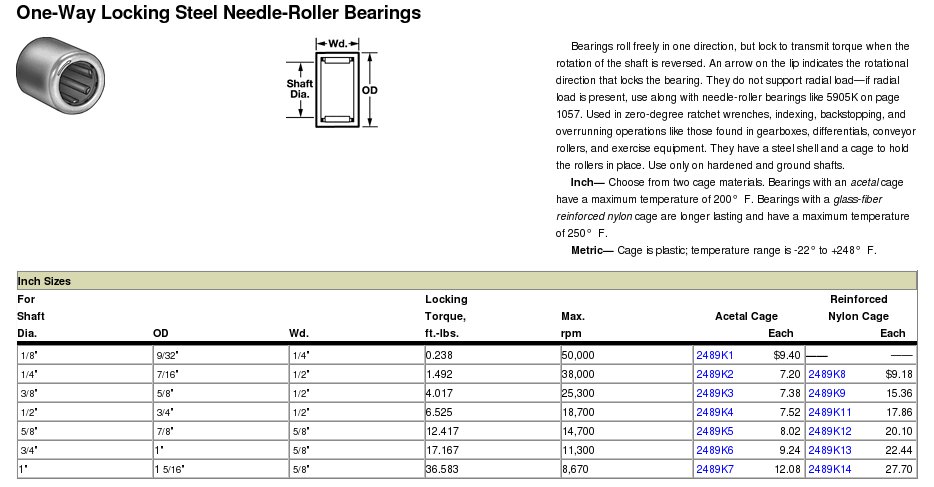
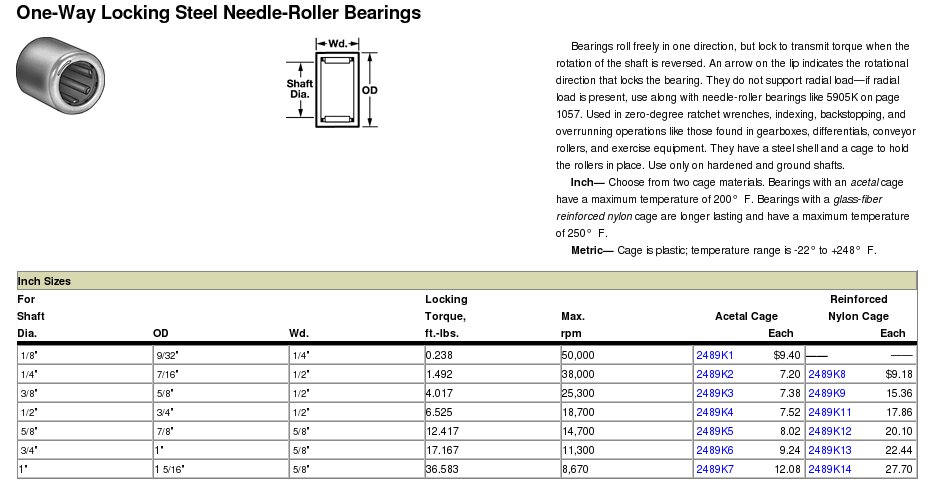
Here is the clutch I will use. Two of these back to back on the 3/4 output
shaft will have a HP capability of about 72 HP at 12,000 RPM.
---------------------------------------
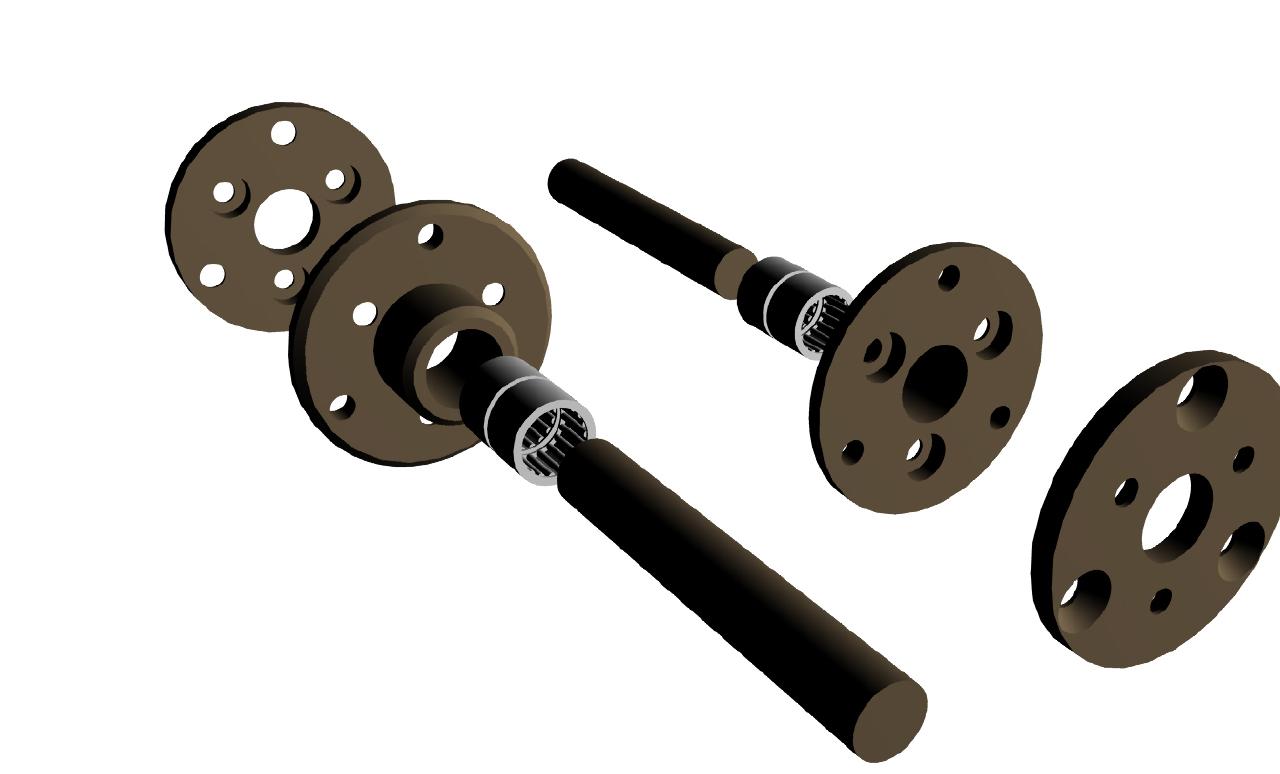
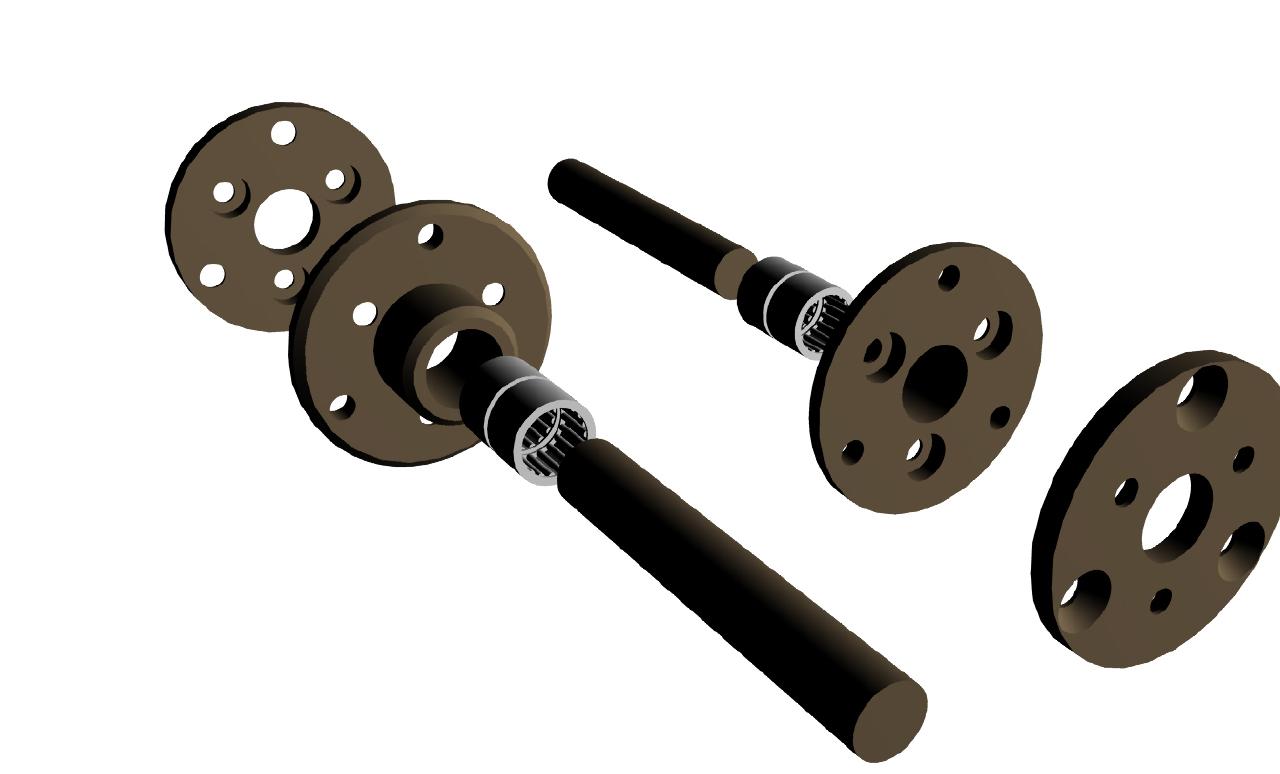
Here is what the planet carrier will look like with the clutchs
and shaft.
I copied it and turned it around so you can see it from both
ends.
--
Paul Lamar ...No rotor no motor.
The Rotary Engine NewsLetter. Powered by Linux.
ACRE NL web site.
http://www.rotaryeng.net
Copyright 1998-2006 All world wide rights reserved.