News: 2007 BMW 335i Coupe to Have 302-HP Turbo Six
The new 2007 BMW 335i coupe has 302 hp and 295 lb-ft
of torque and breaks ground as the first
turbocharged gasoline-powered BMW in decades.
BY MIKE DUSHANE
PHOTOGRAPHY BY CHRISTA LEHMANN/HIDDEN IMAGE
March 2006
The BMW 335i coupe that will appear later this year
may look like nothing more than the latest
chapter in the 3-series coupe book, but there are
some radical changes under the skin. The 335i (the
C goes away on this coupe as it did on the 650i for
the 2006 model year) will have a 3.0-liter
twin-turbo inline-six with piezoelectric direct
injection. The symmetrical turbos are relatively
small and each feed three cylinders. Power output is
up only 47 hp over the normally aspirated
version of the same 3.0-liter six found in the 330i,
but BMW claims that turbo lag is all but
avoided and — more importantly — peak torque
increases 34 percent and is available from 1500 to
5800
rpm. BMW estimates that the twin-turbo setup gives
the 335i's six the power and torque
characteristics of a 4.0-liter V-8 with 10 percent
less fuel consumption and 145 fewer pounds. BMW
expects the 335i to shave more than half a second
from the 330i's 0-to-60 time, which should put it
in the low-five-second range — scarcely more than
the outgoing E46 M3. The 335i is expected to carry
a base price of approximately $42,000 when it goes
on sale this summer. The 2008 M3 is expected to
have a 400-hp naturally aspirated V-8 and cost
$10,000 more.
Why, you ask, would BMW go to all the trouble of
making this complex turbo engine when a V-8 would
be a simpler and purer means to the same end? As
worldwide petroleum reserves decline and prices go
up, efficiency becomes paramount, even for
performance and luxury vehicles. As worldwide
emissions
standards become increasingly strict,
high-performance diesels — recently thought to be
the next big
thing — become less feasible. Mercedes-Benz also
recently announced a piezoelectric direct-injection
gasoline six which is naturally aspirated — for now.
Dr. Thomas Weber, Mercedes-Benz's top
engineering and development officer, confirms that
turbocharged smaller-displacement engines are in
Mercedes-Benz's near-term future as well. Turbos are
here to stay.
--------------------------------------------------------------------
Uploaded by Hans Conser
The reduced automotive mode fuel consumption is a
reflection of the fact the core
engine is smaller and better matched to the low
average HP requirement of a car.
The ideal automotive engine would be a 50 HP core
engine running at optimum BSFC
all of the time during cruise with some sort of
device that bumps the power up
to two or three hundred HP during those rare times
when rapid acceleration is
required. A turbo charger goes along way towards
emulating such a device
as does a hybrid electric motor and a battery. A
Toyota hybrid would be an
excellent example if it were not for the increased
weight of electric motor
and battery. A turbo charger system will weigh less
than 50 pounds
and cost less than an electric hybrid.
The fundamental thing to keep in mind is the BSFC or
the efficiency
of the core engine is not being increased here. This
approach only takes
advantage of the extremely low duty cycle of the
automotive driving mode.
This is known as engine down sizing.
What we are proposing with the turbo compound rotary
increases the efficiency
and drastically improves the BSFC of the core
engine.
Paul Lamar ...No rotor no motor.
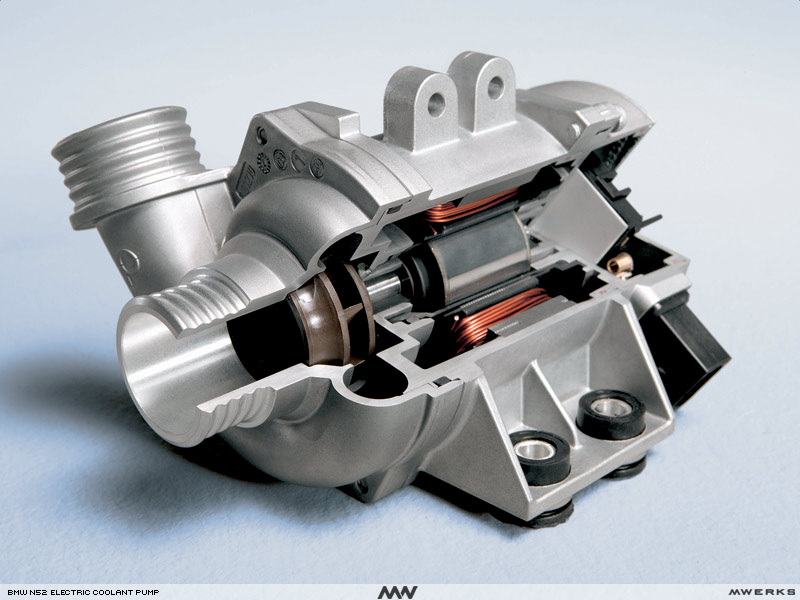
I assume you know that the new BMW 3 liter engines
use an electric water pump. I know that this was
discussed prior to my signing on the list, but it may
be worth considering again. Since these engines are
rated at 260hp, and now maybe 302hp, and since BMWs
have the reputation of being able to run flat out,
they must be flowing approx. the amount of coolant we
need. If you were to underspeed the engine driven
pump with a different pully, the electric pump would
work with it for takeoff and climb and gradually power
down as the cooling demands reduced. At 12,000ft, for
example, you wouldn't be putting out much above 100hp,
and if the ambient temp were low, you wouldn't need
6000rpm worth-30gpm, of coolant flow. If you ran the
engine pump at a good speed for cruise, the elec pump
would just be along for the ride. This should save a
couple of hp and give some redundancy if you break a
drive belt. The elec pump could also help with
potential cavitation in case of air in the system if
plumbed properly. Also it could be mounted near the
radiatior for those who want to use a belly scoop or
aft fuselage mounted radiator.
The only figure I've seen for power consumption is
800 watts, I think, but no flow rate was given.
Dan Stanzione
Nice looking electric pump. The motor looks much larger than
the after market pumps sold over here.
You can't run flat out even in Europe anymore for very long
with that size engine. Yes you can if you have an 120 HP econo box.
The traffic on the Autobahn is just too thick. Just got back
two months ago. Drove from Frankfurt to Paris to Geneva to Italy
and back to Munich six months ago.
800 watts is just over one HP. 800 watts is also 57 amps out of the alternator
and far far more than the electric pumps they are selling in the Summit Racing
catalog. If your electrical system fails or your alternator fails you have
just a few minutues before your engine overheats not to mention the
EFI and the ignition stops working.
Paul Lamar ...No rotor no motor.
The Rotary Engine NewsLetter. Powered by Linux.
ACRE NL web site.
http://www.rotaryeng.net
Copyright 1998-2006 All world wide rights reserved.